Red meat intake showed inconsistent effects on trimethylamine N-oxide levels in randomized controlled trials
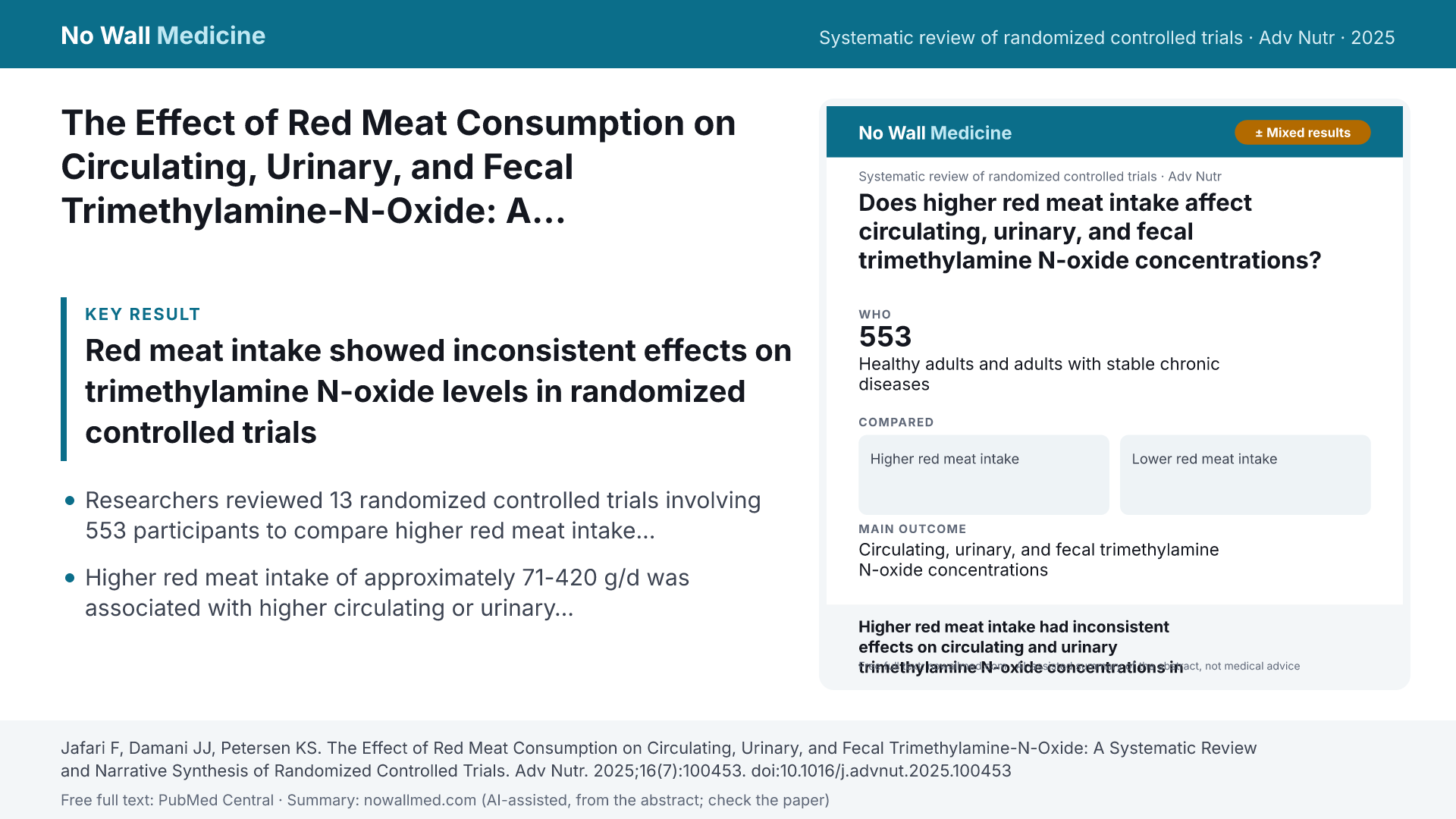
The Effect of Red Meat Consumption on Circulating, Urinary, and Fecal Trimethylamine-N-Oxide: A Systematic Review and Narrative Synthesis of Randomized Controlled Trials
Systematic review of randomized controlled trialsMixed results
Does higher red meat intake affect circulating, urinary, and fecal trimethylamine N-oxide concentrations?
Who
553
Healthy adults and adults with stable chronic diseases
Compared
Higher red meat intake
Lower red meat intake
Main outcome
Circulating, urinary, and fecal trimethylamine N-oxide concentrations
Bottom line: Higher red meat intake had inconsistent effects on circulating and urinary trimethylamine N-oxide concentrations in short-term studies.
Adv Nutr · 2025-05-24 · Save PNG
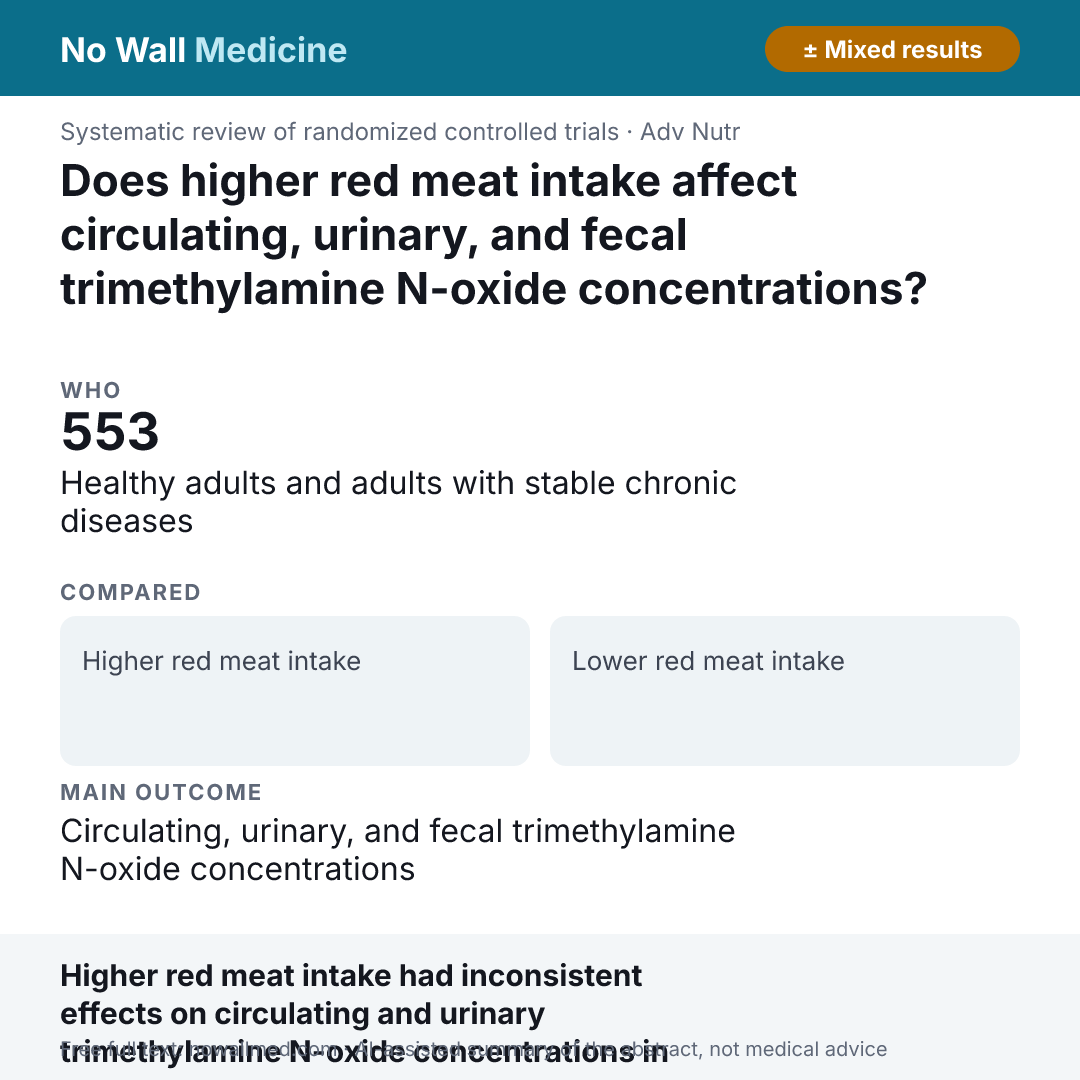
Clinical question: Does higher red meat intake affect circulating, urinary, and fecal trimethylamine N-oxide concentrations?
Key points
- Researchers reviewed 13 randomized controlled trials involving 553 participants to compare higher red meat intake against lower red meat intake.
- Higher red meat intake of approximately 71-420 g/d was associated with higher circulating or urinary trimethylamine N-oxide in 6 comparisons.
- In 7 comparisons, no differences in serum or plasma trimethylamine N-oxide concentrations were observed between the higher and lower red meat diets.
Limitation the authors note: The included studies were short-term with a median duration of 28 d.
Headline and key points written with AI from the paper’s abstract, with every number checked against it. Read the paper before relying on them.
Was this summary helpful?
Subject terms
Headline, design, result, key points, caveat and citation as plain text.
Cite this article
Jafari F, Damani JJ, Petersen KS. The Effect of Red Meat Consumption on Circulating, Urinary, and Fecal Trimethylamine-N-Oxide: A Systematic Review and Narrative Synthesis of Randomized Controlled Trials. Adv Nutr. 2025;16(7):100453. doi:10.1016/j.advnut.2025.100453
Spotted a mistake? Suggest a correction