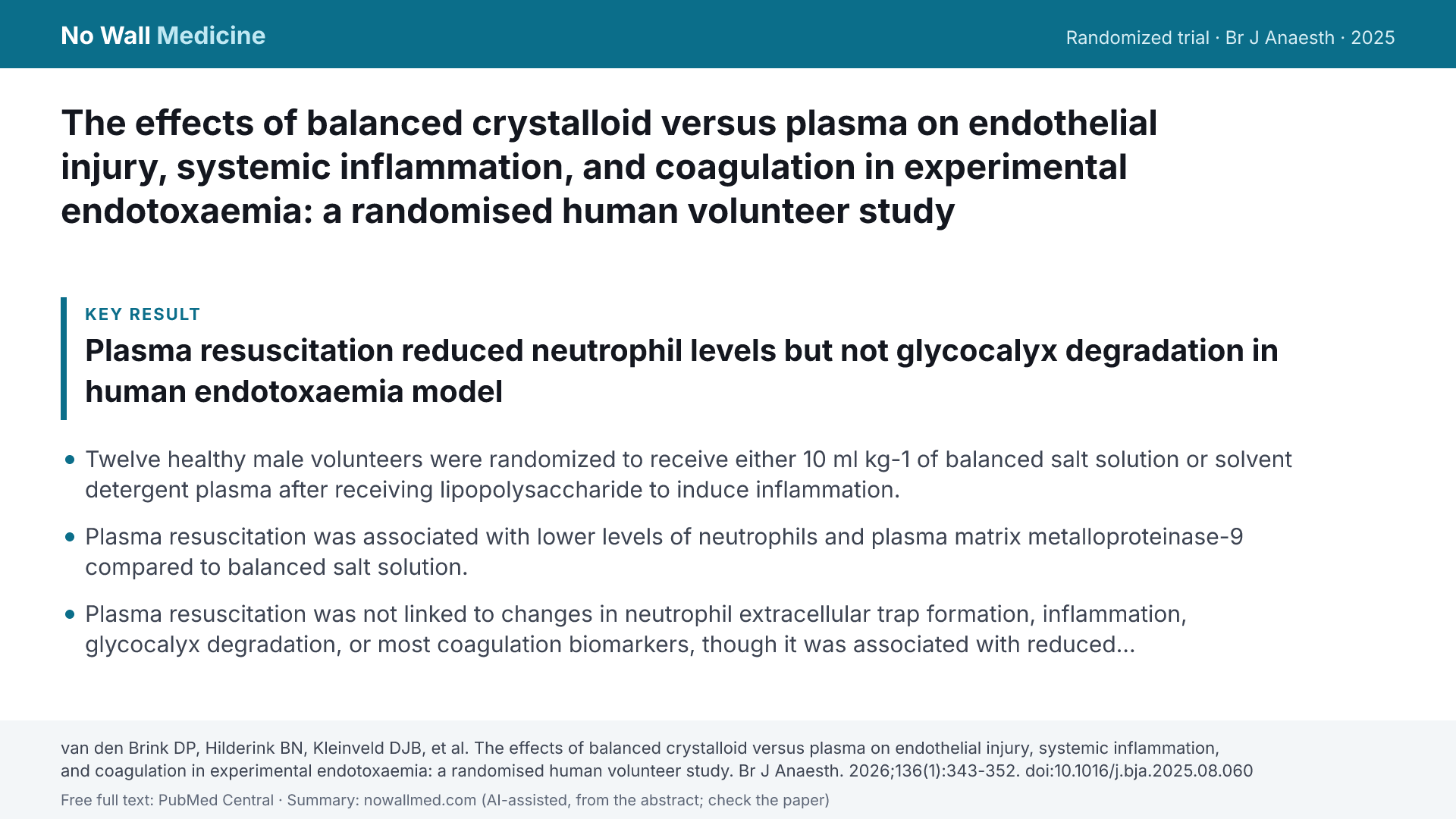
Plasma resuscitation reduced neutrophil levels but not glycocalyx degradation in human endotoxaemia model
The effects of balanced crystalloid versus plasma on endothelial injury, systemic inflammation, and coagulation in experimental endotoxaemia: a randomised human volunteer study
Why it matters: It is unclear whether resuscitation with plasma or crystalloid fluids better preserves the glycocalyx, the protective layer on the inside of blood vessels, during systemic inflammation.
Key points
- Twelve healthy male volunteers were randomized to receive either 10 ml kg-1 of balanced salt solution or solvent detergent plasma after receiving lipopolysaccharide to induce inflammation.
- Plasma resuscitation was associated with lower levels of neutrophils and plasma matrix metalloproteinase-9 compared to balanced salt solution.
- Plasma resuscitation was not linked to changes in neutrophil extracellular trap formation, inflammation, glycocalyx degradation, or most coagulation biomarkers, though it was associated with reduced prolonged prothrombin time.
Headline and key points written with AI from the paper’s abstract, with every number checked against it. Read the paper before relying on them.
Was this summary helpful?
Subject terms
Cite this article
van den Brink DP, Hilderink BN, Kleinveld DJB, Klanderman RB, Pareyn I, Vanhoorelbeke K. The effects of balanced crystalloid versus plasma on endothelial injury, systemic inflammation, and coagulation in experimental endotoxaemia: a randomised human volunteer study. Br J Anaesth. 2025. doi:10.1016/j.bja.2025.08.060
Spotted a mistake? Suggest a correction
Top studies every Monday
The week’s key trials and guidelines in your specialties, plus any topics you follow. By email, free.
Get the weekly digest