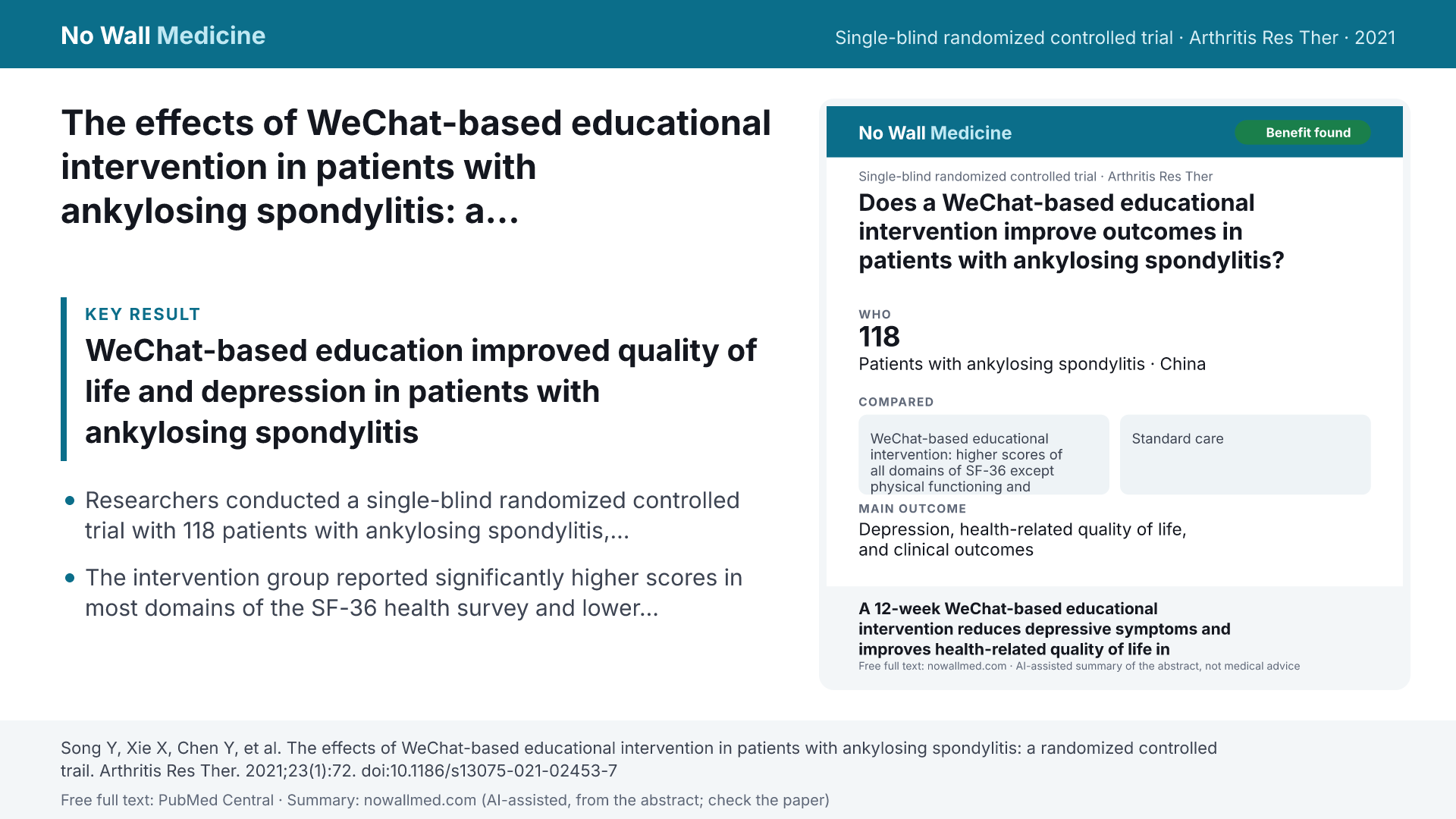
WeChat-based education improved quality of life and depression in patients with ankylosing spondylitis
The effects of WeChat-based educational intervention in patients with ankylosing spondylitis: a randomized controlled trail
Single-blind randomized controlled trialBenefit found
Does a WeChat-based educational intervention improve outcomes in patients with ankylosing spondylitis?
Who
118
Patients with ankylosing spondylitis · China
Compared
WeChat-based educational intervention: higher scores of all domains of SF-36 except physical functioning and validity
Standard care
Main outcome
Depression, health-related quality of life, and clinical outcomes
Bottom line: A 12-week WeChat-based educational intervention reduces depressive symptoms and improves health-related quality of life in patients.
Arthritis Res Ther · 2021-03-04Download image
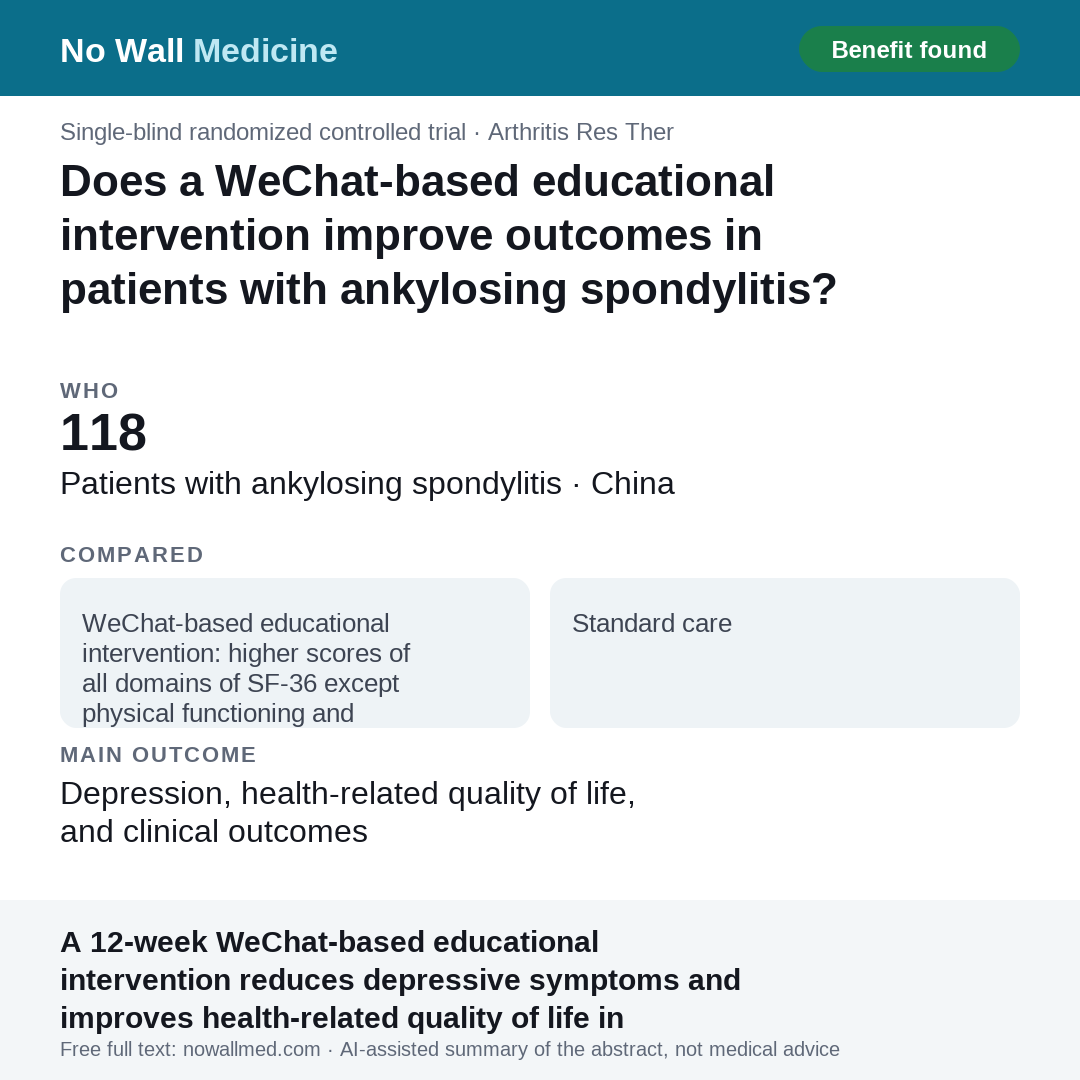
Clinical question: Does a WeChat-based educational intervention improve outcomes in patients with ankylosing spondylitis?
Why it matters: It was unknown if educational interventions delivered via mobile applications could benefit patients with ankylosing spondylitis regarding depression and health-related quality of life.
Key points
- Researchers conducted a single-blind randomized controlled trial with 118 patients with ankylosing spondylitis, comparing a 12-week WeChat-based educational intervention to standard care.
- The intervention group reported significantly higher scores in most domains of the SF-36 health survey and lower depressive symptoms compared to the control group.
- No significant difference was observed between the groups for other clinical outcomes at 12 weeks.
Headline and key points written with AI from the paper’s abstract, with every number checked against it. Read the paper before relying on them.
Was this summary helpful?
Subject terms
Cite this article
Song Y, Xie X, Chen Y, et al. The effects of WeChat-based educational intervention in patients with ankylosing spondylitis: a randomized controlled trail. Arthritis Res Ther. 2021. doi:10.1186/s13075-021-02453-7
Spotted a mistake? Suggest a correction