Contextual effects were linked to most improvements in pain and disability during exercise therapy
The impact of contextual effects in exercise therapy for low back pain: a systematic review and meta-analysis
Systematic review and meta-analysisBenefit found
What proportion of pain and disability improvement is attributable to contextual effects?
Who
Patients with low back pain
Compared
0.60Pain (95% CI 0.40-0.89)
0.69Disability (95% CI 0.48-1.00)
Main outcome
Proportion of improvement in pain and disability
Bottom line: A large extent of pain and disability improvement is attributable to contextual effects in exercise therapy.
Limitation: The certainty of the evidence was low.
BMC Med · 2024-10-23Download image
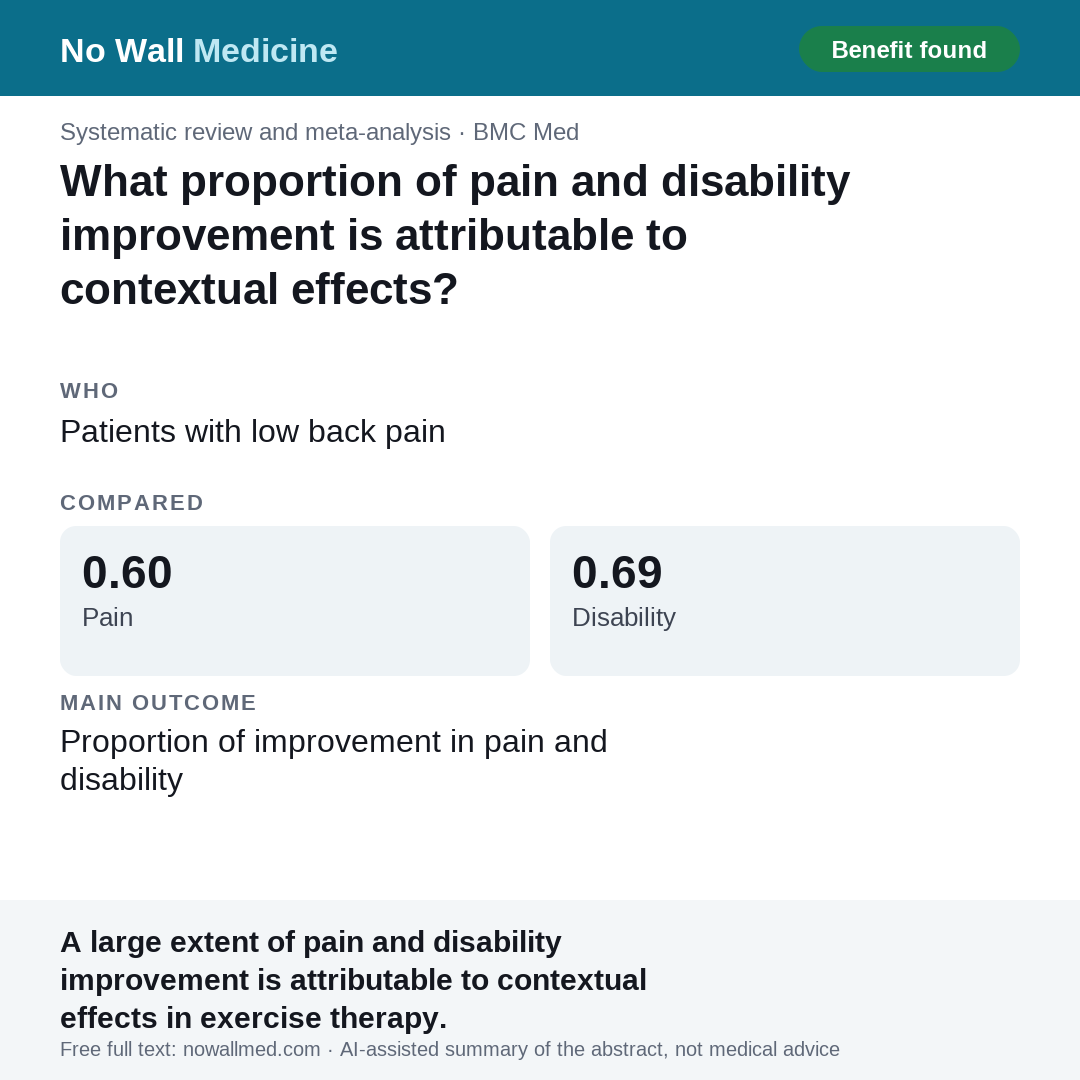
Clinical question: What proportion of pain and disability improvement is attributable to contextual effects?
Why it matters: It is unknown what proportion of improvement in pain and disability is due to contextual factors rather than the specific exercise therapy itself.
Key points
- Researchers analyzed eight randomized controlled trials comparing exercise therapy to placebo interventions for patients with low back pain.
- The proportion of improvement attributable to contextual effects was 0.60 (95% CI 0.40-0.89) for pain and 0.69 (95% CI 0.48-1.00) for disability.
- The certainty of the evidence for these findings was rated as low by the GRADE methodology.
Limitation the authors note: The certainty of the evidence was low.
Headline and key points written with AI from the paper’s abstract, with every number checked against it. Read the paper before relying on them.
Was this summary helpful?
Subject terms
Cite this article
de Roode A, Heymans MW, van Lankveld W, Staal JB. The impact of contextual effects in exercise therapy for low back pain: a systematic review and meta-analysis. BMC Med. 2024. doi:10.1186/s12916-024-03679-3
Spotted a mistake? Suggest a correction
Top studies every Monday
The week’s key trials and guidelines in your specialties, plus any topics you follow. By email, free.
Get the weekly digest