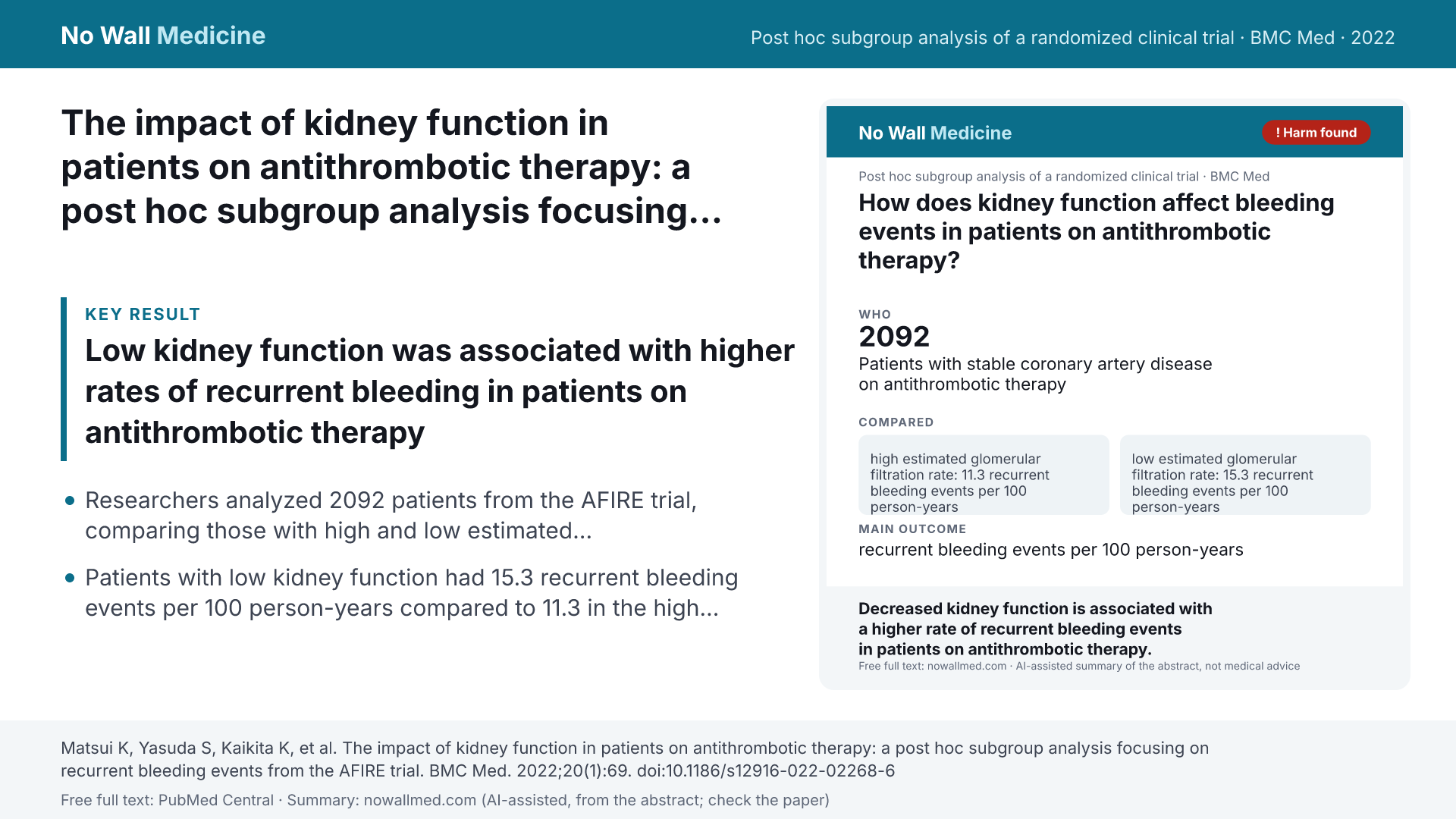
Low kidney function was associated with higher rates of recurrent bleeding in patients on antithrombotic therapy
The impact of kidney function in patients on antithrombotic therapy: a post hoc subgroup analysis focusing on recurrent bleeding events from the AFIRE trial
Post hoc subgroup analysis of a randomized clinical trialHarm found
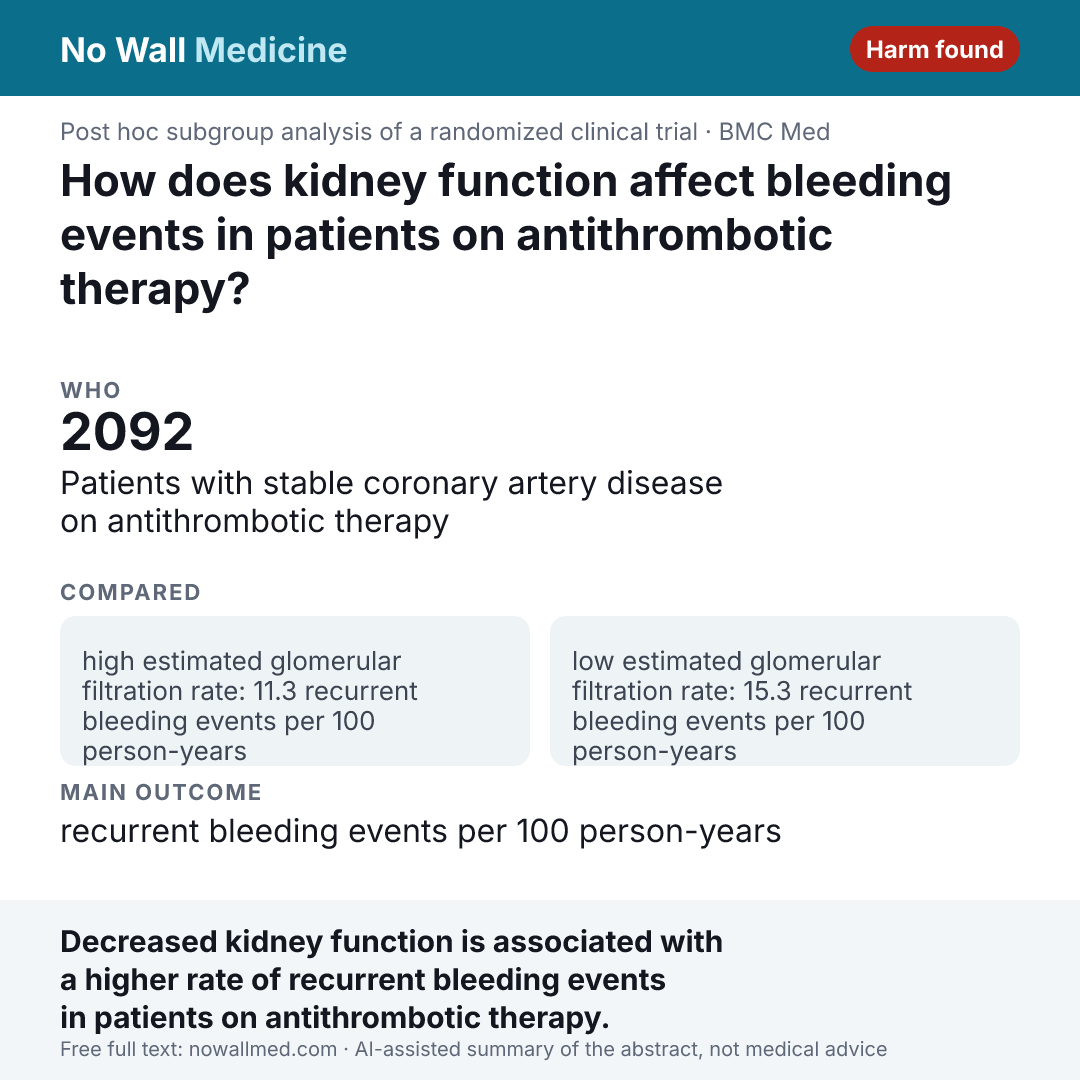
How does kidney function affect bleeding events in patients on antithrombotic therapy?
Who
2092
Patients with stable coronary artery disease on antithrombotic therapy
Compared
high estimated glomerular filtration rate: 11.3 recurrent bleeding events per 100 person-years
low estimated glomerular filtration rate: 15.3 recurrent bleeding events per 100 person-years
Main outcome
recurrent bleeding events per 100 person-years
Result: rate ratio 0.738 (95% confidence interval 0.615-0.886)
Bottom line: Decreased kidney function is associated with a higher rate of recurrent bleeding events in patients on antithrombotic therapy.
BMC Med · 2022-02-25 · Save PNG
Same trial (UMIN000016612, NCT02642419)
Papers we list that report this registered trial, oldest first. Read a secondary analysis alongside the main results.
- Secondary analysis Harm found
This paper BMC Med 2022-02 - Secondary analysis Benefit found
Rivaroxaban monotherapy was associated with lower total thrombotic and bleeding events than combination therapy JAMA Cardiol 2022-06 - Secondary analysis Benefit found
Rivaroxaban monotherapy compared to combination therapy in patients with atrial fibrillation and coronary artery disease JAMA Cardiol 2025-08
Clinical question: How does kidney function affect bleeding events in patients on antithrombotic therapy?
Why it matters: It is often unclear how kidney function affects the risk of recurrent bleeding events in patients receiving antithrombotic therapy.
Key points
- Researchers analyzed 2092 patients from the AFIRE trial, comparing those with high and low estimated glomerular filtration rate, which is a measure of kidney function.
- Patients with low kidney function had 15.3 recurrent bleeding events per 100 person-years compared to 11.3 in the high kidney function group.
- The cumulative bleeding events per 100 patients at 1 year were 5.4 in the high kidney function group and 6.2 in the low kidney function group.
Headline and key points written with AI from the paper’s abstract, with every number checked against it. Read the paper before relying on them.
Was this summary helpful?
Subject terms
Headline, design, result, key points, caveat and citation as plain text.
Cite this article
Matsui K, Yasuda S, Kaikita K, et al. The impact of kidney function in patients on antithrombotic therapy: a post hoc subgroup analysis focusing on recurrent bleeding events from the AFIRE trial. BMC Med. 2022;20(1):69. doi:10.1186/s12916-022-02268-6
Spotted a mistake? Suggest a correction