Digital technologies show variable performance for measuring tuberculosis medication adherence in systematic review
The performance of digital technologies for measuring tuberculosis medication adherence: a systematic review
Systematic reviewMixed results
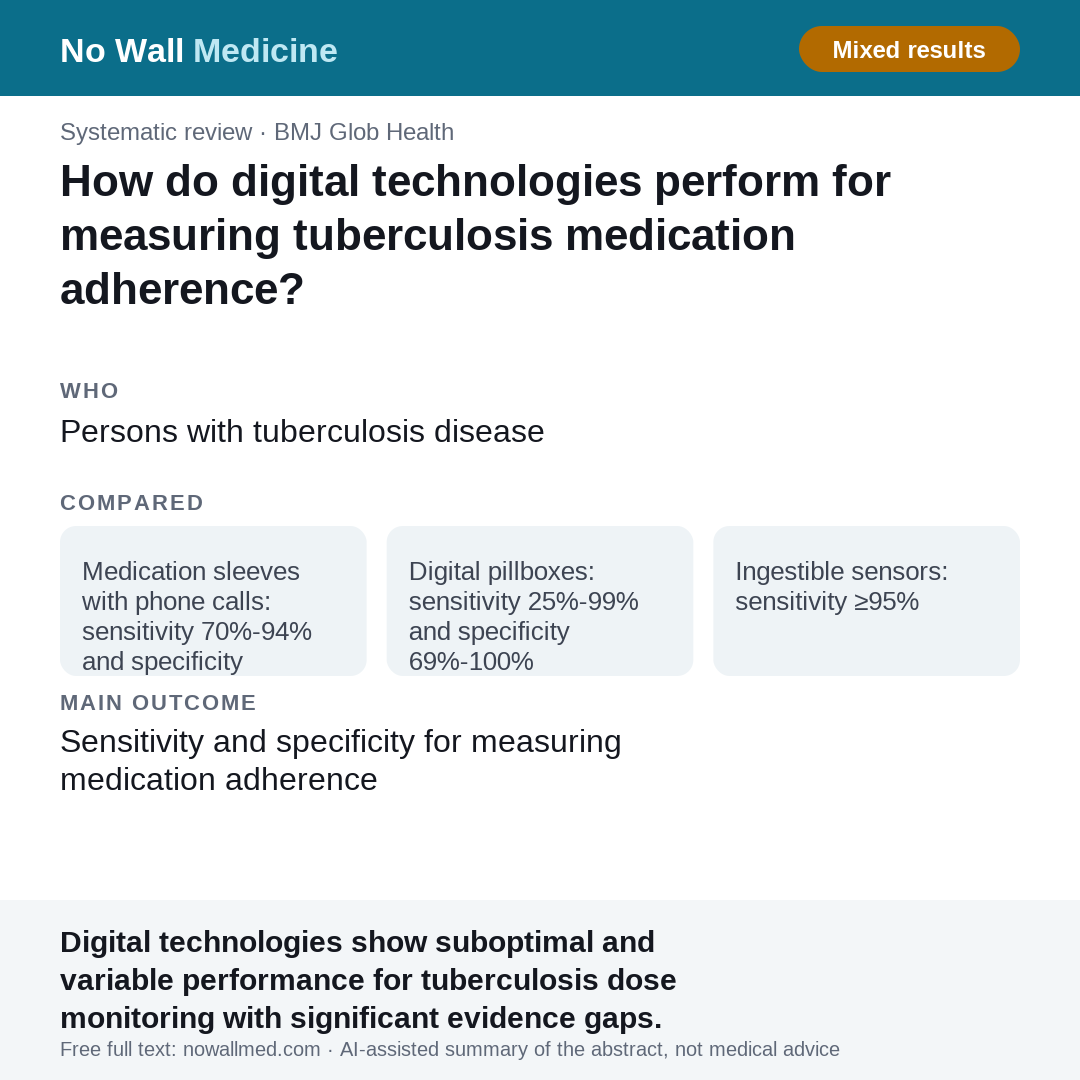
How do digital technologies perform for measuring tuberculosis medication adherence?
Who
Persons with tuberculosis disease
Compared
Medication sleeves with phone calls: sensitivity 70%-94% and specificity 0%-61%
Digital pillboxes: sensitivity 25%-99% and specificity 69%-100%
Ingestible sensors: sensitivity ≥95%
Main outcome
Sensitivity and specificity for measuring medication adherence
Bottom line: Digital technologies show suboptimal and variable performance for tuberculosis dose monitoring with significant evidence gaps.
Limitation: Participant selection was the most frequent potential source of bias.
BMJ Glob Health · 2024-07-16Download image
Clinical question: How do digital technologies perform for measuring tuberculosis medication adherence?
Why it matters: Estimates of how well digital technologies measure tuberculosis medication adherence vary across different devices and studies.
Key points
- Researchers reviewed 13 studies involving at least 20 participants to evaluate how digital adherence technologies measure tuberculosis medication use.
- Medication sleeves with phone calls showed 70%-94% sensitivity and 0%-61% specificity compared to urine testing.
- Digital pillboxes showed 25%-99% sensitivity and 69%-100% specificity compared to pill counts, while ingestible sensors had sensitivity of ≥95%.
Limitation the authors note: Participant selection was the most frequent potential source of bias.
Headline and key points written with AI from the paper’s abstract, with every number checked against it. Read the paper before relying on them.
Abstract
Introduction
Digital adherence technologies (DATs), such as phone-based technologies and digital pillboxes, can provide more person-centric approaches to support tuberculosis (TB) treatment. However, there are varying estimates of their performance for measuring medication adherence. Methods
We conducted a systematic review (PROSPERO-CRD42022313526), which identified relevant published literature and preprints from January 2000 to April 2023 in five databases. Studies reporting quantitative data on the performance of DATs for measuring TB medication adherence against a reference standard, with at least 20 participants, were included. Study characteristics and performance outcomes (eg, sensitivity, specificity and predictive values) were extracted. Sensitivity was the proportion correctly classified as adherent by the DAT, among persons deemed adherent by a reference standard. Specificity was the proportion correctly classified as non-adherent by the DAT, among those deemed non-adherent by a reference standard. Results
Of 5692 studies identified by our systematic search, 13 met inclusion criteria. These studies investigated medication sleeves with phone calls (branded as '99DOTS'; N=4), digital pillboxes N=5), ingestible sensors (N=2), artificial intelligence-based video-observed therapy (N=1) and multifunctional mobile applications (N=1). All but one involved persons with TB disease. For medication sleeves with phone calls, compared with urine testing, reported sensitivity and specificity were 70%-94% and 0%-61%, respectively. For digital pillboxes, compared with pill counts, reported sensitivity and specificity were 25%-99% and 69%-100%, respectively. For ingestible sensors, the sensitivity of dose detection was ≥95% compared with direct observation. Participant selection was the most frequent potential source of bias. Conclusion
The limited number of studies available suggests suboptimal and variable performance of DATs for dose monitoring, with significant evidence gaps, notably in real-world programmatic settings. Future research should aim to improve understanding of the relationships of specific technologies, settings and user engagement with DAT performance and should measure and report performance in a more standardised manner.
Abstract reproduced under the article’s CC BY licence.
Topics
Cite this article
Zary M, Mohamed MS, Kafie C, Chilala CI, Bahukudumbi S, Foster N. The performance of digital technologies for measuring tuberculosis medication adherence: a systematic review. BMJ Glob Health. 2024. doi:10.1136/bmjgh-2024-015633
Spotted a mistake? Suggest a correction
Top studies every Monday
The week’s key trials and guidelines in your specialties, by email. Free.
Get the weekly digest