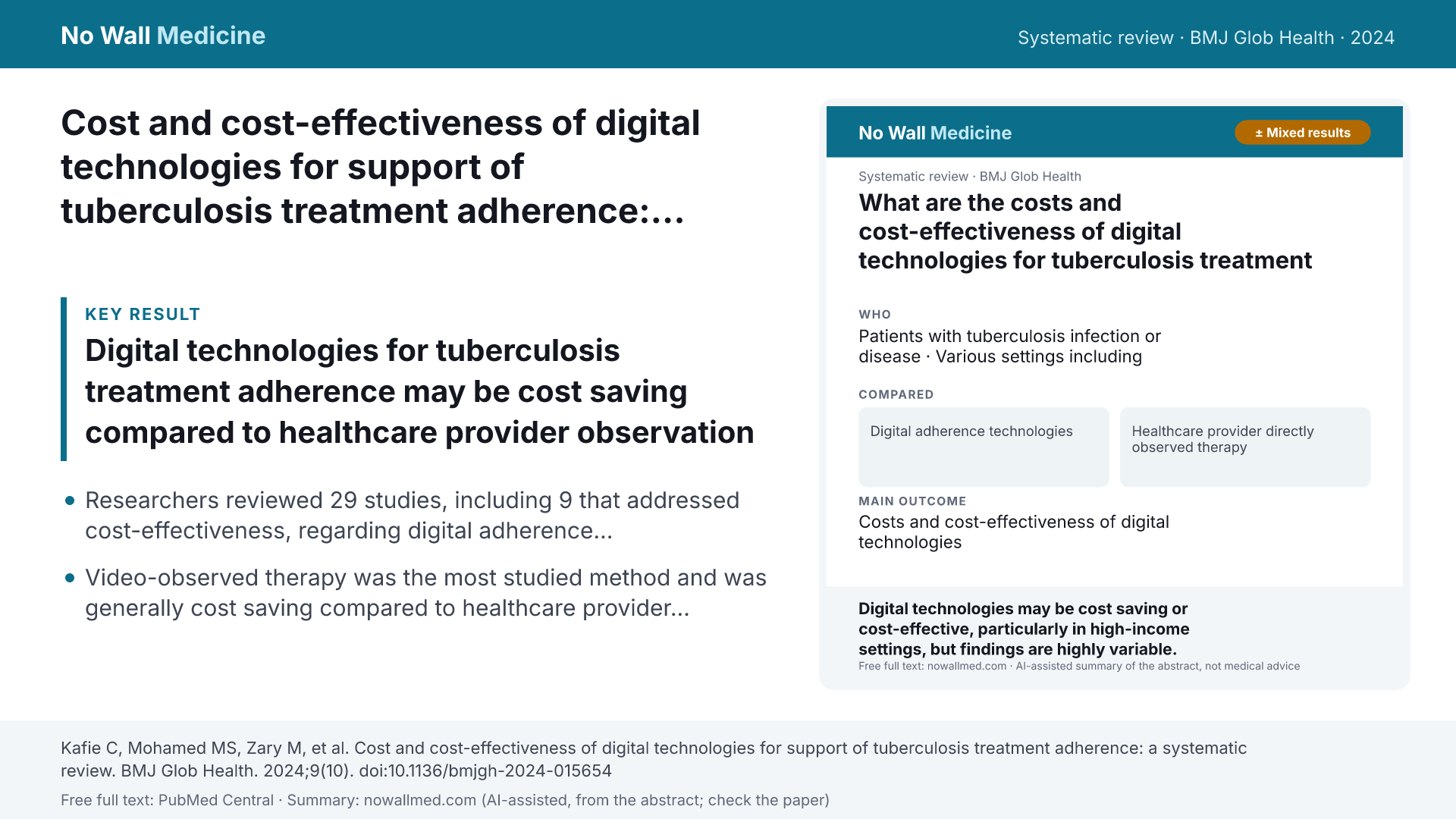
Digital technologies for tuberculosis treatment adherence may be cost saving compared to healthcare provider observation
Cost and cost-effectiveness of digital technologies for support of tuberculosis treatment adherence: a systematic review
Systematic reviewMixed results
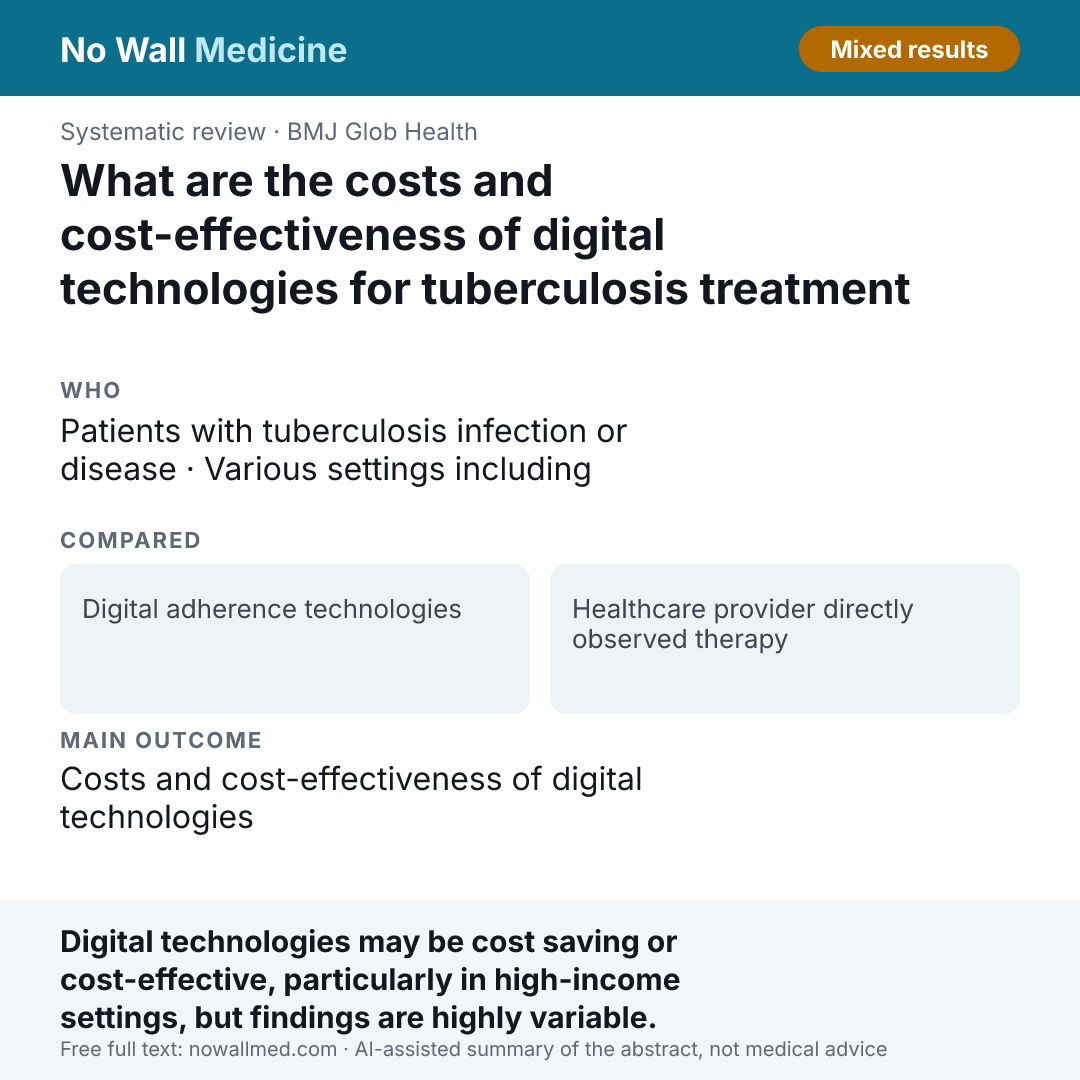
What are the costs and cost-effectiveness of digital technologies for tuberculosis treatment adherence?
Who
Patients with tuberculosis infection or disease · Various settings including high-income countries
Compared
Digital adherence technologies
Healthcare provider directly observed therapy
Main outcome
Costs and cost-effectiveness of digital technologies
Bottom line: Digital technologies may be cost saving or cost-effective, particularly in high-income settings, but findings are highly variable.
Limitation: Only eight studies adequately reported most Consolidated Health Economic Evaluation Reporting Standards elements.
BMJ Glob Health · 2024-10-30 · Save PNG
Clinical question: What are the costs and cost-effectiveness of digital technologies for tuberculosis treatment adherence?
Key points
- Researchers reviewed 29 studies, including 9 that addressed cost-effectiveness, regarding digital adherence technologies like text message reminders and digital pillboxes for tuberculosis treatment.
- Video-observed therapy was the most studied method and was generally cost saving compared to healthcare provider directly observed therapy, especially when patient costs were included.
- Cost-effectiveness results varied widely, ranging from no clinical effect in one study using short message service to greater effectiveness with cost savings in others.
Limitation the authors note: Only eight studies adequately reported at least 80% of the elements required by the Consolidated Health Economic Evaluation Reporting Standards checklist.
Headline and key points written with AI from the paper’s abstract, with every number checked against it. Read the paper before relying on them.
Was this summary helpful?
Abstract
Background
Digital adherence technologies (DATs) may provide a patient-centred approach to supporting tuberculosis (TB) medication adherence and improving treatment outcomes. We synthesised evidence addressing costs and cost-effectiveness of DATs to support TB treatment. Methods
A systematic review (PROSPERO-CRD42022313531) identified relevant literature from January 2000 to April 2023 in MEDLINE, Embase, CENTRAL, CINAHL, Web of Science along with preprints from medRxiv, Europe PMC and ClinicalTrials.gov. Studies with observational, experimental or quasi-experimental designs (minimum 20 participants) and modelling studies reporting quantitative data on the cost or cost-effectiveness of DATs for TB infection or disease treatment were included. Study characteristics, cost and cost-effectiveness outcomes were extracted. Results
Of 3619 titles identified by our systematic search, 29 studies met inclusion criteria, of which 9 addressed cost-effectiveness. DATs included short message service (SMS) reminders, phone-based technologies, digital pillboxes, ingestible sensors and video-observed therapy (VOT). VOT was the most extensively studied (16 studies) and was generally cost saving when compared with healthcare provider directly observed therapy (DOT), particularly when costs to patients were included-though findings were largely from high-income countries. Cost-effectiveness findings were highly variable, ranging from no clinical effect in one study (SMS), to greater effectiveness with concurrent cost savings (VOT) in others. Only eight studies adequately reported at least 80% of the elements required by Consolidated Health Economic Evaluation Reporting Standards, a standard reporting checklist for health economic evaluations. Conclusion
DATs may be cost saving or cost-effective compared with healthcare provider DOT, particularly in high-income settings. However, more data of higher quality are needed, notably in lower-income and middle-income countries which have the greatest TB burden.
Abstract reproduced under the article’s CC BY licence.
Subject terms
Headline, design, result, key points, caveat and citation as plain text.
Cite this article
Kafie C, Mohamed MS, Zary M, et al. Cost and cost-effectiveness of digital technologies for support of tuberculosis treatment adherence: a systematic review. BMJ Glob Health. 2024;9(10). doi:10.1136/bmjgh-2024-015654
Spotted a mistake? Suggest a correction