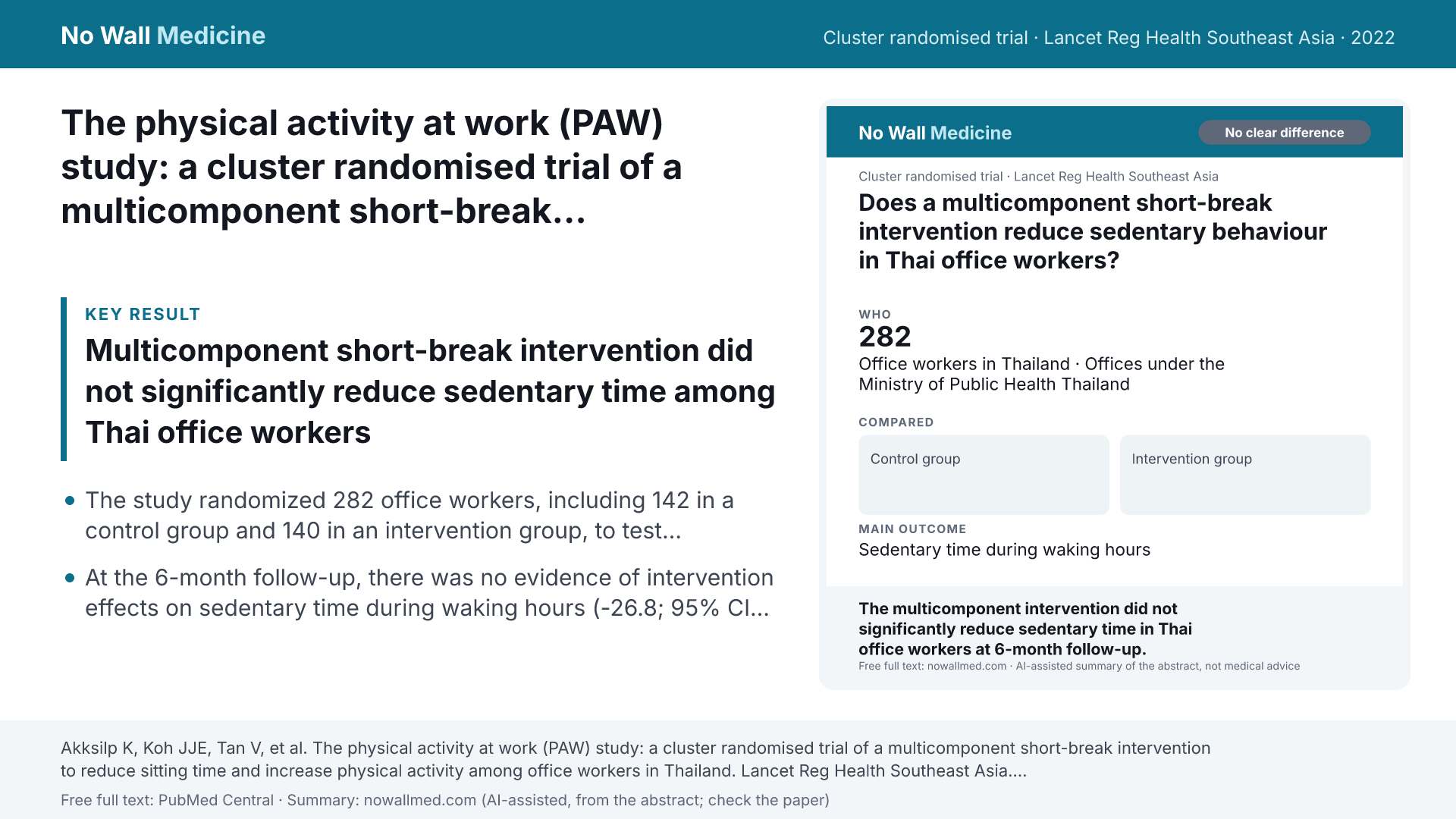
Multicomponent short-break intervention did not significantly reduce sedentary time among Thai office workers
The physical activity at work (PAW) study: a cluster randomised trial of a multicomponent short-break intervention to reduce sitting time and increase physical activity among office workers in Thailand
Cluster randomised trialNo clear difference
Does a multicomponent short-break intervention reduce sedentary behaviour in Thai office workers?
Who
282
Office workers in Thailand · Offices under the Ministry of Public Health Thailand
Compared
Control group
Intervention group
Main outcome
Sedentary time during waking hours
Result: -26.8; 95% CI = -69.2 to 15.7 min
Bottom line: The multicomponent intervention did not significantly reduce sedentary time in Thai office workers at 6-month follow-up.
Funded by: Thai Health Promotion Foundation and International Decision Support Initiative
Lancet Reg Health Southeast Asia · 2022-10-19Download image
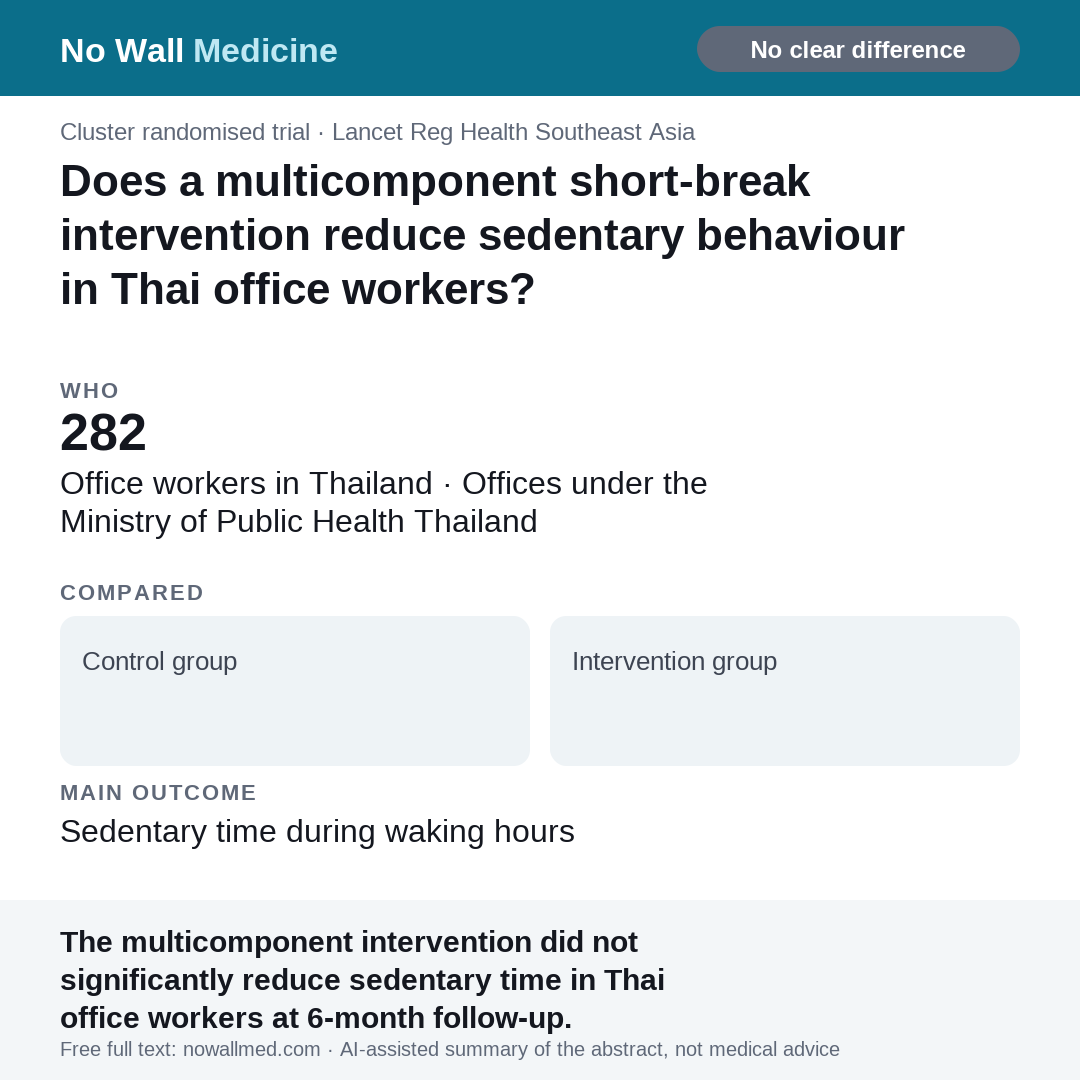
Clinical question: Does a multicomponent short-break intervention reduce sedentary behaviour in Thai office workers?
Why it matters: It was unknown if a multicomponent intervention involving individual, social, environmental, and organizational components could reduce sedentary behavior in Thai office workers.
Key points
- The study randomized 282 office workers, including 142 in a control group and 140 in an intervention group, to test a program using pedometers, incentives, and group breaks.
- At the 6-month follow-up, there was no evidence of intervention effects on sedentary time during waking hours (-26.8; 95% CI = -69.2 to 15.7 min) or physical activity levels.
- Adjusted analysis showed no evidence of a difference between groups for moderate-to-vigorous physical activity (5.45; 95% CI = -0.15 to 11.1 min) or step count (718; 95% CI = -45 to 1481 steps).
Headline and key points written with AI from the paper’s abstract, with every number checked against it. Read the paper before relying on them.
Was this summary helpful?
Cite this article
Akksilp K, Koh JJE, Tan V, Tong EH, Budtarad N, Xueying G. The physical activity at work (PAW) study: a cluster randomised trial of a multicomponent short-break intervention to reduce sitting time and increase physical activity among office workers in Thailand. Lancet Reg Health Southeast Asia. 2022. doi:10.1016/j.lansea.2022.100086
Spotted a mistake? Suggest a correction