Reducing daily medication doses after brain stimulation was associated with visual dysfunction in Parkinson's disease
The reduction of LEDD leads to visual dysfunction in patients with PD after STN-DBS: a randomized clinical trial
Prospective, randomized, double-blinded clinical trialHarm found
Does levodopa-equivalent daily dose reduction affect visual function after subthalamic nucleus deep brain stimulation?
Who
208
Patients with Parkinson's disease · Multi-center
Compared
Levodopa-equivalent daily dose reduction: significant decline in visual function, retinal nerve fiber layer thickness, and vessel density
No levodopa-equivalent daily dose reduction
Main outcome
Visual impairment in Parkinson's disease questionnaire
Bottom line: Reducing levodopa-equivalent daily dose after subthalamic nucleus deep brain stimulation leads to visual dysfunction.
Int J Surg · 2025-01-01Download image
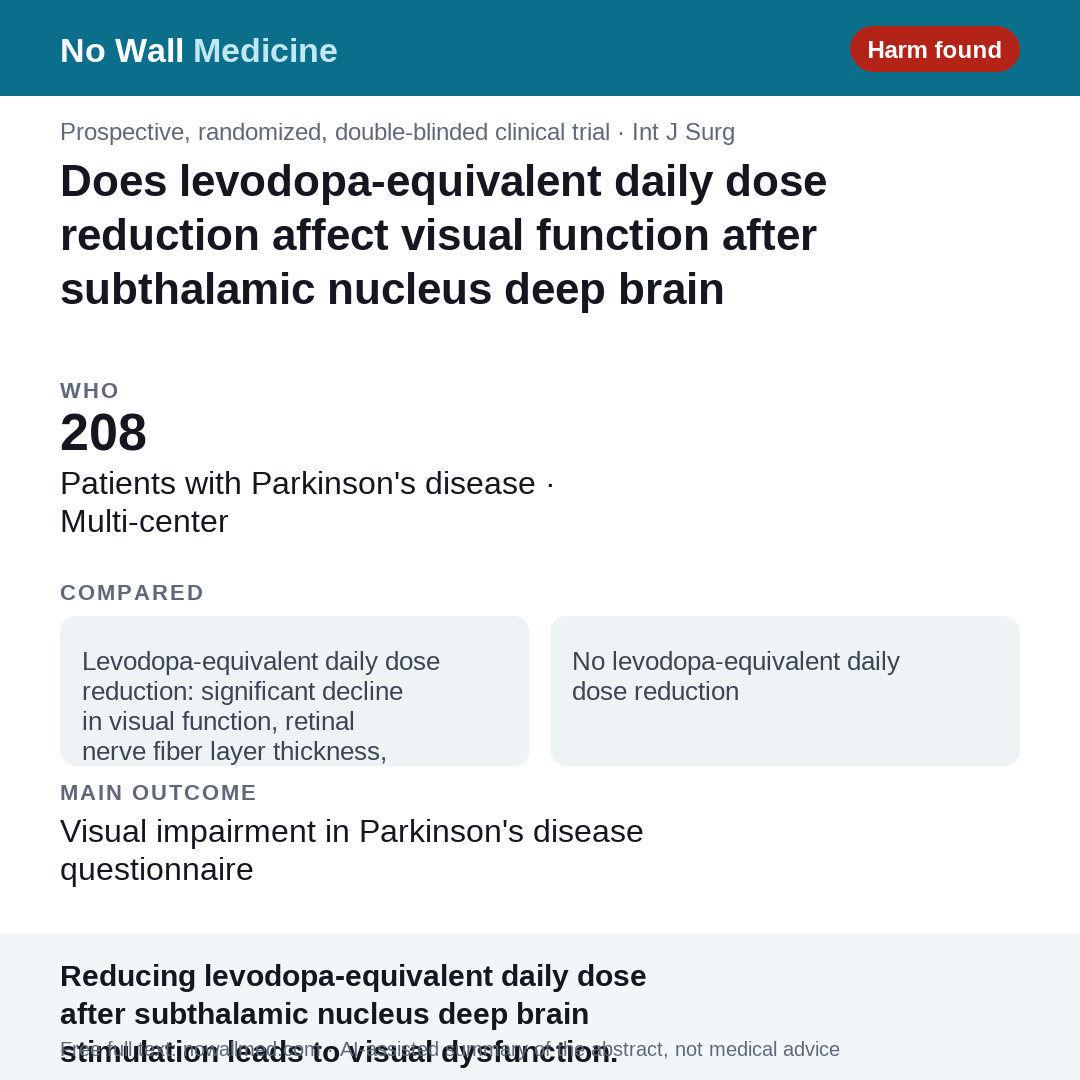
Clinical question: Does levodopa-equivalent daily dose reduction affect visual function after subthalamic nucleus deep brain stimulation?
Why it matters: It was unknown how adjusting medication doses after subthalamic nucleus deep brain stimulation affects visual function in patients with Parkinson's disease.
Key points
- Researchers conducted a randomized trial with 208 patients with Parkinson's disease who received subthalamic nucleus deep brain stimulation, a procedure involving electrodes in the brain.
- At 12 months, the group with reduced levodopa-equivalent daily dose showed a significant decline in visual function, retinal nerve fiber layer thickness, and vessel density compared to the non-reduction group (P<0.001).
- In the short term, deep brain stimulation and stimulation did not significantly affect visual function scores at 1 month (9.269±8.385 vs. 8.938±7.666, P=0.6746).
Headline and key points written with AI from the paper’s abstract, with every number checked against it. Read the paper before relying on them.
Was this summary helpful?
Subject terms
Cite this article
Sun J, Ma S, Li Z, Jia J, Wu Q, Hou Y. The reduction of LEDD leads to visual dysfunction in patients with PD after STN-DBS: a randomized clinical trial. Int J Surg. 2025. doi:10.1097/JS9.0000000000002018
Spotted a mistake? Suggest a correction
Top studies every Monday
The week’s key trials and guidelines in your specialties, plus any topics you follow. By email, free.
Get the weekly digest