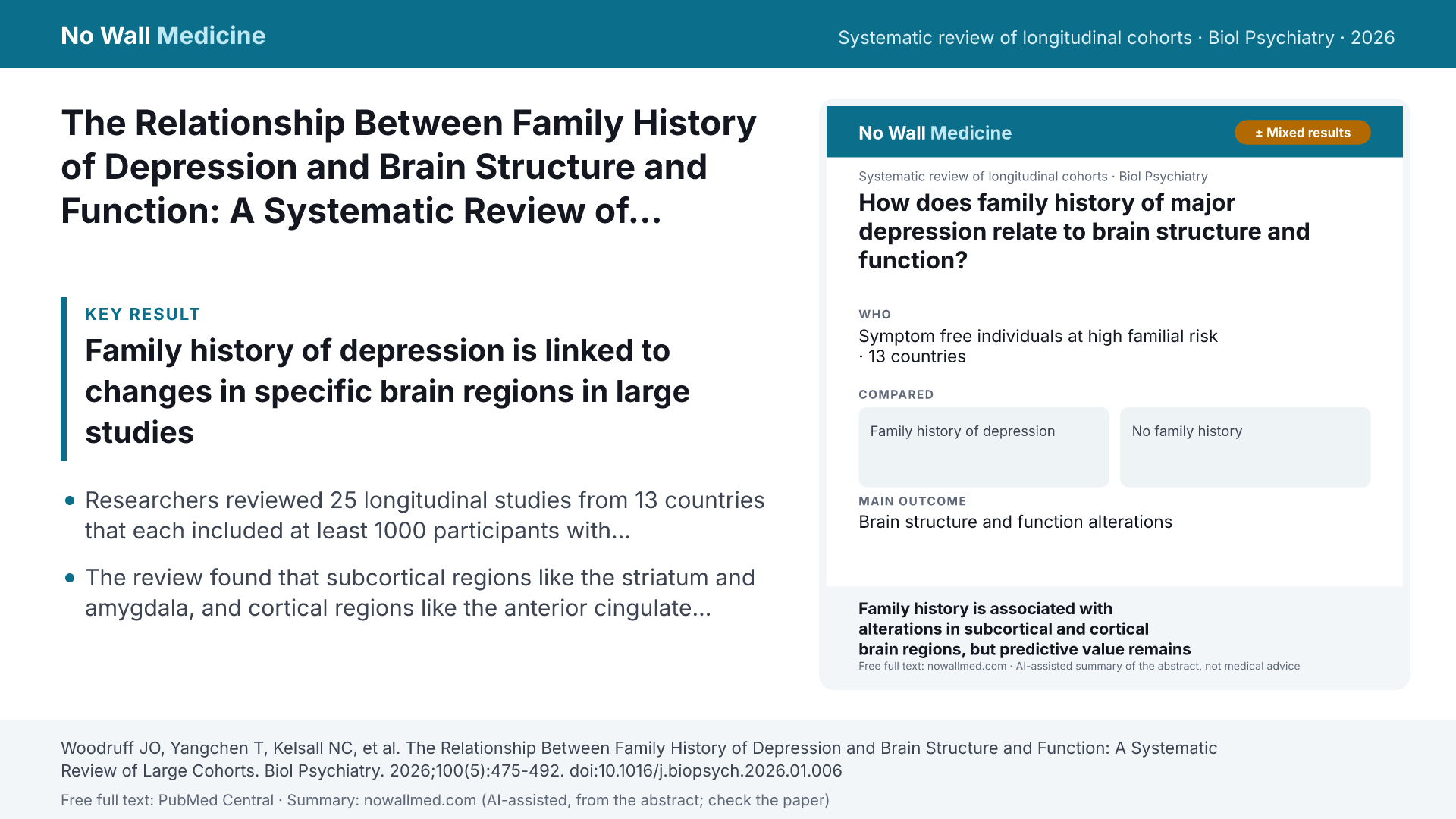
Family history of depression is linked to changes in specific brain regions in large studies
The Relationship Between Family History of Depression and Brain Structure and Function: A Systematic Review of Large Cohorts
Systematic review of longitudinal cohortsMixed results
How does family history of major depression relate to brain structure and function?
Who
Symptom free individuals at high familial risk · 13 countries
Compared
Family history of depression
No family history
Main outcome
Brain structure and function alterations
Bottom line: Family history is associated with alterations in subcortical and cortical brain regions, but predictive value remains unclear.
Limitation: Current evidence for whether these brain regions predict psychopathology is limited.
Biol Psychiatry · 2026-01-15Download image
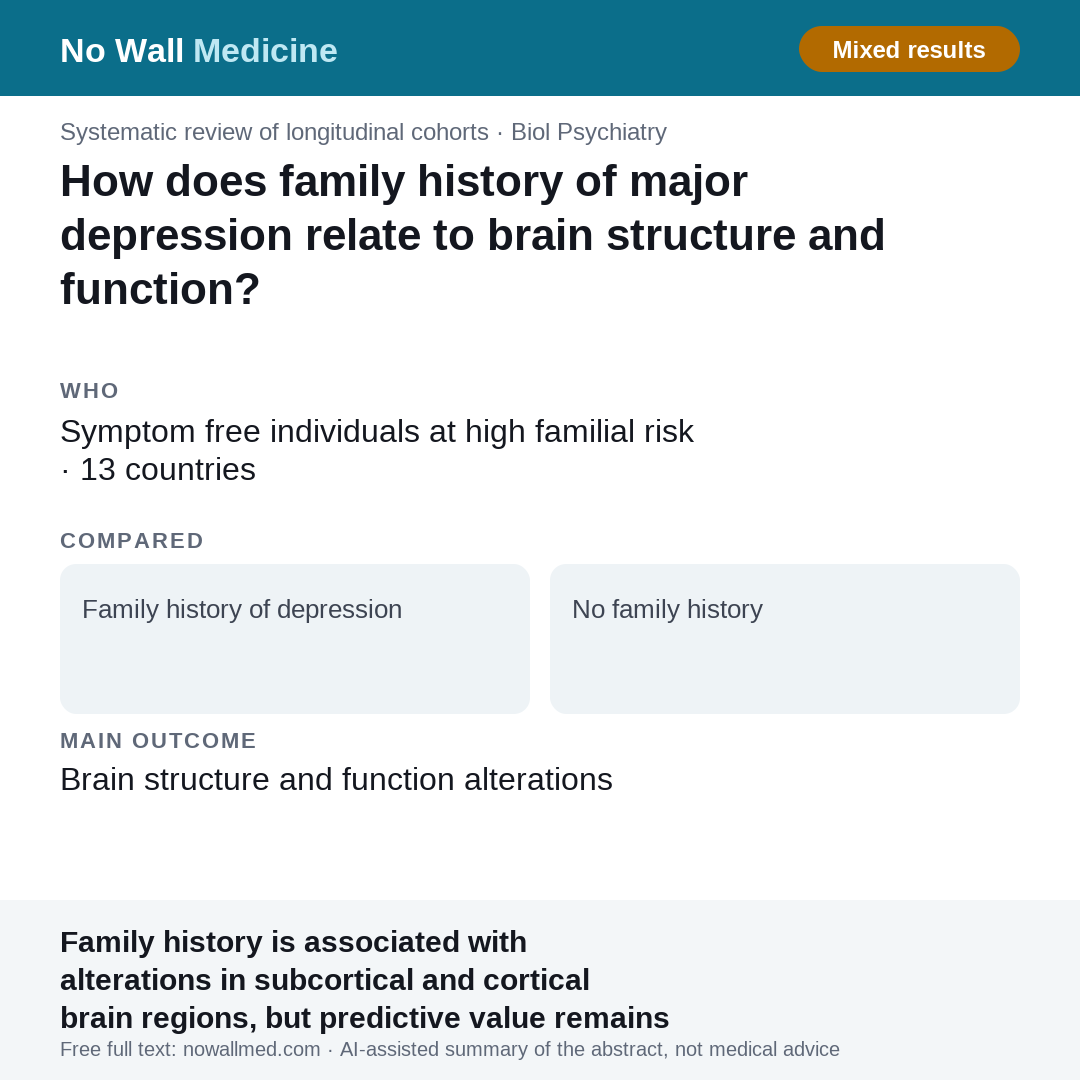
Clinical question: How does family history of major depression relate to brain structure and function?
Why it matters: It is difficult to distinguish between brain mechanisms that predispose people to depression and those that develop after having the disorder.
Key points
- Researchers reviewed 25 longitudinal studies from 13 countries that each included at least 1000 participants with brain imaging and family history data.
- The review found that subcortical regions like the striatum and amygdala, and cortical regions like the anterior cingulate and prefrontal cortex, most frequently showed alterations.
- The studies examined how family history of major depression relates to brain structure and function in people who do not yet have symptoms.
Limitation the authors note: Current evidence for whether these specific brain region alterations predict future mental health disorders is limited.
Headline and key points written with AI from the paper’s abstract, with every number checked against it. Read the paper before relying on them.
Was this summary helpful?
Subject terms
Cite this article
Woodruff JO, Yangchen T, Kelsall NC, et al. The Relationship Between Family History of Depression and Brain Structure and Function: A Systematic Review of Large Cohorts. Biol Psychiatry. 2026. doi:10.1016/j.biopsych.2026.01.006
Spotted a mistake? Suggest a correction