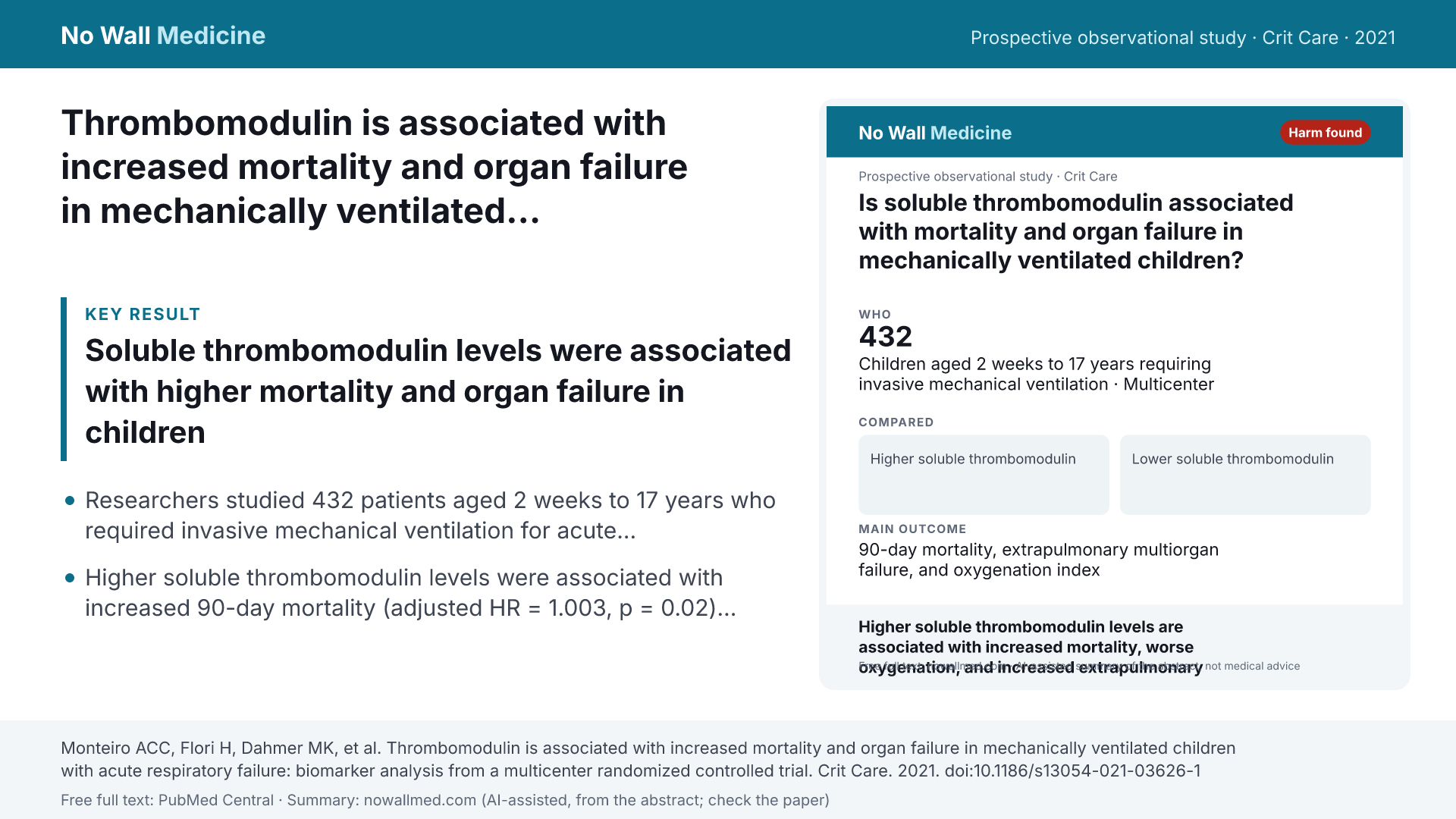
Soluble thrombomodulin levels were associated with higher mortality and organ failure in children
Thrombomodulin is associated with increased mortality and organ failure in mechanically ventilated children with acute respiratory failure: biomarker analysis from a multicenter randomized controlled trial
Prospective observational studyHarm found
Is soluble thrombomodulin associated with mortality and organ failure in mechanically ventilated children?
Who
432
Children aged 2 weeks to 17 years requiring invasive mechanical ventilation · Multicenter
Compared
Higher soluble thrombomodulin
Lower soluble thrombomodulin
Main outcome
90-day mortality, extrapulmonary multiorgan failure, and oxygenation index
Result: adjusted hazard ratio 1.003 (p = 0.02)
Bottom line: Higher soluble thrombomodulin levels are associated with increased mortality, worse oxygenation, and increased extrapulmonary multiorgan failure in children.
Crit Care · 2021-08-03Download image
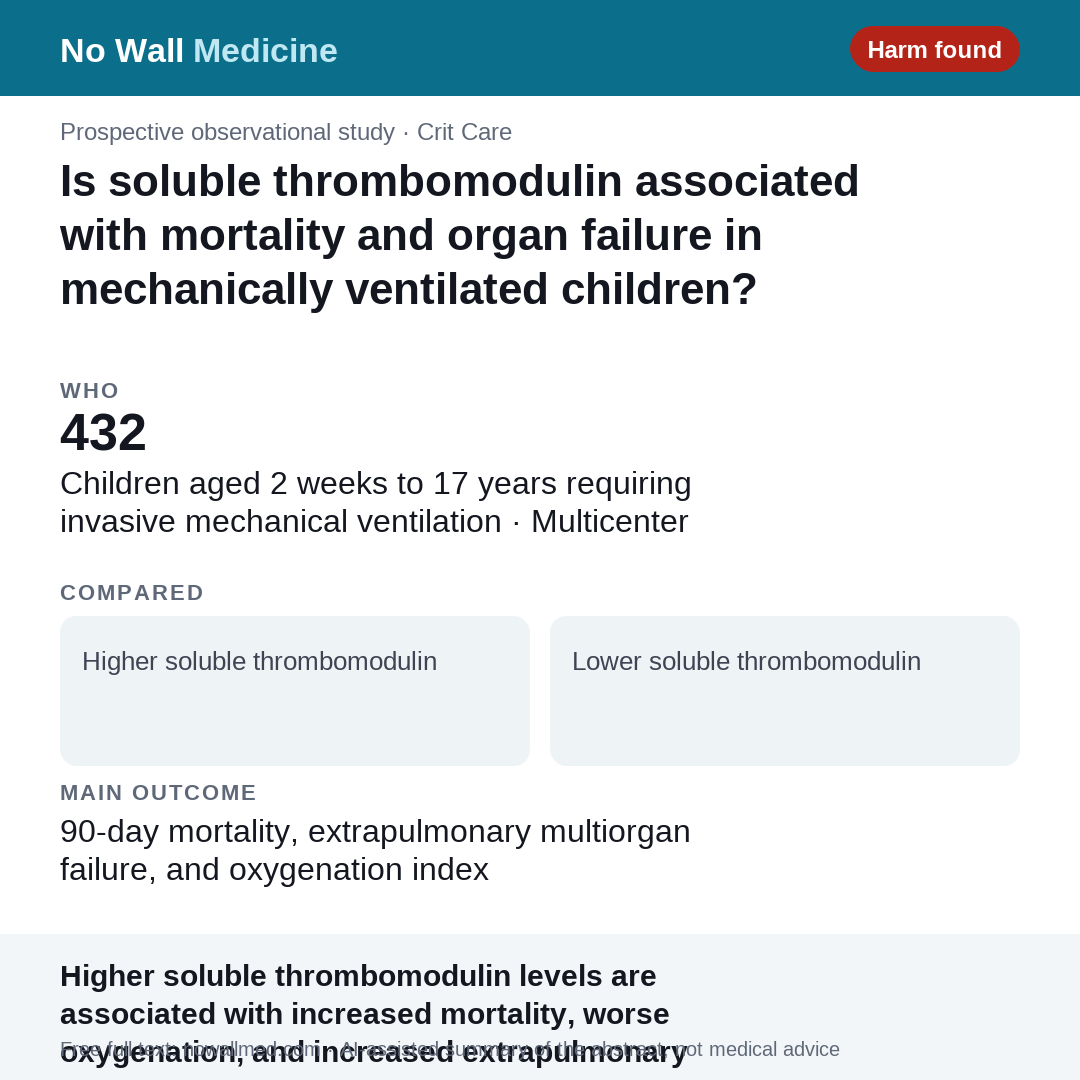
Clinical question: Is soluble thrombomodulin associated with mortality and organ failure in mechanically ventilated children?
Why it matters: It is unknown if soluble thrombomodulin, a marker of vascular injury, can help predict outcomes in children with acute respiratory failure.
Key points
- Researchers studied 432 patients aged 2 weeks to 17 years who required invasive mechanical ventilation for acute respiratory failure.
- Higher soluble thrombomodulin levels were associated with increased 90-day mortality (adjusted HR = 1.003, p = 0.02) and worse oxygenation index.
- Both initial soluble thrombomodulin levels and the rate of change were associated with increased extrapulmonary multiorgan failure.
Headline and key points written with AI from the paper’s abstract, with every number checked against it. Read the paper before relying on them.
Was this summary helpful?
Abstract
Background
Acute respiratory failure (ARF) can progress to acute respiratory distress syndrome and death. Biomarkers may allow for risk stratification and prognostic enrichment in ARF. Thrombomodulin (TM) is a transmembrane antithrombotic mediator expressed in endothelial cells. It is cleaved into its soluble form (sTM) during inflammation and vascular injury. Levels of sTM correlate with inflammation and end organ dysfunction. Methods
This was a prospective observational study of 432 patients aged 2 weeks-17 years requiring invasive mechanical ventilation. It was ancillary to the multicenter clinical trial, Randomized Evaluation of Sedation Titration for Respiratory Failure (RESTORE). After consent, patients had up to 3 plasma samples collected at 24-h intervals within 5 days after intubation. sTM was assayed by ELISA. The Hazard ratio (HR) for 90-day mortality was determined by Cox regression. Mixed effect models (MEM) were used to test for association with extrapulmonary multiorgan failure (MOF) and oxygenation index (OI). Age, race, sex and PRISM-III scores were used as confounding variables for multivariable analyses. Results
sTM values ranged from 16.6 to 670.9 ng/ml within 5 days after intubation. Higher sTM was associated with increased 90-day mortality (n = 432, adjusted HR = 1.003, p = 0.02) and worse OI in the first 5 days after intubation (n = 252, Estimate = 0.02, p < 0.01). Both initial and slope of sTM were associated with increased extrapulmonary MOF in unadjusted and adjusted analyses (Intercept, Estimate = 0.003, p < 0.0001; and slope, Estimate = 0.01, p = 0.0009, n = 386). Conclusions
Plasma sTM is associated with mortality, severity of hypoxic respiratory failure and worsening extrapulmonary MOF in children with ARF. This suggests a role of vascular injury in the pathogenesis of ARF and provides potential applicability towards targeted therapies. Trial registration
https://clinicaltrials.gov/ct2/show/NCT00814099 . In healthy lung endothelium, thrombomodulin (TM) recruits thrombin to activate Protein-C (PC/APC), that inhibits plasminogen activator-1 (PAI-1) and thrombosis. In inflamed and damaged endothelium, TM is cleaved into its soluble form (sTM), precluding its usual regulation of thrombosis. In this study, we measured plasma sTM levels in pediatric patients with respiratory failure and found that sTM correlated with mortality and other clinical markers of poor outcomes.
Abstract reproduced under the article’s CC BY licence.
Subject terms
Cite this article
Monteiro ACC, Flori H, Dahmer MK, et al. Thrombomodulin is associated with increased mortality and organ failure in mechanically ventilated children with acute respiratory failure: biomarker analysis from a multicenter randomized controlled trial. Crit Care. 2021. doi:10.1186/s13054-021-03626-1
Spotted a mistake? Suggest a correction