Extra outdoor time per school day was associated with lower myopia onset in children
Time Outdoors in Reducing Myopia: A School-Based Cluster Randomized Trial with Objective Monitoring of Outdoor Time and Light Intensity
Prospective, cluster-randomized, examiner-masked, 3-arm trialBenefit found
Does increasing outdoor time per school day reduce myopia onset and shift?
Who
6295
6295 students aged 6 to 9 years · 24 primary schools in Shanghai, China
Compared
24.9%Control
20.6%Test I
23.8%Test II
Main outcome
2-year cumulative incidence of myopia
Result: incidence risk ratio 0.84 (95% CI 0.72-0.99) for test I and 0.89 (95% CI 0.79-0.99) for test II
Bottom line: Increasing outdoor time reduced the risk of myopia onset and myopic shifts in children.
Ophthalmology · 2022-06-30Download image
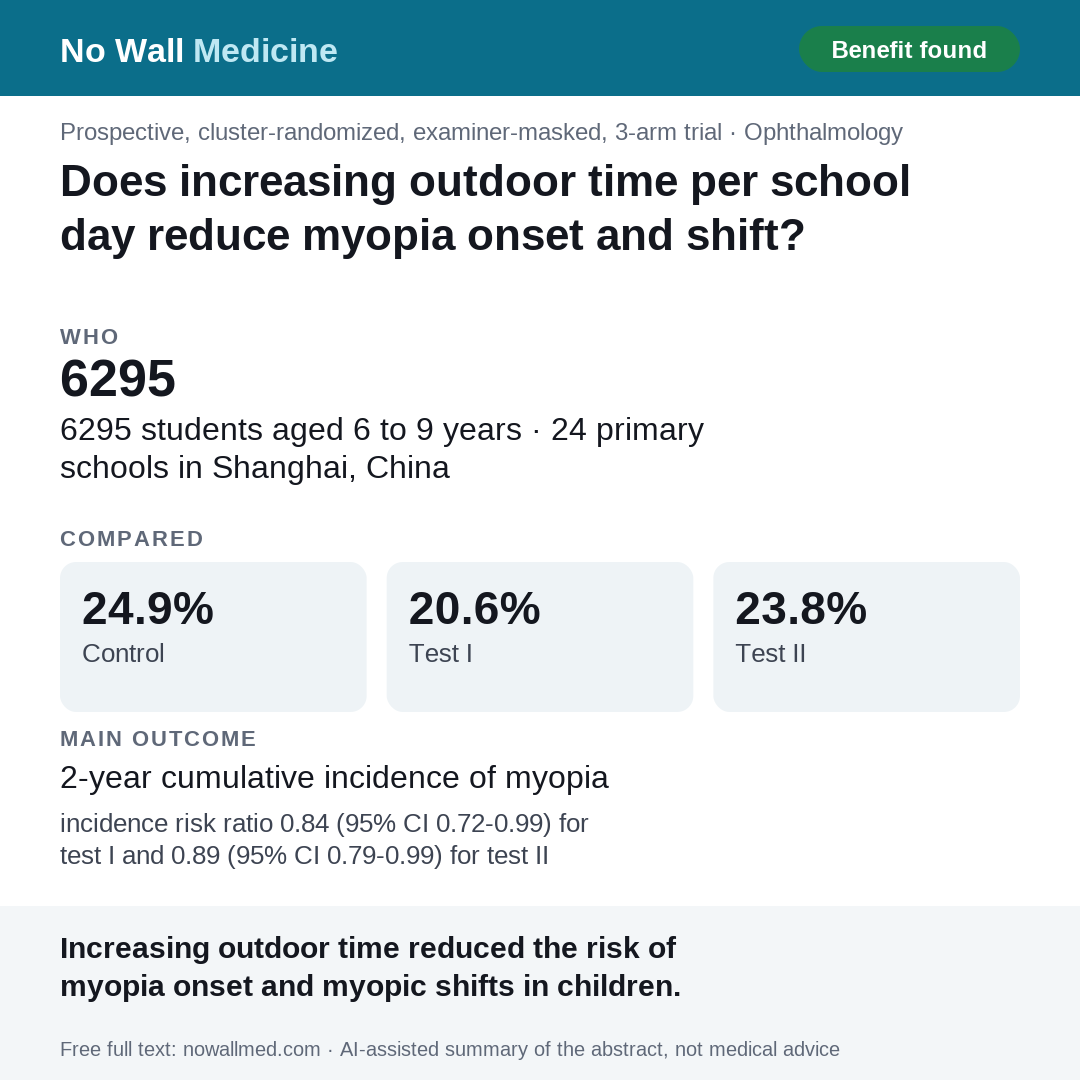
Clinical question: Does increasing outdoor time per school day reduce myopia onset and shift?
Why it matters: It was unknown if increasing daily outdoor time and light intensity could influence the onset of myopia and the progression of eye growth in children.
Key points
- Researchers studied 6295 students aged 6 to 9 years across 24 schools, comparing habitual outdoor time to groups receiving 40 or 80 additional minutes of outdoor time.
- The adjusted incidence of myopia was lower in the 40-minute group (IRR, 0.84; 95% CI, 0.72-0.99; P = 0.035) and the 80-minute group (IRR = 0.89; 95% CI, 0.79-0.99; P = 0.041) compared to control.
- Test groups showed less myopic shift and axial elongation, which is the lengthening of the eye, compared to the control group.
Headline and key points written with AI from the paper’s abstract, with every number checked against it. Read the paper before relying on them.
Was this summary helpful?
Subject terms
Cite this article
He X, Sankaridurg P, Wang J, Chen J, Naduvilath T, He M. Time Outdoors in Reducing Myopia: A School-Based Cluster Randomized Trial with Objective Monitoring of Outdoor Time and Light Intensity. Ophthalmology. 2022. doi:10.1016/j.ophtha.2022.06.024
Spotted a mistake? Suggest a correction
Top studies every Monday
The week’s key trials and guidelines in your specialties, plus any topics you follow. By email, free.
Get the weekly digest