Rehabilitation interventions show greater motor recovery improvements in acute and subacute stroke phases
Time Post-Stroke and Upper Extremity Stroke Motor Recovery Rehabilitation: A Meta-Analysis
Meta-analysis of 157 randomized controlled trialsBenefit found
Does timing post-stroke affect upper extremity rehabilitation effectiveness on Fugl-Meyer Assessment scores?
Who
157
Adults aged 18 years or older diagnosed with stroke
Compared
Acute and subacute phases: significant beneficial effects
Chronic post-stroke phase: significant improvements
Main outcome
Fugl-Meyer Assessment Upper Extremity scores
Bottom line: Rehabilitation interventions show greater Fugl-Meyer Assessment Upper Extremity score improvements in acute and subacute phases than chronic phases.
Neurorehabil Neural Repair · 2025-07-23Download image
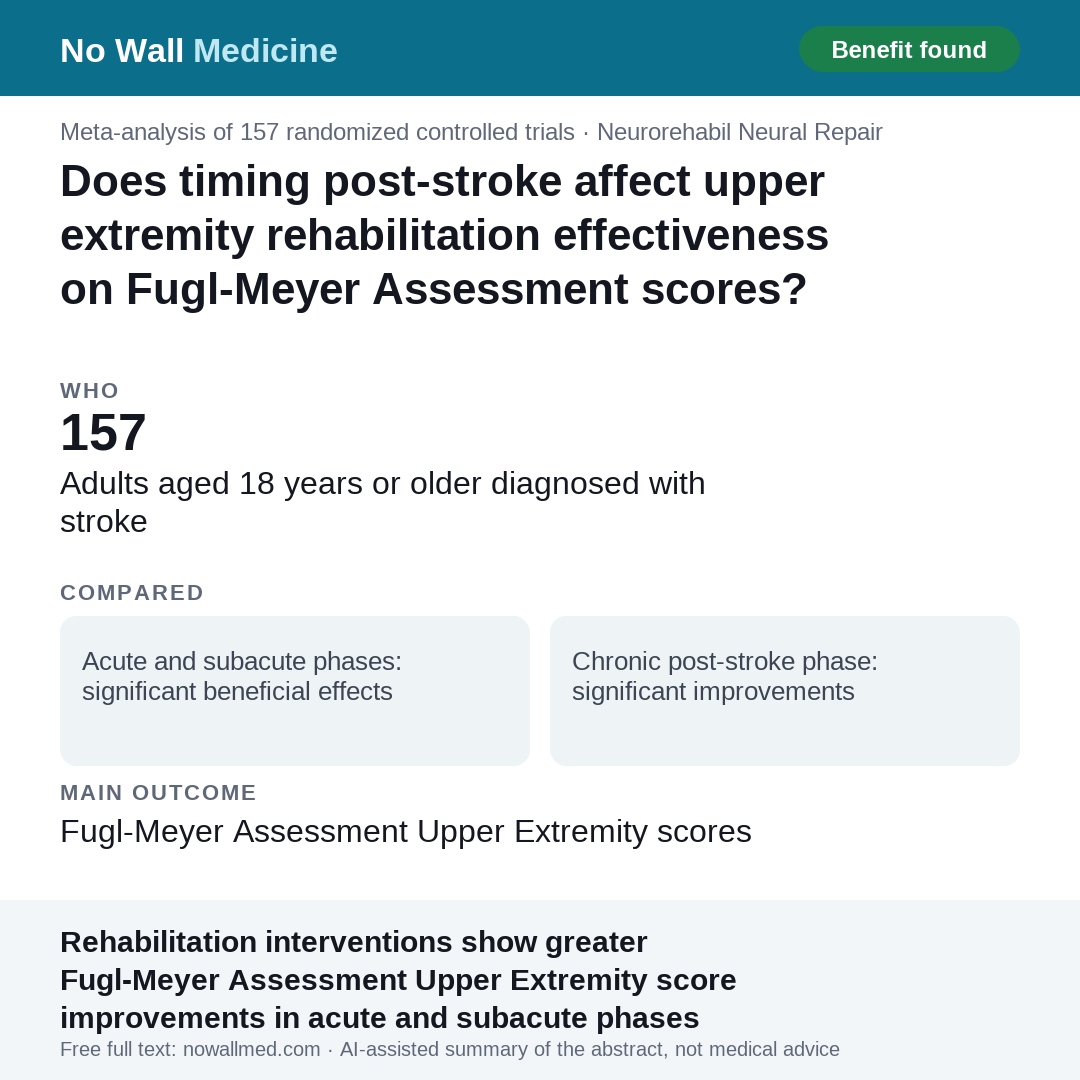
Clinical question: Does timing post-stroke affect upper extremity rehabilitation effectiveness on Fugl-Meyer Assessment scores?
Why it matters: It is unclear how the timing of rehabilitation after a stroke affects the effectiveness of motor recovery interventions.
Key points
- Researchers analyzed 157 randomized controlled trials involving 17 types of interventions for upper extremity rehabilitation after a stroke.
- Interventions in the acute and subacute phases showed greater improvements in Fugl-Meyer Assessment Upper Extremity scores than those in the chronic phase.
- In the acute and subacute phases, 11 of 16 assessed interventions showed significant beneficial effects, while 7 of 9 assessed in the chronic phase showed significant improvements.
Headline and key points written with AI from the paper’s abstract, with every number checked against it. Read the paper before relying on them.
Was this summary helpful?
Subject terms
Cite this article
Mehrabi S, Flores-Sandoval C, Fleet JL, Dukelow SP, Bateman EA, Teasell R. Time Post-Stroke and Upper Extremity Stroke Motor Recovery Rehabilitation: A Meta-Analysis. Neurorehabil Neural Repair. 2025. doi:10.1177/15459683251356975
Spotted a mistake? Suggest a correction
Top studies every Monday
The week’s key trials and guidelines in your specialties, plus any topics you follow. By email, free.
Get the weekly digest