Tranexamic acid lowers bleeding risk in coronary artery surgery patients
Tranexamic Acid in Patients Undergoing Coronary-Artery Surgery
Why it matters: Tranexamic acid reduced bleeding and transfusion in coronary-artery surgery without increasing death or thrombotic complications, but was linked to more postoperative seizures.
Context written by the No Wall Medicine team.
Randomized trialNo clear difference
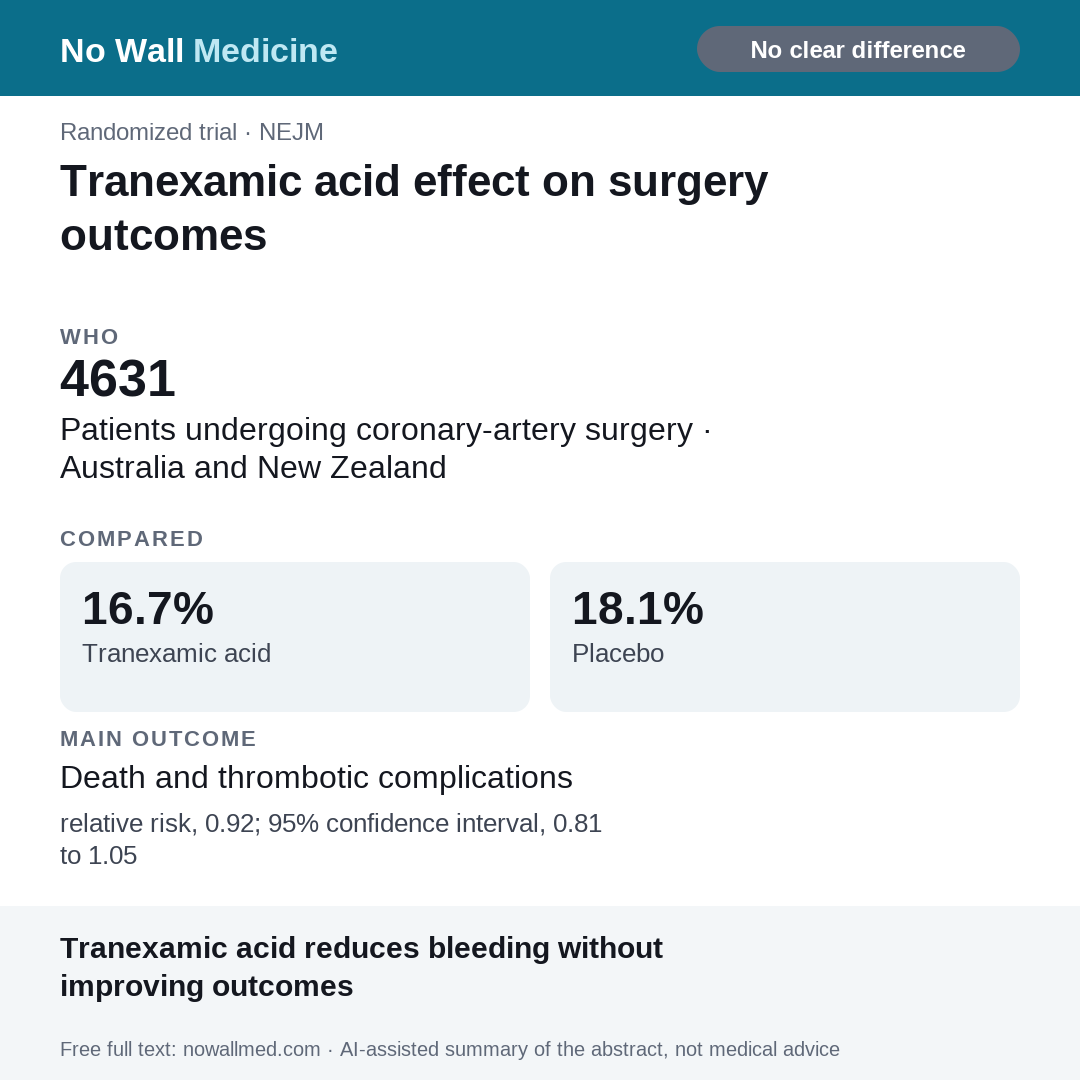
Tranexamic acid effect on surgery outcomes
Who
4631
Patients undergoing coronary-artery surgery · Australia and New Zealand
Compared
16.7%Tranexamic acid (386/2311)
18.1%Placebo (420/2320)
Main outcome
Death and thrombotic complications
Result: relative risk, 0.92; 95% confidence interval, 0.81 to 1.05
Bottom line: Tranexamic acid reduces bleeding without improving outcomes
Funded by: Australian National Health
NEJM · 2016-10-23Download image
Trial at a glance
Bottom line: Tranexamic acid lowers bleeding risk without increasing death or thrombotic complications risk
Clinical question
Does tranexamic acid improve outcomes in coronary-artery surgery patients?
Design
2-by-2 factorial design, randomized. Australia and New Zealand, no specific years or sites stated
Who was studied
4662 patients undergoing coronary-artery surgery
Interventions
- tranexamic acid group: received tranexamic acid
- placebo group: received placebo
Primary outcome
composite of death and thrombotic complications. 16.7% in tranexamic acid group, 18.1% in placebo group
Secondary outcomes
- blood products transfused: 4331 units in tranexamic acid group, 7994 units in placebo group
- major hemorrhage or cardiac tamponade: 1.4% in tranexamic acid group, 2.8% in placebo group
- seizures: 0.7% in tranexamic acid group, 0.1% in placebo group
Harms
higher risk of postoperative seizures with tranexamic acid
Funding
Australian National Health and Medical Research Council and others
Written with AI from the abstract; every number was checked against it. Details such as eligibility criteria may be missing because the abstract does not give them. Read the paper before relying on it.
Key points
- 4631 patients undergoing coronary-artery surgery were compared.
- 16.7% of tranexamic acid patients had primary outcome events, versus 18.1% of placebo patients.
- Tranexamic acid was linked to a higher risk of postoperative seizures, 0.7% versus 0.1%.
Headline and key points written with AI from the paper’s abstract, with every number checked against it. Read the paper before relying on them.
Topics
Cite this article
Myles PS, Smith JA, Forbes A, Silbert B, Jayarajah M, Painter T. Tranexamic Acid in Patients Undergoing Coronary-Artery Surgery. NEJM. 2016. doi:10.1056/NEJMoa1606424
Spotted a mistake? Suggest a correction