Higher mean flow velocity index linked to hemorrhagic transformation after thrombectomy
Transcranial doppler (TCD) in predicting outcomes following successful mechanical thrombectomy of large vessel occlusions in anterior circulation: a systematic review and meta-analysis
Systematic review and meta-analysisBenefit found
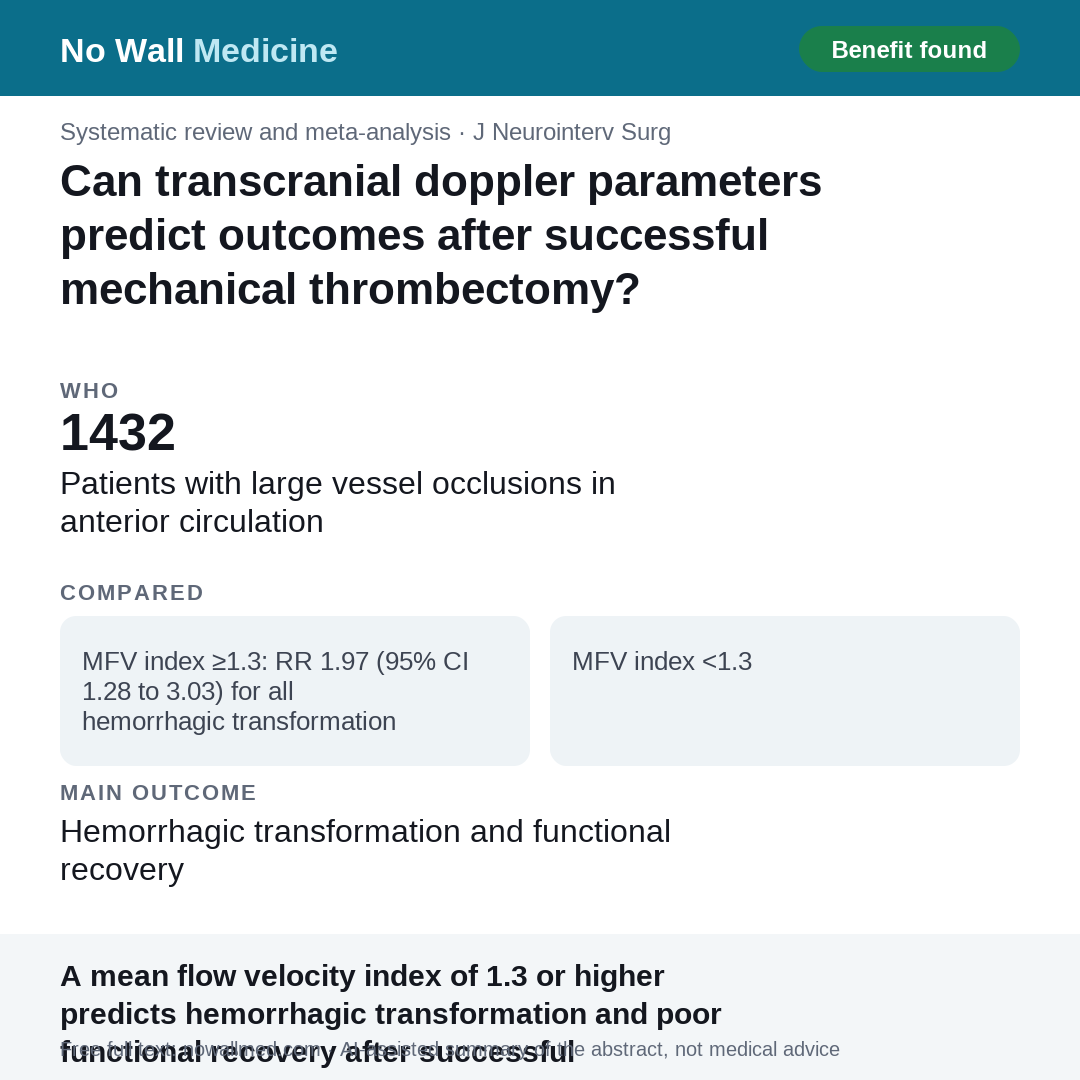
Can transcranial doppler parameters predict outcomes after successful mechanical thrombectomy?
Who
1432
Patients with large vessel occlusions in anterior circulation
Compared
MFV index ≥1.3: RR 1.97 (95% CI 1.28 to 3.03) for all hemorrhagic transformation
MFV index <1.3
Main outcome
Hemorrhagic transformation and functional recovery
Result: RR 1.65 (95% CI 1.27 to 2.14) for poor functional status
Bottom line: A mean flow velocity index of 1.3 or higher predicts hemorrhagic transformation and poor functional recovery after successful mechanical thrombectomy.
J Neurointerv Surg · 2025-11-18Download image
Clinical question: Can transcranial doppler parameters predict outcomes after successful mechanical thrombectomy?
Why it matters: Predictive value of transcranial doppler parameters after mechanical thrombectomy is not well established
Key points
- 1432 patients were studied after mechanical thrombectomy, with 59% male and mean age 63-73 years.
- Mean flow velocity index was higher in patients with hemorrhagic transformation, with relative risk 1.97.
- No difference in peak systolic velocity was found among groups with and without hemorrhagic transformation.
Limitation the authors note: Findings need confirmation in large-scale, multi-center studies
Headline and key points written with AI from the paper’s abstract, with every number checked against it. Read the paper before relying on them.
Was this summary helpful?
Subject terms
Cite this article
Jazayeri SB, Sabayan B, Pirahanchi Y, Ravi V, Carrión-Penagos J, Bowers J. Transcranial doppler (TCD) in predicting outcomes following successful mechanical thrombectomy of large vessel occlusions in anterior circulation: a systematic review and meta-analysis. J Neurointerv Surg. 2025. doi:10.1136/jnis-2024-022457
Spotted a mistake? Suggest a correction
Top studies every Monday
The week’s key trials and guidelines in your specialties, plus any topics you follow. By email, free.
Get the weekly digest