Airway eosinophilia in COPD patients is associated with type 2 inflammation and corticosteroid response
Transcriptomic profiling of the airway epithelium in COPD links airway eosinophilia to type 2 inflammation and corticosteroid response
Post hoc analysis of a randomized controlled trialBenefit found
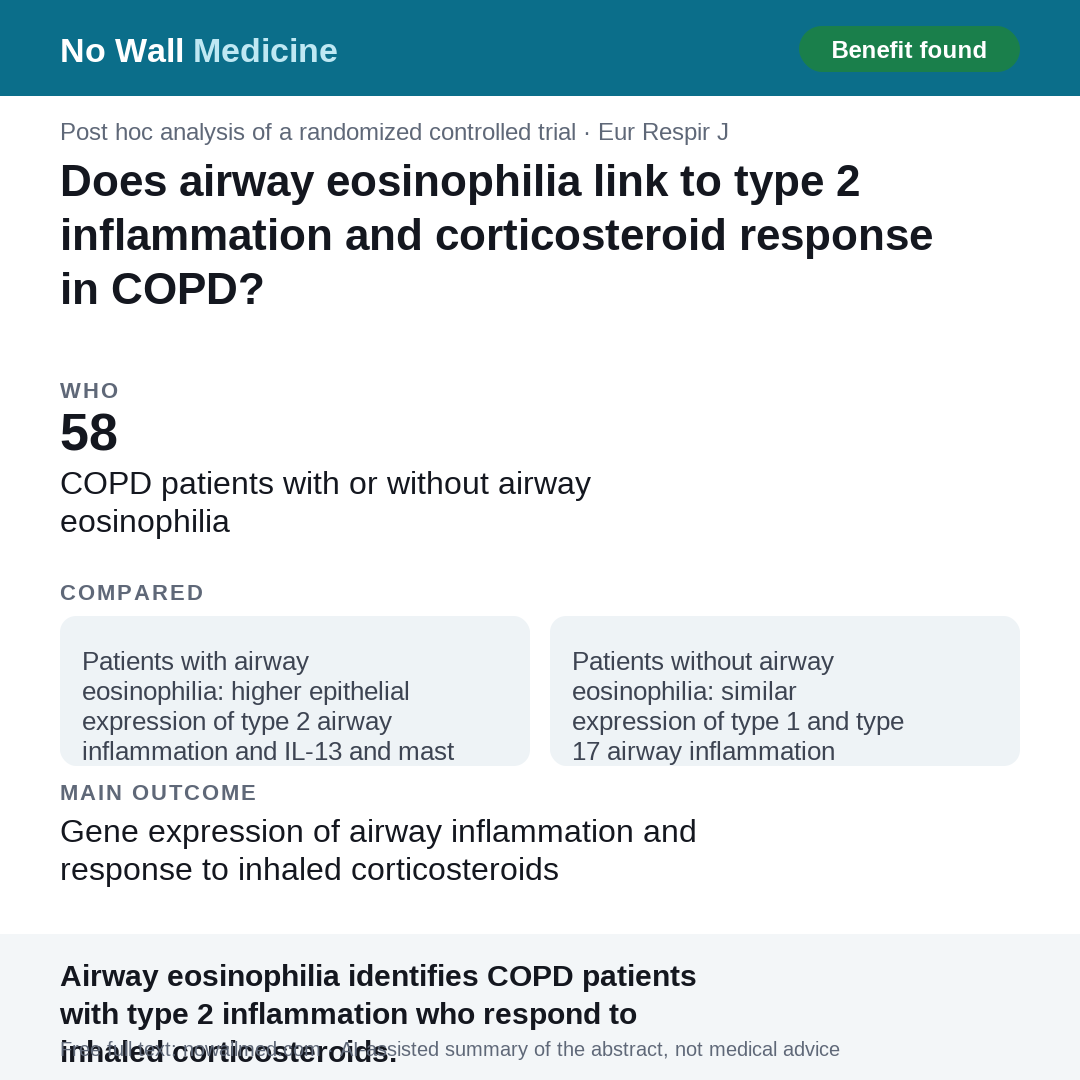
Does airway eosinophilia link to type 2 inflammation and corticosteroid response in COPD?
Who
58
COPD patients with or without airway eosinophilia
Compared
Patients with airway eosinophilia: higher epithelial expression of type 2 airway inflammation and IL-13 and mast cell activation
Patients without airway eosinophilia: similar expression of type 1 and type 17 airway inflammation
Main outcome
Gene expression of airway inflammation and response to inhaled corticosteroids
Bottom line: Airway eosinophilia identifies COPD patients with type 2 inflammation who respond to inhaled corticosteroids.
Eur Respir J · 2025-05-06Download image
Clinical question: Does airway eosinophilia link to type 2 inflammation and corticosteroid response in COPD?
Why it matters: It is unclear how airway eosinophilia relates to specific gene expression patterns and how these patients respond to inhaled corticosteroid treatment.
Key points
- Researchers analyzed 58 patients with chronic obstructive pulmonary disease (COPD) using airway epithelial brushings to compare gene expression between those with and without airway eosinophilia.
- Patients with airway eosinophilia, defined as eosinophils >1% of the total leukocyte count, showed higher expression of type 2 inflammation, interleukin-13, and mast cell activation at baseline.
- After 12 weeks of inhaled corticosteroid treatment, the expression of type 2 inflammation and mast cell gene signatures was reduced in the airway eosinophilia group.
Headline and key points written with AI from the paper’s abstract, with every number checked against it. Read the paper before relying on them.
Was this summary helpful?
Subject terms
Cite this article
Leung C, Park HY, Li X, Koelwyn GJ, Tuong J, Vahedi SM. Transcriptomic profiling of the airway epithelium in COPD links airway eosinophilia to type 2 inflammation and corticosteroid response. Eur Respir J. 2025. doi:10.1183/13993003.01875-2024
Spotted a mistake? Suggest a correction
Top studies every Monday
The week’s key trials and guidelines in your specialties, plus any topics you follow. By email, free.
Get the weekly digest