Electrical acupoint stimulation improved motor function and daily living scores in stroke patients
Transcutaneous electrical acupoint stimulation for upper limb spasticity after stroke: effect and feasibility-a randomised pilot study
Randomized, double-blind pilot studyBenefit found
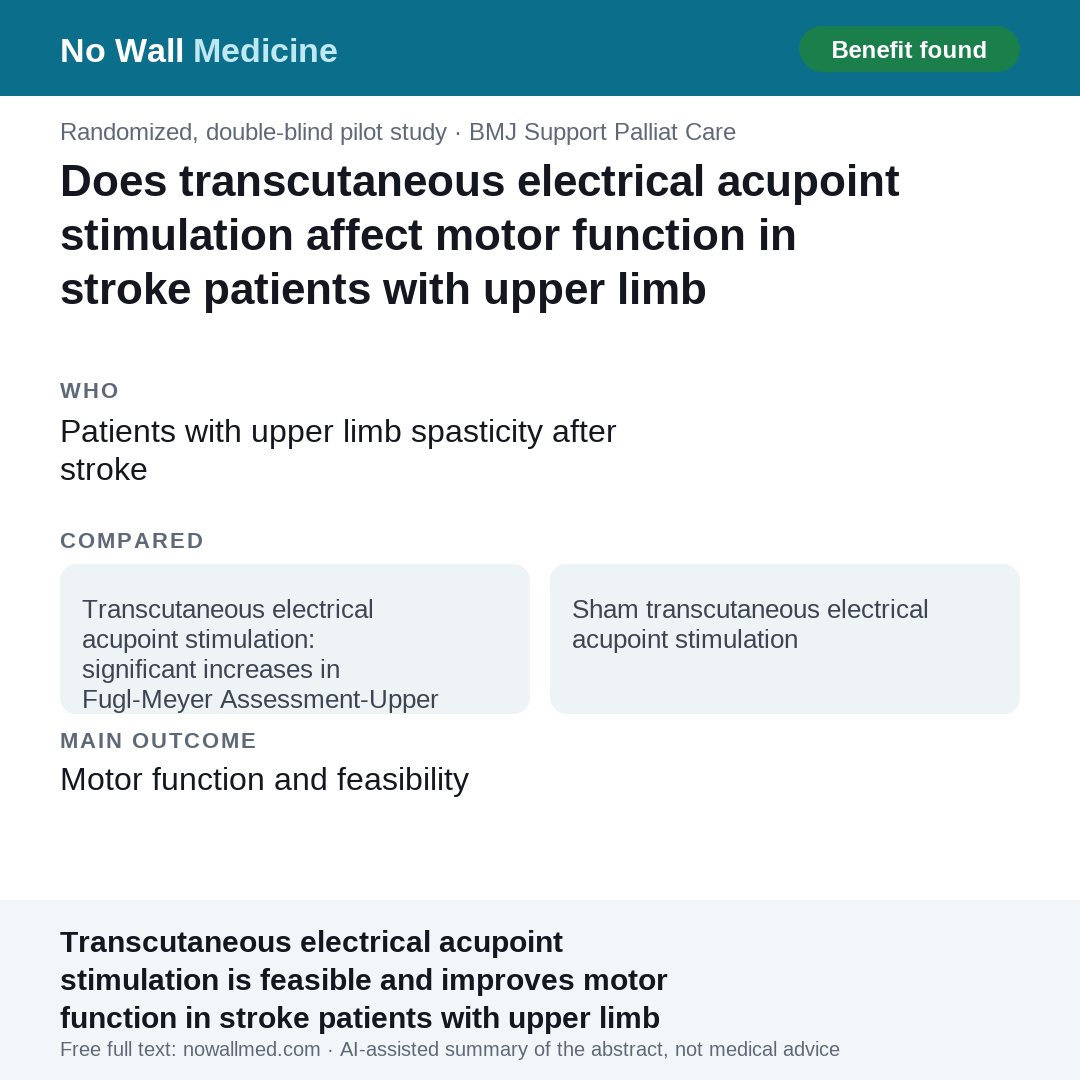
Does transcutaneous electrical acupoint stimulation affect motor function in stroke patients with upper limb spasticity?
Who
Patients with upper limb spasticity after stroke
Compared
Transcutaneous electrical acupoint stimulation: significant increases in Fugl-Meyer Assessment-Upper Extremity score (P value=0.013)
Sham transcutaneous electrical acupoint stimulation
Main outcome
Motor function and feasibility
Bottom line: Transcutaneous electrical acupoint stimulation is feasible and improves motor function in stroke patients with upper limb spasticity.
Limitation: This was a pilot study
BMJ Support Palliat Care · 2025-02-26Download image
Clinical question: Does transcutaneous electrical acupoint stimulation affect motor function in stroke patients with upper limb spasticity?
Why it matters: The potential effects and feasibility of transcutaneous electrical acupoint stimulation for managing upper limb spasticity after stroke remain uncertain.
Key points
- Researchers conducted a randomized pilot study comparing transcutaneous electrical acupoint stimulation to a sham treatment in patients with upper limb spasticity after stroke.
- After 6 weeks, the stimulation group showed significant increases in Fugl-Meyer Assessment-Upper Extremity scores (P value=0.013), Wolf Motor Function Test scores (P value=0.001), and Barthel Index scores (P value=0.008).
- The stimulation group also had lower scores for integrated electromyogram (p=0.048) and root mean square of the biceps (p=0.033) at week 6.
Headline and key points written with AI from the paper’s abstract, with every number checked against it. Read the paper before relying on them.
Abstract
Importance
Limb spasticity is a common issue among stroke patients. Transcutaneous electrical acupoint stimulation (TEAS) is recommended as an alternative therapy for managing upper limb spasticity after stroke; however, its potential effects and feasibility remain uncertain. Objective
To investigate the potential effects and feasibility of TEAS on motor function in patients with upper limb spasticity after stroke. Methods
This randomised controlled, double-blined pilot study was conducted in two phases. All the patients were randomly divided into two groups: the TEAS group and the sham TEAS group. The intervention period for both TEAS and sham TEAS was 6 weeks, with each session lasting 30 min and conducted thrice weekly. The outcomes measured were the Fugl-Meyer Assessment-Upper Extremity (FMA-UE) score, the effective improvement rate, the modified Ashworth Scale (MAS), the Wolf Motor Function Test (WMFT), the visual analogue scale (VAS), the Barthel index (BI) and the surface electromyography (sEMG). Results
All participants completed the course of therapy. Baseline characteristics were comparable across the two groups. Compared with the sham TEAS group, the TEAS group showed significant increases in FMA-UE score (P value=0.013), WMFT score (P value=0.001) and BI score (P value=0.008) at week 6. For integrated electromyogram (p=0.048) and root mean square of the biceps (p=0.033), lower scores were identified in the TEAS group compared with the sham TEAS group with a significant difference at week 6. Conclusion
TEAS was acceptable and feasible in participants with upper limb spasticity after stroke. A pivotal study of this therapy is justified.
Abstract reproduced under the article’s CC BY NC licence.
Topics
Cite this article
Wang Y, Zhang L, Yin R, Zhang Y, Dai Z, Wang M. Transcutaneous electrical acupoint stimulation for upper limb spasticity after stroke: effect and feasibility-a randomised pilot study. BMJ Support Palliat Care. 2025. doi:10.1136/spcare-2024-005174
Spotted a mistake? Suggest a correction