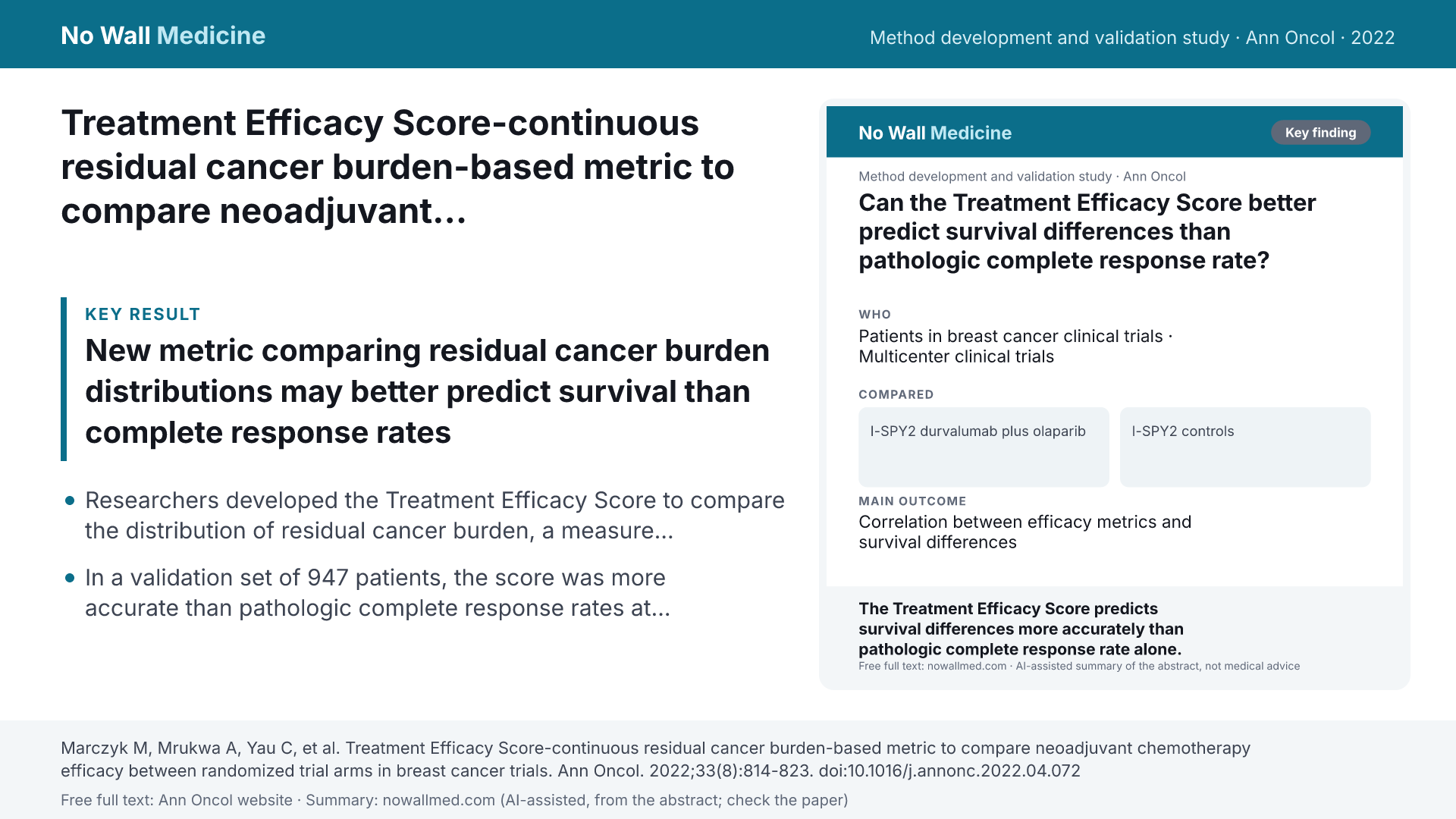
New metric comparing residual cancer burden distributions may better predict survival than complete response rates
Treatment Efficacy Score-continuous residual cancer burden-based metric to compare neoadjuvant chemotherapy efficacy between randomized trial arms in breast cancer trials
Method development and validation studyKey finding
Can the Treatment Efficacy Score better predict survival differences than pathologic complete response rate?
Who
Patients in breast cancer clinical trials · Multicenter clinical trials
Compared
I-SPY2 durvalumab plus olaparib
I-SPY2 controls
Main outcome
Correlation between efficacy metrics and survival differences
Bottom line: The Treatment Efficacy Score predicts survival differences more accurately than pathologic complete response rate alone.
Ann Oncol · 2022-05-02Download image

Clinical question: Can the Treatment Efficacy Score better predict survival differences than pathologic complete response rate?
Why it matters: Standard pathologic complete response rates do not capture how much a treatment reduces the amount of remaining cancer in patients who do not achieve a full response.
Key points
- Researchers developed the Treatment Efficacy Score to compare the distribution of residual cancer burden, a measure of remaining tumor after chemotherapy, between clinical trial arms.
- In a validation set of 947 patients, the score was more accurate than pathologic complete response rates at identifying less effective regimens that failed to reduce high residual cancer burden.
- The correlation between the Treatment Efficacy Score and survival was higher than the correlation between the difference in pathologic complete response rates and survival.
Headline and key points written with AI from the paper’s abstract, with every number checked against it. Read the paper before relying on them.
Was this summary helpful?
Subject terms
Headline, design, result, key points, caveat and citation as plain text.
Cite this article
Marczyk M, Mrukwa A, Yau C, et al. Treatment Efficacy Score-continuous residual cancer burden-based metric to compare neoadjuvant chemotherapy efficacy between randomized trial arms in breast cancer trials. Ann Oncol. 2022. doi:10.1016/j.annonc.2022.04.072
Spotted a mistake? Suggest a correction