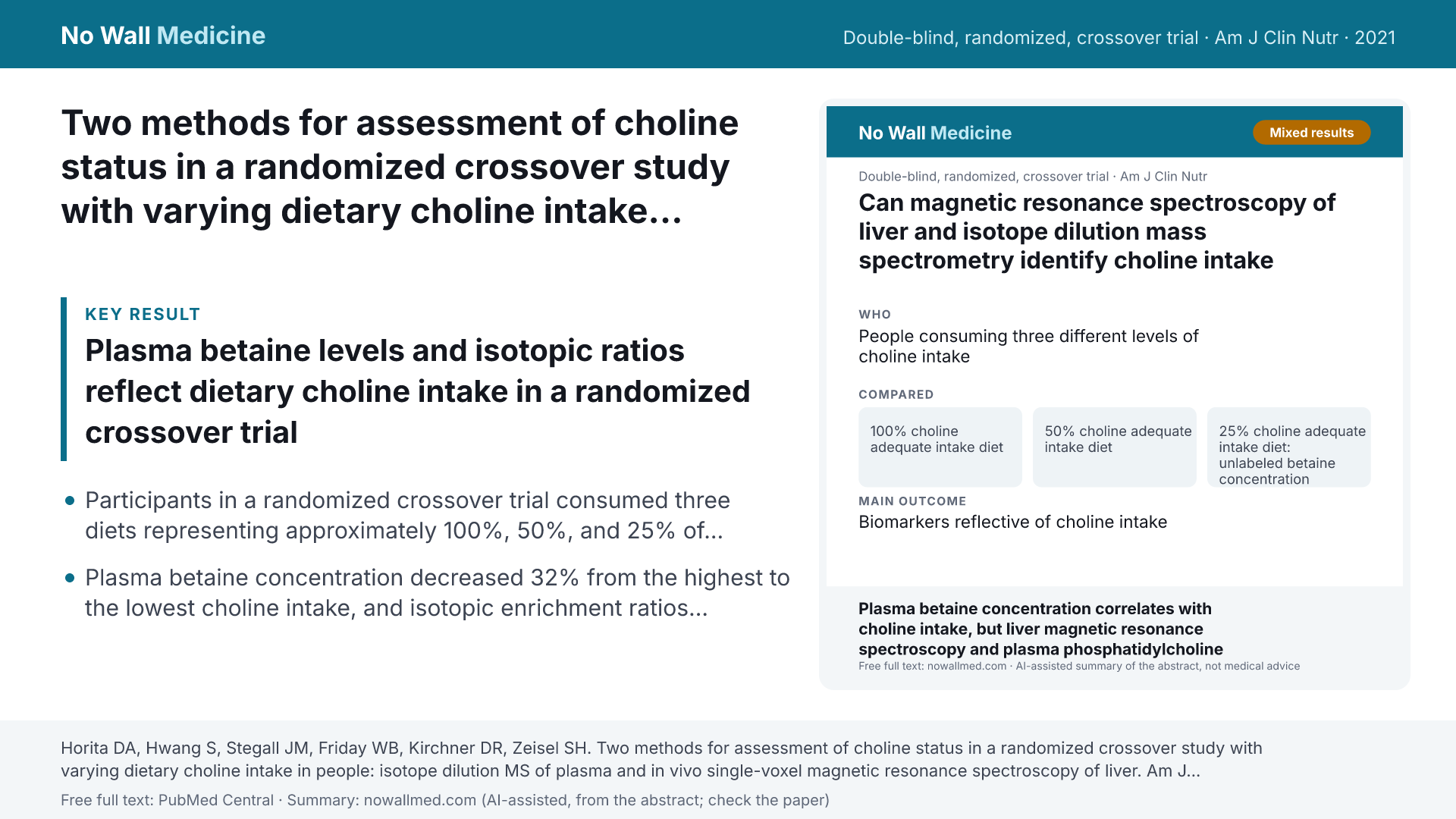
Plasma betaine levels and isotopic ratios reflect dietary choline intake in a randomized crossover trial
Two methods for assessment of choline status in a randomized crossover study with varying dietary choline intake in people: isotope dilution MS of plasma and in vivo single-voxel magnetic resonance spectroscopy of liver
Double-blind, randomized, crossover trialMixed results
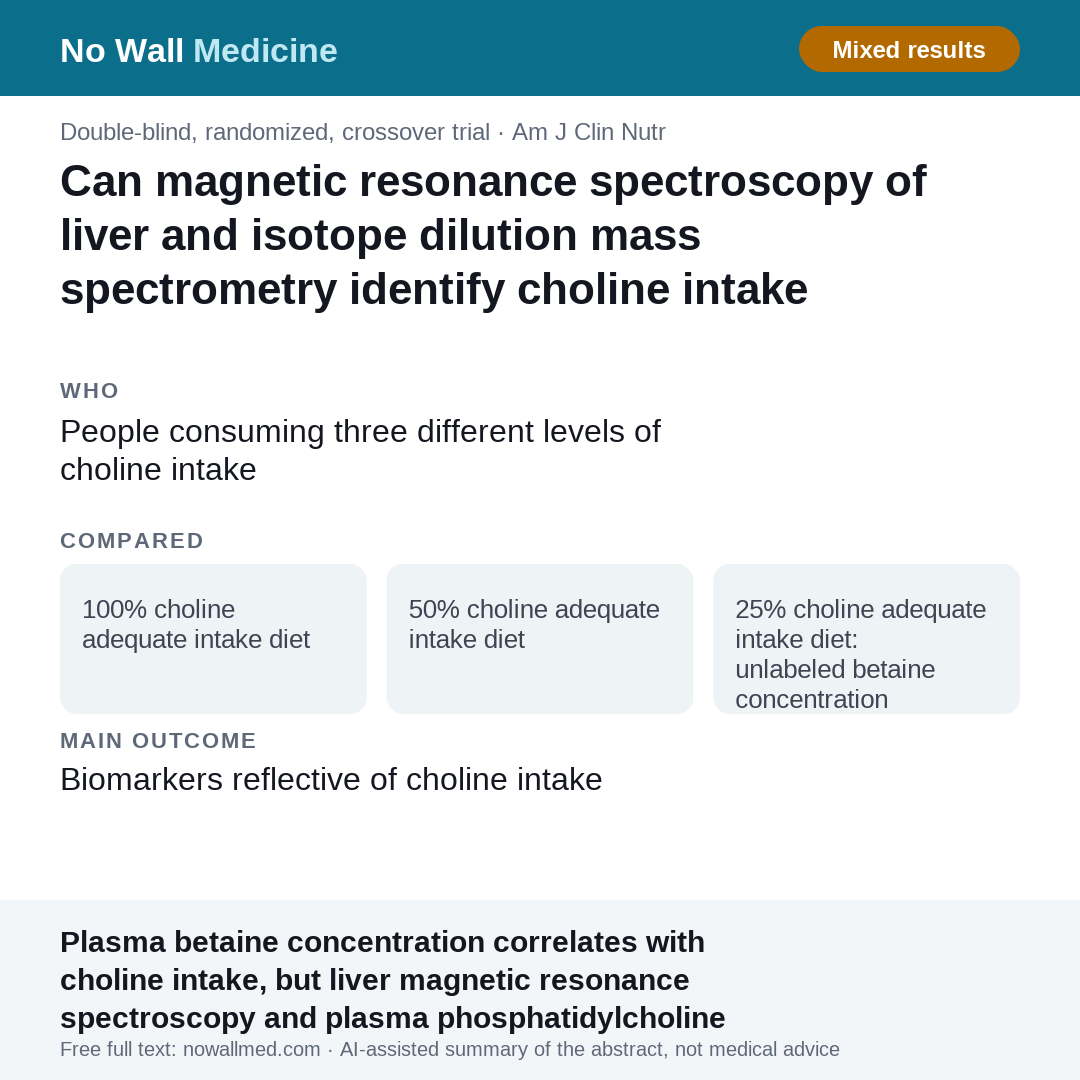
Can magnetic resonance spectroscopy of liver and isotope dilution mass spectrometry identify choline intake biomarkers?
Who
People consuming three different levels of choline intake
Compared
100% choline adequate intake diet
50% choline adequate intake diet
25% choline adequate intake diet: unlabeled betaine concentration decreased 32% from highest to lowest intake
Main outcome
Biomarkers reflective of choline intake
Bottom line: Plasma betaine concentration correlates with choline intake, but liver magnetic resonance spectroscopy and plasma phosphatidylcholine did not show significant effects.
Limitation: Variable spectral quality limited interpretation of magnetic resonance spectroscopy of liver.
Am J Clin Nutr · 2021-03-06Download image
Clinical question: Can magnetic resonance spectroscopy of liver and isotope dilution mass spectrometry identify choline intake biomarkers?
Why it matters: Clinical assessment of choline status is difficult because current methods to identify biomarkers reflective of choline intake are not well established.
Key points
- Participants in a randomized crossover trial consumed three diets representing approximately 100%, 50%, and 25% of the recommended choline intake for 2-wk periods.
- Plasma betaine concentration decreased 32% from the highest to the lowest choline intake, and isotopic enrichment ratios of betaine showed significant between-diet effects (q < 0.0001).
- Liver choline concentrations measured by magnetic resonance spectroscopy and plasma phosphatidylcholine concentrations did not show statistically significant between-diet effects.
Limitation the authors note: Variable spectral quality of magnetic resonance spectroscopy limited the interpretation of liver choline measurements.
Headline and key points written with AI from the paper’s abstract, with every number checked against it. Read the paper before relying on them.
Was this summary helpful?
Subject terms
Cite this article
Horita DA, Hwang S, Stegall JM, Friday WB, Kirchner DR, Zeisel SH. Two methods for assessment of choline status in a randomized crossover study with varying dietary choline intake in people: isotope dilution MS of plasma and in vivo single-voxel magnetic resonance spectroscopy of liver. Am J Clin Nutr. 2021. doi:10.1093/ajcn/nqaa439
Spotted a mistake? Suggest a correction