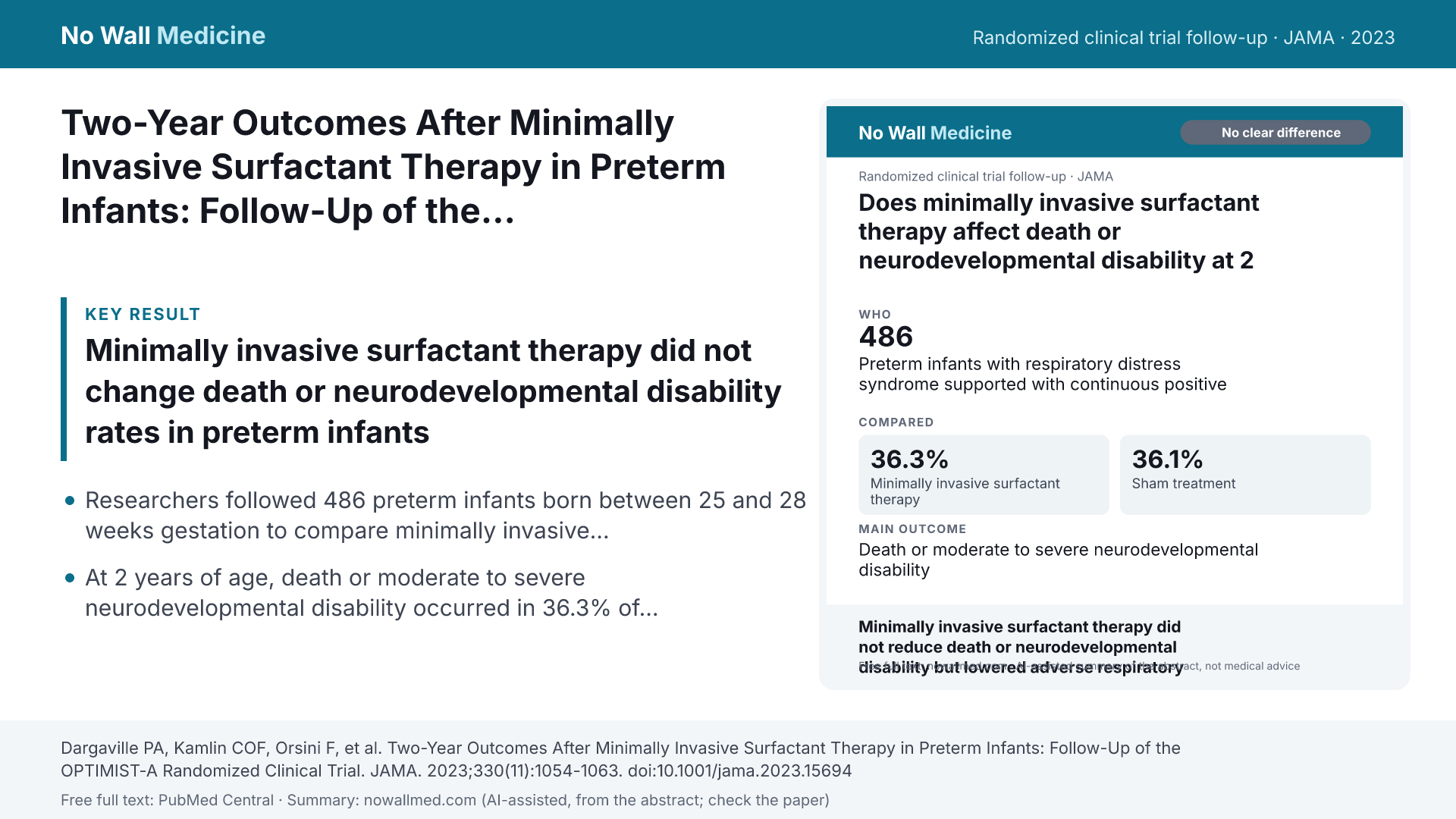
Minimally invasive surfactant therapy did not change death or neurodevelopmental disability rates in preterm infants
Two-Year Outcomes After Minimally Invasive Surfactant Therapy in Preterm Infants: Follow-Up of the OPTIMIST-A Randomized Clinical Trial
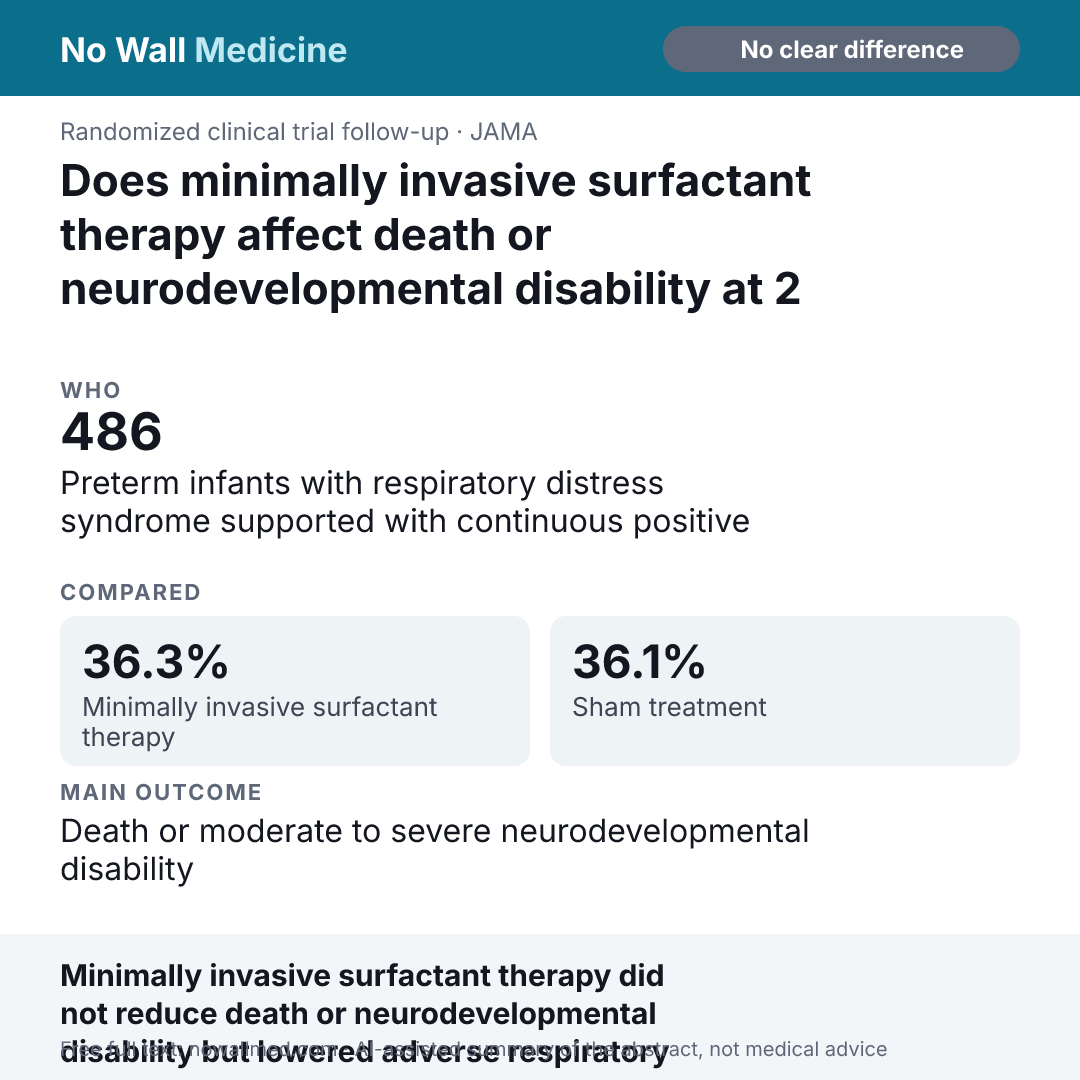
Randomized clinical trial follow-upNo clear difference
Does minimally invasive surfactant therapy affect death or neurodevelopmental disability at 2 years?
Who
486
Preterm infants with respiratory distress syndrome supported with continuous positive airway pressure · 33 tertiary-level neonatal intensive care units in 11 countries
Compared
36.3%Minimally invasive surfactant therapy
36.1%Sham treatment
Main outcome
Death or moderate to severe neurodevelopmental disability
Result: relative risk 1.0 (95% CI 0.81-1.24)
Bottom line: Minimally invasive surfactant therapy did not reduce death or neurodevelopmental disability but lowered adverse respiratory outcomes.
JAMA · 2023-09-11 · Save PNG
Same trial (ACTRN12611000916943)
Papers we list that report this registered trial, oldest first. Read a secondary analysis alongside the main results.
- Main results No clear difference
Minimally invasive surfactant did not reduce death or lung disease in preterm infants JAMA 2021-12 - Longer follow-up No clear difference
This paper JAMA 2023-09
Clinical question: Does minimally invasive surfactant therapy affect death or neurodevelopmental disability at 2 years?
Why it matters: The long-term effects of administering surfactant through a thin catheter in preterm infants with respiratory distress syndrome remain to be definitively clarified.
Key points
- Researchers followed 486 preterm infants born between 25 and 28 weeks gestation to compare minimally invasive surfactant therapy via thin catheter against a sham treatment.
- At 2 years of age, death or moderate to severe neurodevelopmental disability occurred in 36.3% of the surfactant group and 36.1% of the control group.
- Infants receiving the surfactant therapy had lower rates of hospitalization for respiratory illness at 25.1% compared to 38.2% in the control group.
Headline and key points written with AI from the paper’s abstract, with every number checked against it. Read the paper before relying on them.
Was this summary helpful?
Subject terms
Headline, design, result, key points, caveat and citation as plain text.
Cite this article
Dargaville PA, Kamlin COF, Orsini F, et al. Two-Year Outcomes After Minimally Invasive Surfactant Therapy in Preterm Infants: Follow-Up of the OPTIMIST-A Randomized Clinical Trial. JAMA. 2023;330(11):1054-1063. doi:10.1001/jama.2023.15694
Spotted a mistake? Suggest a correction