Machine learning identifies three distinct lupus patient groups with different responses to belimumab therapy
Unsupervised machine learning identifies distinct SLE patient endotypes with differential response to belimumab
Analysis of phase III trial dataMixed results
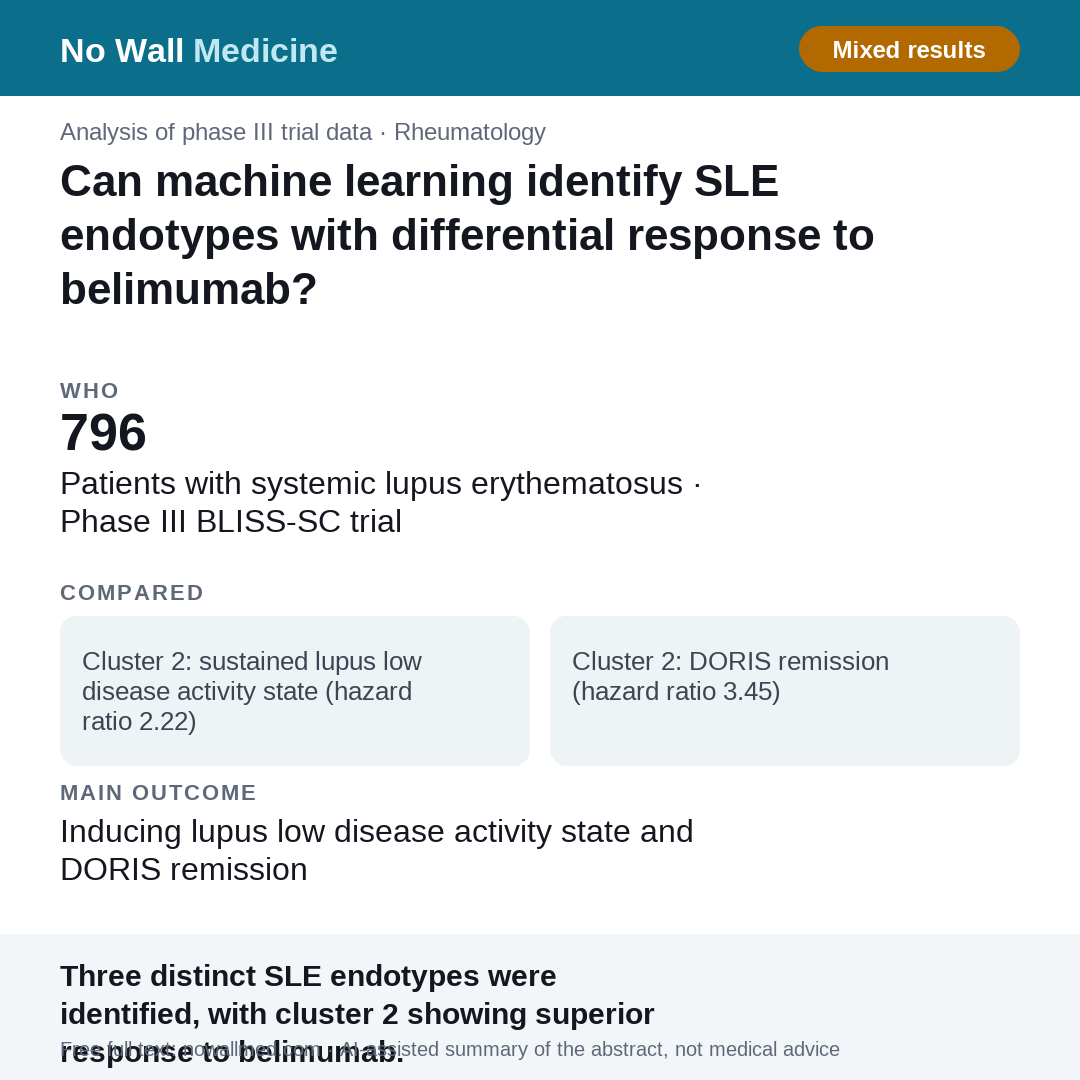
Can machine learning identify SLE endotypes with differential response to belimumab?
Who
796
Patients with systemic lupus erythematosus · Phase III BLISS-SC trial
Compared
Cluster 2: sustained lupus low disease activity state (hazard ratio 2.22)
Cluster 2: DORIS remission (hazard ratio 3.45)
Main outcome
Inducing lupus low disease activity state and DORIS remission
Result: hazard ratio 2.22 (95% CI 1.18-4.17) for sustained LLDAS
Bottom line: Three distinct SLE endotypes were identified, with cluster 2 showing superior response to belimumab.
Rheumatology · 2025-04-17Download image
Clinical question: Can machine learning identify SLE endotypes with differential response to belimumab?
Why it matters: It is unclear how different biological profiles of systemic lupus erythematosus patients affect how well they respond to belimumab treatment.
Key points
- Researchers analyzed 796 patients with systemic lupus erythematosus from the phase III BLISS-SC trial using machine learning to group patients by B cell and blood profile characteristics.
- In cluster 2, which contained 366 patients, belimumab was superior to placebo for inducing sustained lupus low disease activity state (hazard ratio: 2.22) and DORIS remission (hazard ratio: 3.45).
- Three distinct groups were identified, including a cluster of 239 patients with higher serological activity and specific antibody levels.
Headline and key points written with AI from the paper’s abstract, with every number checked against it. Read the paper before relying on them.
Was this summary helpful?
Subject terms
Cite this article
Depascale R, Da Mutten R, Lindblom J, Cetrez N, Palazzo L, Iaccarino L. Unsupervised machine learning identifies distinct SLE patient endotypes with differential response to belimumab. Rheumatology. 2025. doi:10.1093/rheumatology/keaf215
Spotted a mistake? Suggest a correction
Top studies every Monday
The week’s key trials and guidelines in your specialties, plus any topics you follow. By email, free.
Get the weekly digest