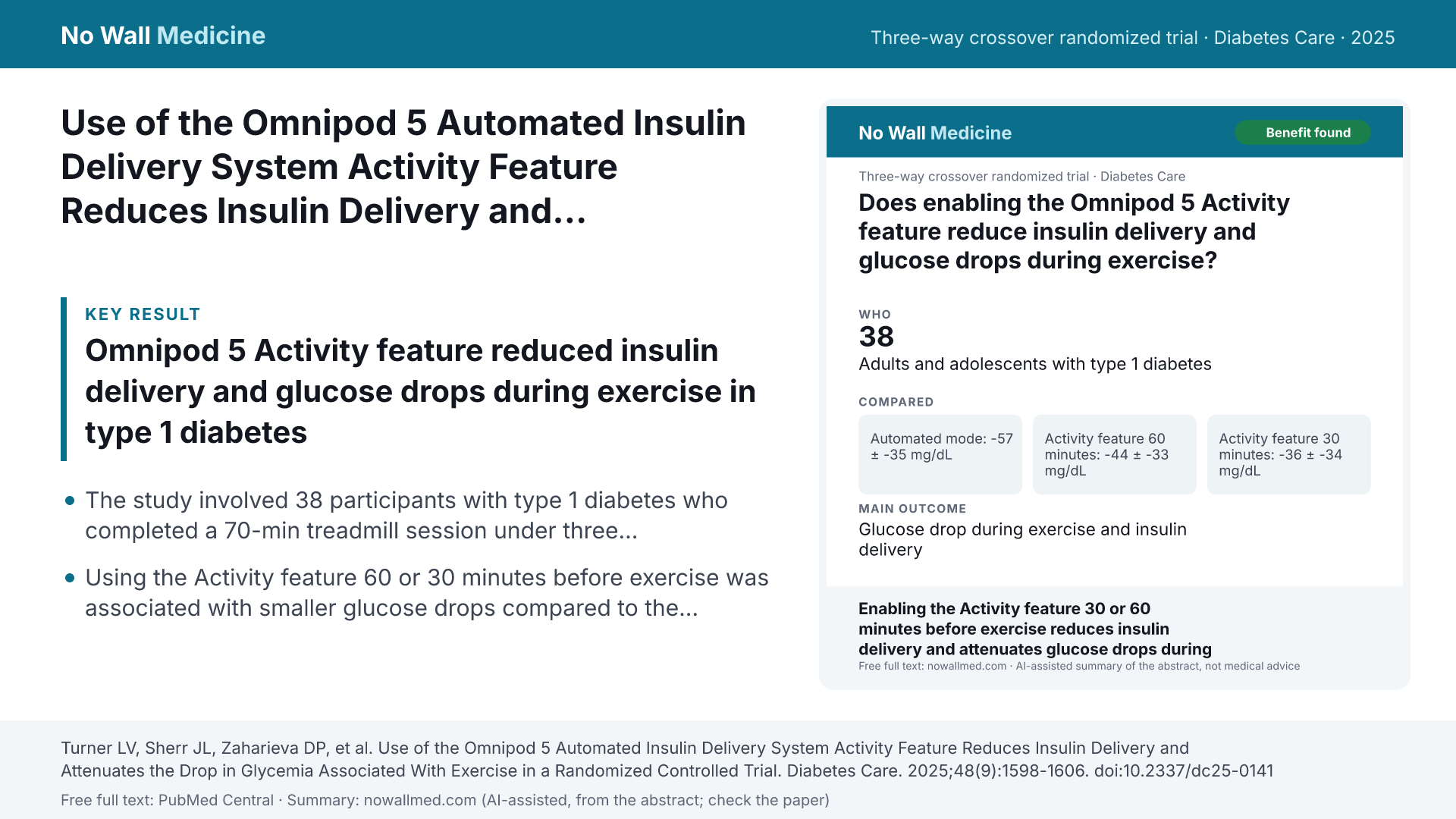
Omnipod 5 Activity feature reduced insulin delivery and glucose drops during exercise in type 1 diabetes
Use of the Omnipod 5 Automated Insulin Delivery System Activity Feature Reduces Insulin Delivery and Attenuates the Drop in Glycemia Associated With Exercise in a Randomized Controlled Trial
Three-way crossover randomized trialBenefit found
Does enabling the Omnipod 5 Activity feature reduce insulin delivery and glucose drops during exercise?
Who
38
Adults and adolescents with type 1 diabetes
Compared
Automated mode: -57 ± -35 mg/dL
Activity feature 60 minutes: -44 ± -33 mg/dL
Activity feature 30 minutes: -36 ± -34 mg/dL
Main outcome
Glucose drop during exercise and insulin delivery
Bottom line: Enabling the Activity feature 30 or 60 minutes before exercise reduces insulin delivery and attenuates glucose drops during exercise.
Limitation: Hypoglycemia incidence did not differ significantly between the three conditions.
Diabetes Care · 2025-07-18 · Save PNG
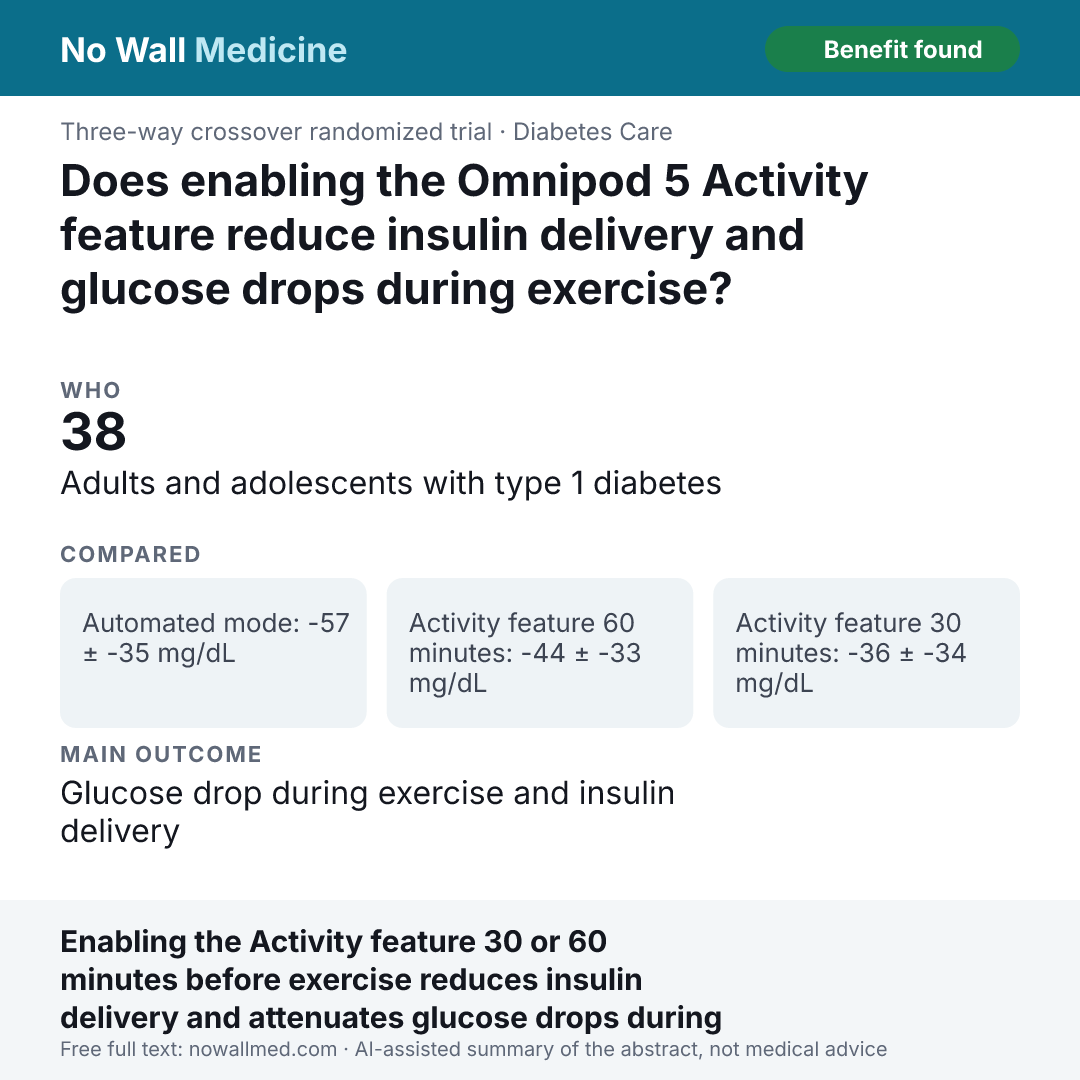
Clinical question: Does enabling the Omnipod 5 Activity feature reduce insulin delivery and glucose drops during exercise?
Why it matters: Clinicians and patients need to know if specific settings on automated insulin delivery systems can help manage blood sugar levels during prolonged exercise.
Key points
- The study involved 38 participants with type 1 diabetes who completed a 70-min treadmill session under three different settings of the Omnipod 5 automated insulin delivery system.
- Using the Activity feature 60 or 30 minutes before exercise was associated with smaller glucose drops compared to the automated mode (-44 ± -33 mg/dL and -36 ± -34 mg/dL versus -57 ± -35 mg/dL).
- The percentage of participants experiencing hypoglycemia during exercise did not differ significantly between the automated mode (42%), the 60-minute feature (29%), or the 30-minute feature (24%).
Headline and key points written with AI from the paper’s abstract, with every number checked against it. Read the paper before relying on them.
Was this summary helpful?
Subject terms
Headline, design, result, key points, caveat and citation as plain text.
Cite this article
Turner LV, Sherr JL, Zaharieva DP, et al. Use of the Omnipod 5 Automated Insulin Delivery System Activity Feature Reduces Insulin Delivery and Attenuates the Drop in Glycemia Associated With Exercise in a Randomized Controlled Trial. Diabetes Care. 2025;48(9):1598-1606. doi:10.2337/dc25-0141
Spotted a mistake? Suggest a correction