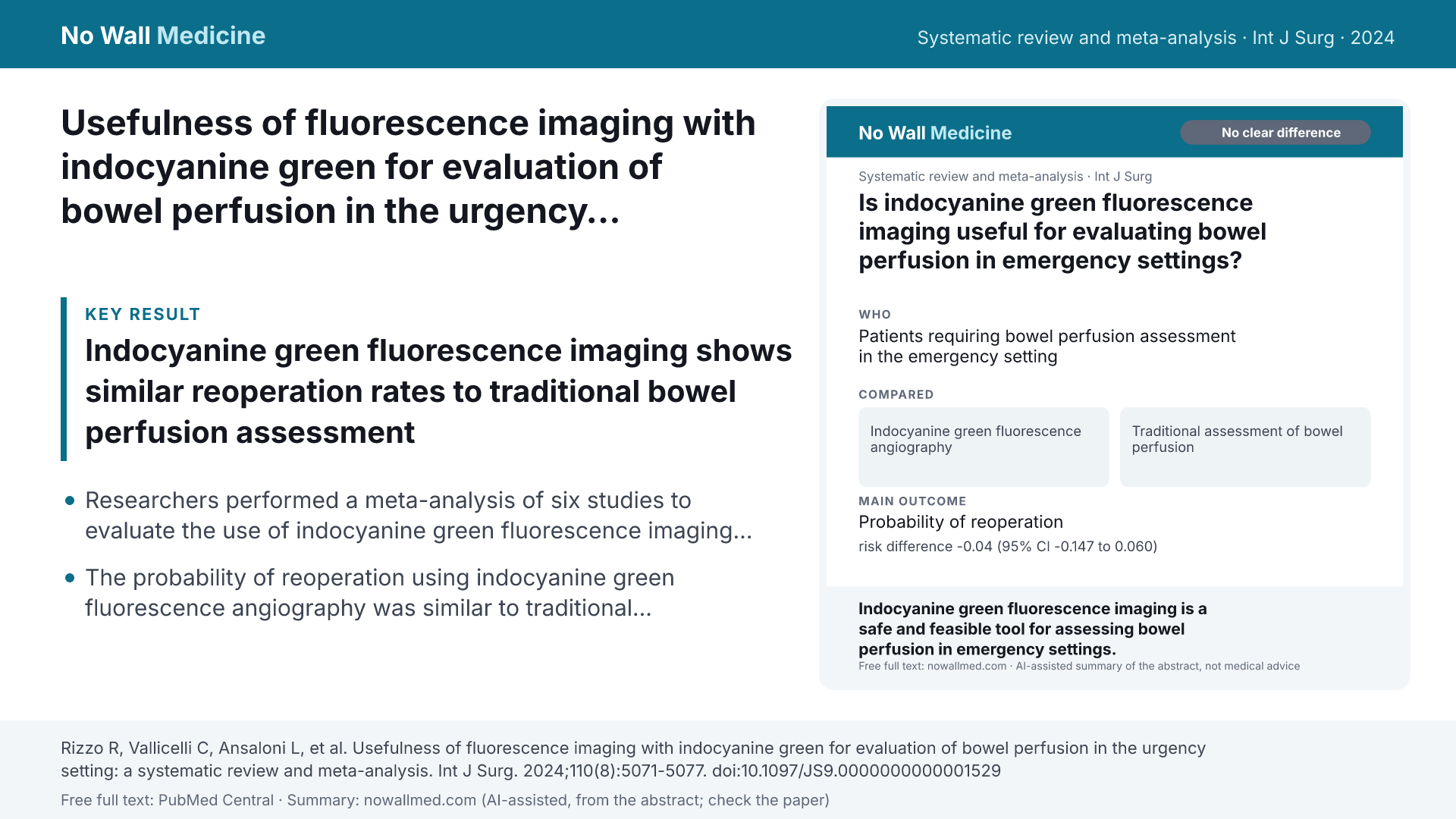
Indocyanine green fluorescence imaging shows similar reoperation rates to traditional bowel perfusion assessment
Usefulness of fluorescence imaging with indocyanine green for evaluation of bowel perfusion in the urgency setting: a systematic review and meta-analysis
Systematic review and meta-analysisNo clear difference
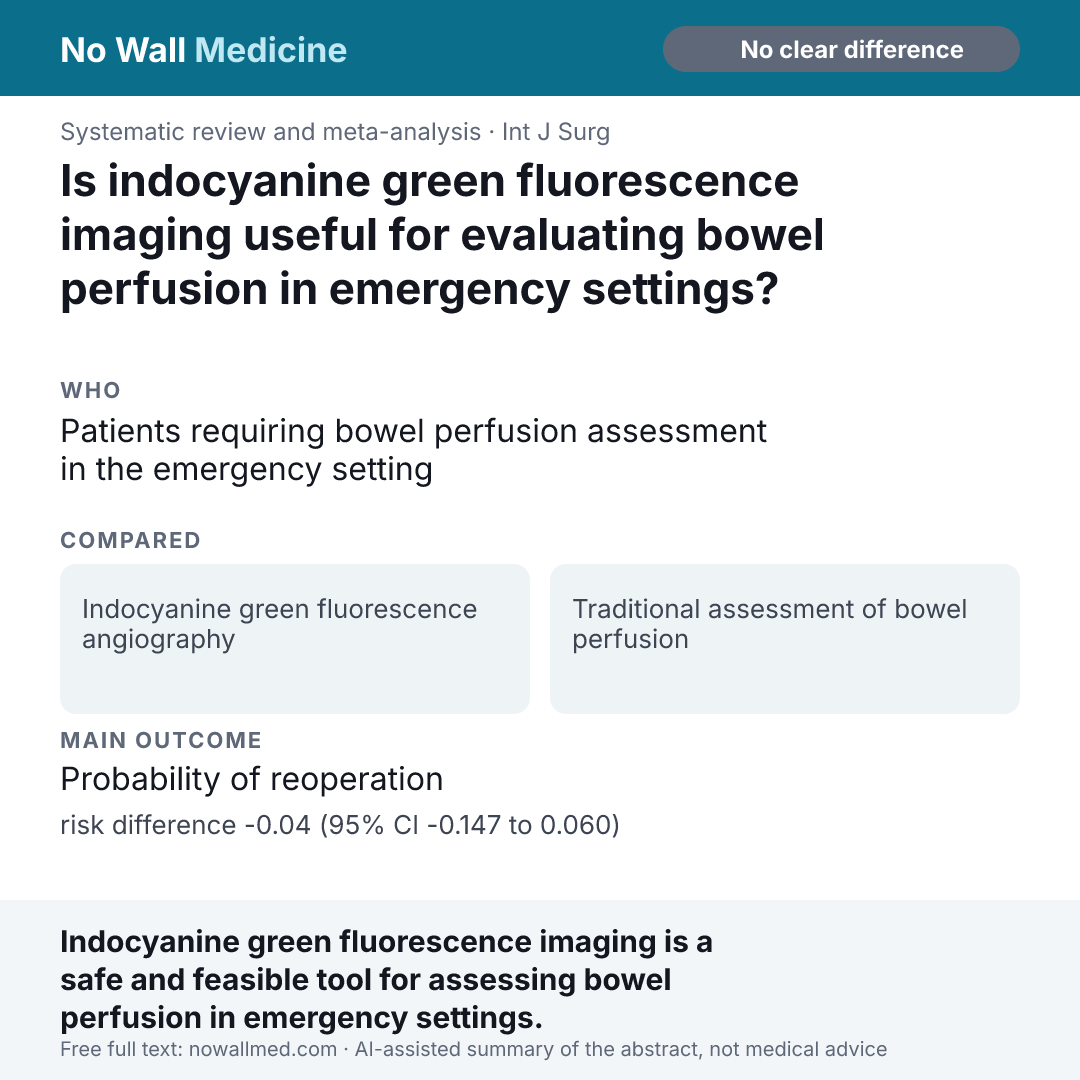
Is indocyanine green fluorescence imaging useful for evaluating bowel perfusion in emergency settings?
Who
Patients requiring bowel perfusion assessment in the emergency setting
Compared
Indocyanine green fluorescence angiography
Traditional assessment of bowel perfusion
Main outcome
Probability of reoperation
Result: risk difference -0.04 (95% CI -0.147 to 0.060)
Bottom line: Indocyanine green fluorescence imaging is a safe and feasible tool for assessing bowel perfusion in emergency settings.
Limitation: Heterogeneity was not negligible with a 59.9% of the I2 index.
Int J Surg · 2024-08-01 · Save PNG
Clinical question: Is indocyanine green fluorescence imaging useful for evaluating bowel perfusion in emergency settings?
Why it matters: Large prospective studies or randomized controlled trials evaluating the feasibility, safety, and utility of indocyanine green in emergency settings are lacking.
Key points
- Researchers performed a meta-analysis of six studies to evaluate the use of indocyanine green fluorescence imaging for assessing blood flow to the bowel in emergency settings.
- The probability of reoperation using indocyanine green fluorescence angiography was similar to traditional assessment, with a risk difference of -0.04 (95% CI: -0.147 to 0.060).
- The results were statistically significant with a P value of 0.029, though there was a 59.9% I2 index indicating non-negligible heterogeneity.
Limitation the authors note: The meta-analysis included only six studies and showed non-negligible heterogeneity with a 59.9% I2 index.
Headline and key points written with AI from the paper’s abstract, with every number checked against it. Read the paper before relying on them.
Was this summary helpful?
Subject terms
Headline, design, result, key points, caveat and citation as plain text.
Cite this article
Rizzo R, Vallicelli C, Ansaloni L, et al. Usefulness of fluorescence imaging with indocyanine green for evaluation of bowel perfusion in the urgency setting: a systematic review and meta-analysis. Int J Surg. 2024;110(8):5071-5077. doi:10.1097/JS9.0000000000001529
Spotted a mistake? Suggest a correction