Ketamine-induced brain connectivity changes resemble patterns seen in schizophrenia across the illness course
Validation of ketamine as a pharmacological model of thalamic dysconnectivity across the illness course of schizophrenia
Double-blind, placebo-controlled studyBenefit found
Does ketamine-induced thalamic dysconnectivity resemble the pattern seen in schizophrenia?
Who
Healthy volunteers and individuals with schizophrenia or clinical high-risk psychosis
Compared
Ketamine: robust thalamo-cortical hyper-connectivity with sensory and motor regions
Lamotrigine pre-treatment: not reduced by lamotrigine pre-treatment
Main outcome
thalamic dysconnectivity similarity coefficients
Bottom line: Ketamine reproduces the thalamic hyper-connectivity observed in schizophrenia across its illness course.
Mol Psychiatry · 2022-04-14 · Save PNG
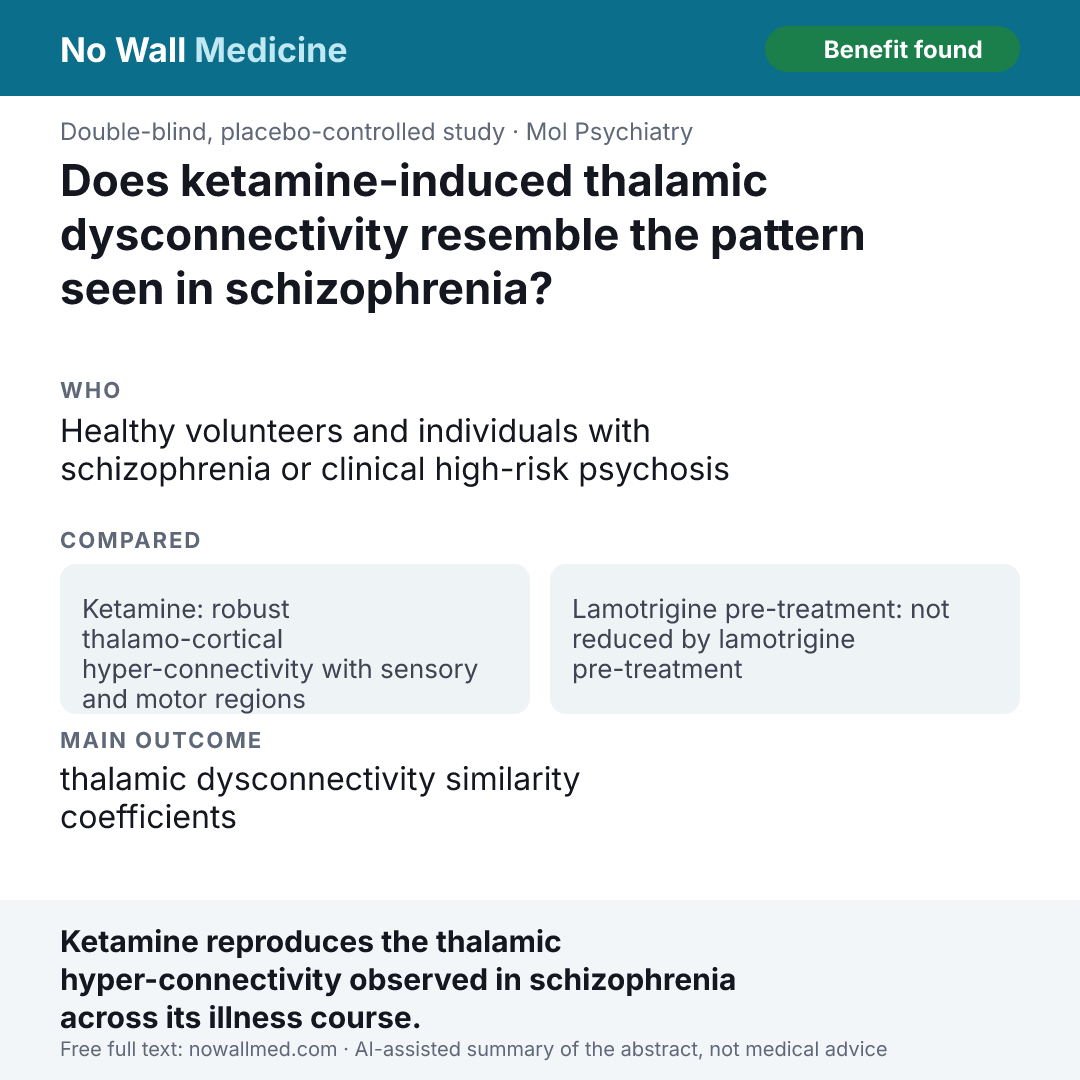
Clinical question: Does ketamine-induced thalamic dysconnectivity resemble the pattern seen in schizophrenia?
Why it matters: It was not directly tested to what extent ketamine-induced thalamic dysconnectivity resembles the thalamic dysconnectivity patterns observed in schizophrenia.
Key points
- Healthy volunteers receiving ketamine infusions showed thalamo-cortical hyper-connectivity with sensory and motor regions that was not reduced by the glutamate release inhibitor lamotrigine.
- Ketamine similarity coefficients were higher in people with chronic schizophrenia and early illness schizophrenia than in healthy controls, while clinical high-risk individuals showed an intermediate trend.
- Higher ketamine similarity coefficients were correlated with greater hallucination severity in people with schizophrenia.
Headline and key points written with AI from the paper’s abstract, with every number checked against it. Read the paper before relying on them.
Was this summary helpful?
Subject terms
Headline, design, result, key points, caveat and citation as plain text.
Cite this article
Abram SV, Roach BJ, Fryer SL, et al. Validation of ketamine as a pharmacological model of thalamic dysconnectivity across the illness course of schizophrenia. Mol Psychiatry. 2022;27(5):2448-2456. doi:10.1038/s41380-022-01502-0
Spotted a mistake? Suggest a correction