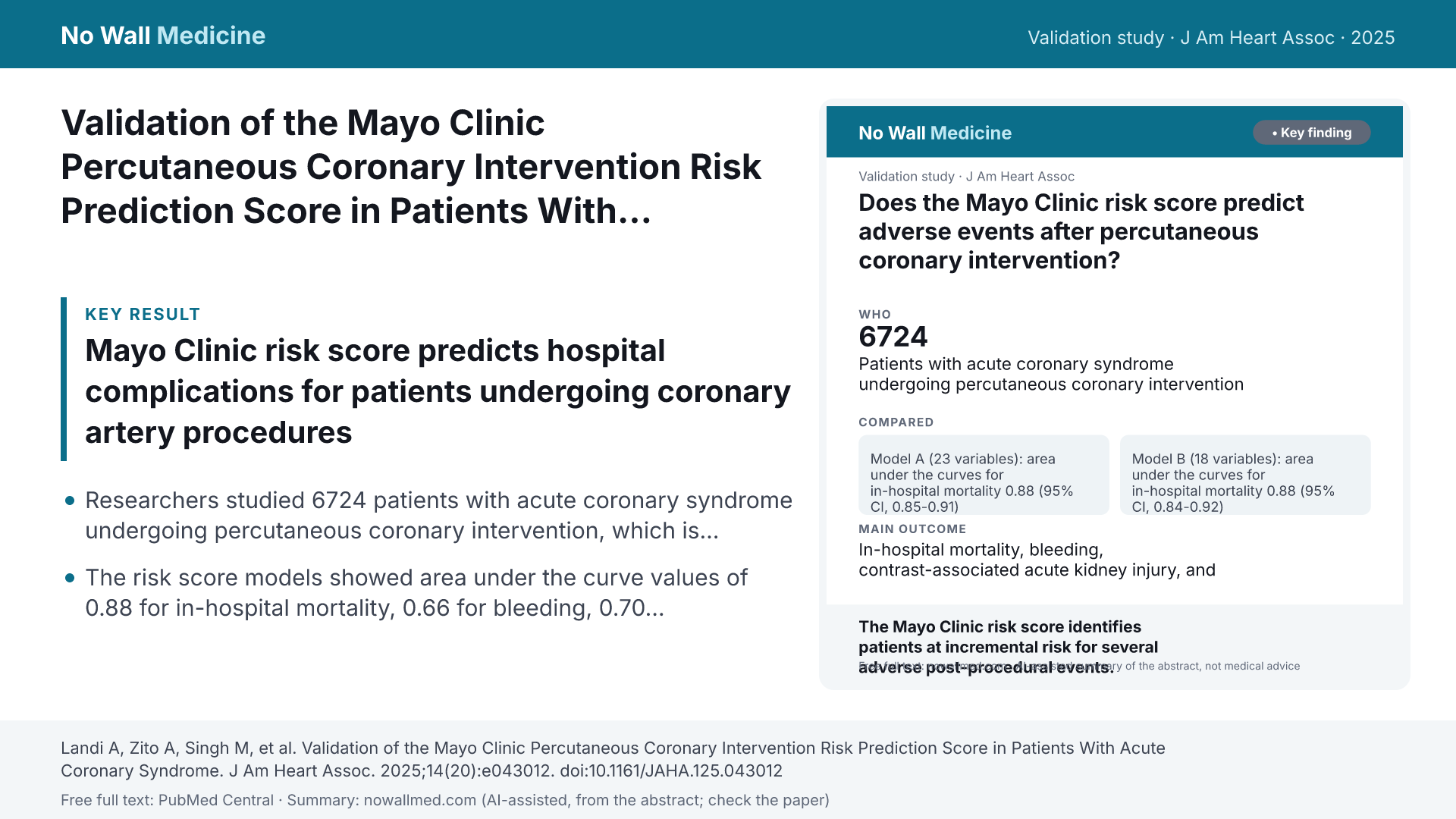
Mayo Clinic risk score predicts hospital complications for patients undergoing coronary artery procedures
Validation of the Mayo Clinic Percutaneous Coronary Intervention Risk Prediction Score in Patients With Acute Coronary Syndrome
Validation studyKey finding
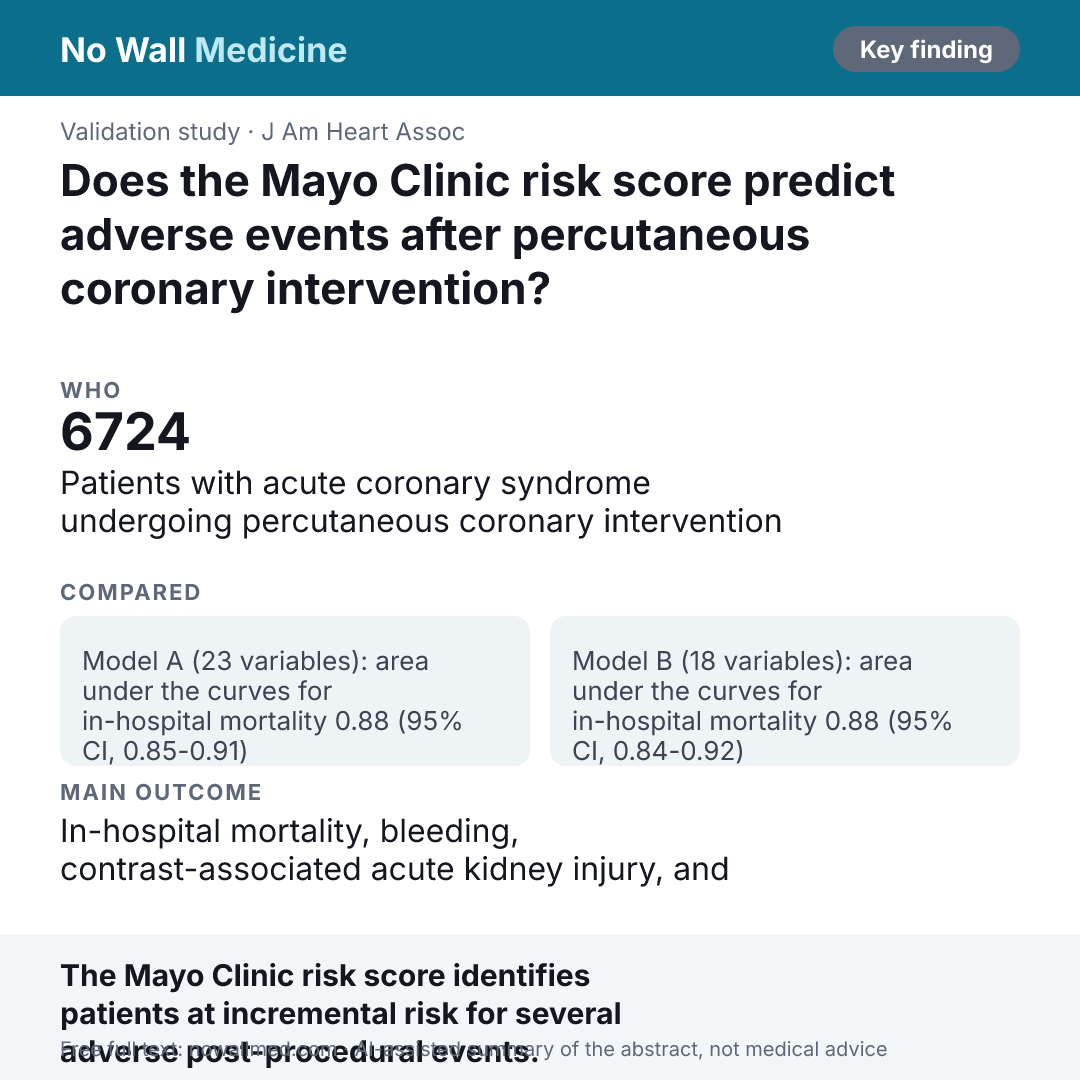
Does the Mayo Clinic risk score predict adverse events after percutaneous coronary intervention?
Who
6724
Patients with acute coronary syndrome undergoing percutaneous coronary intervention · MATRIX trial
Compared
Model A (23 variables): area under the curves for in-hospital mortality 0.88 (95% CI, 0.85-0.91)
Model B (18 variables): area under the curves for in-hospital mortality 0.88 (95% CI, 0.84-0.92)
Main outcome
In-hospital mortality, bleeding, contrast-associated acute kidney injury, and stroke
Bottom line: The Mayo Clinic risk score identifies patients at incremental risk for several adverse post-procedural events.
J Am Heart Assoc · 2025-10-09 · Save PNG
Same trial (NCT01433627)
Papers we list that report this registered trial, oldest first. Read a secondary analysis alongside the main results.
- Main results Key finding
Declining hemoglobin levels were associated with higher 1-year mortality in patients with acute coronary syndrome JACC 2021-01 - Related analysis Key finding
This paper J Am Heart Assoc 2025-10 - Related analysis Key finding
Fourth universal definition of heart attack after procedure predicts higher death risk in specific patients Circulation 2026-01
Clinical question: Does the Mayo Clinic risk score predict adverse events after percutaneous coronary intervention?
Why it matters: The Mayo Clinic risk score lacked external validation in patients specifically presenting with acute coronary syndrome.
Key points
- Researchers studied 6724 patients with acute coronary syndrome undergoing percutaneous coronary intervention, which is a procedure to open blocked heart arteries.
- The risk score models showed area under the curve values of 0.88 for in-hospital mortality, 0.66 for bleeding, 0.70 for contrast-associated acute kidney injury, and 0.65 for stroke.
- Higher risk score categories were associated with a gradual increase in 1-year mortality and bleeding risks.
Headline and key points written with AI from the paper’s abstract, with every number checked against it. Read the paper before relying on them.
Was this summary helpful?
Subject terms
Headline, design, result, key points, caveat and citation as plain text.
Cite this article
Landi A, Zito A, Singh M, et al. Validation of the Mayo Clinic Percutaneous Coronary Intervention Risk Prediction Score in Patients With Acute Coronary Syndrome. J Am Heart Assoc. 2025;14(20):e043012. doi:10.1161/JAHA.125.043012
Spotted a mistake? Suggest a correction