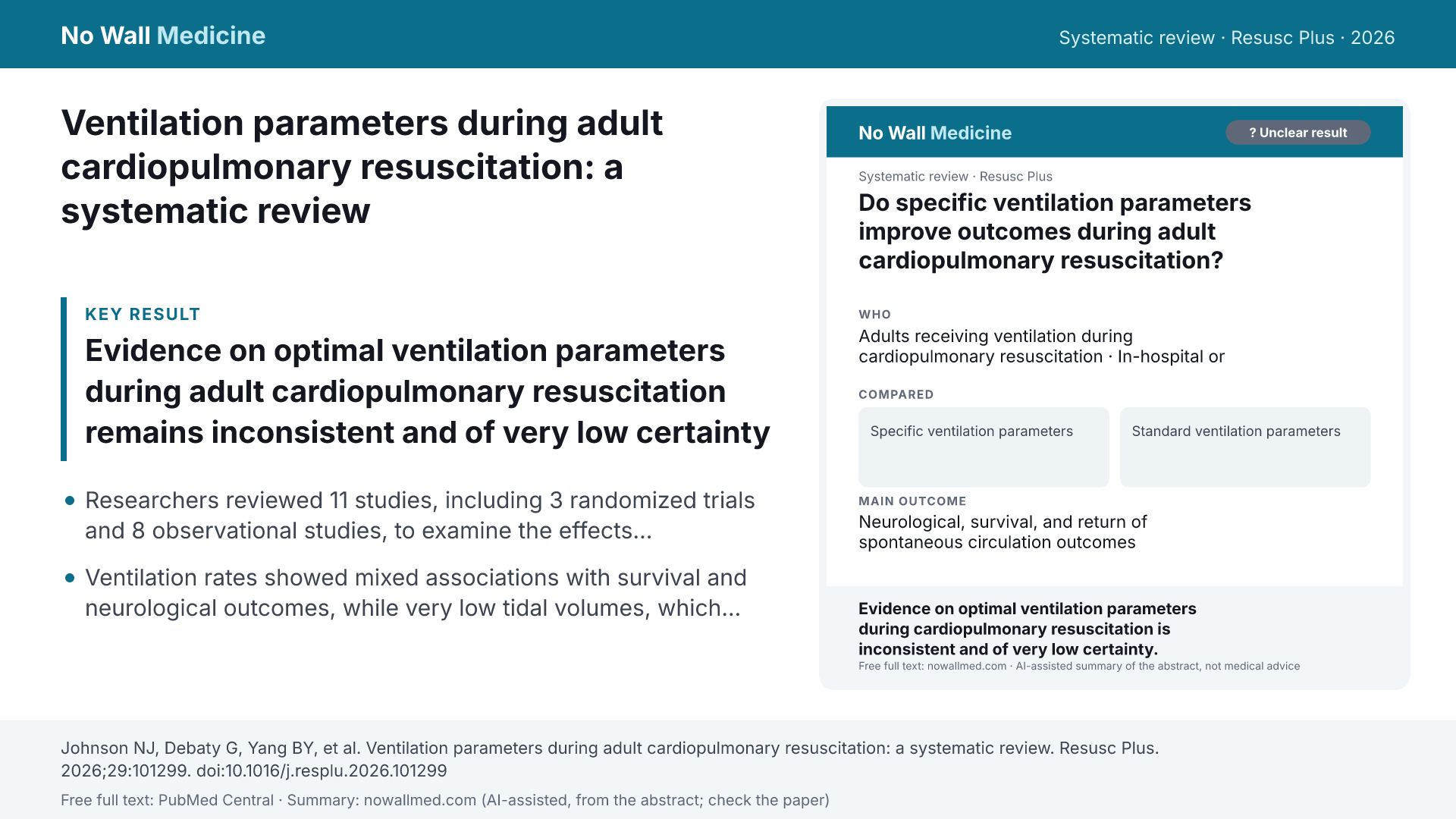
Evidence on optimal ventilation parameters during adult cardiopulmonary resuscitation remains inconsistent and of very low certainty
Ventilation parameters during adult cardiopulmonary resuscitation: a systematic review
Systematic reviewUnclear result
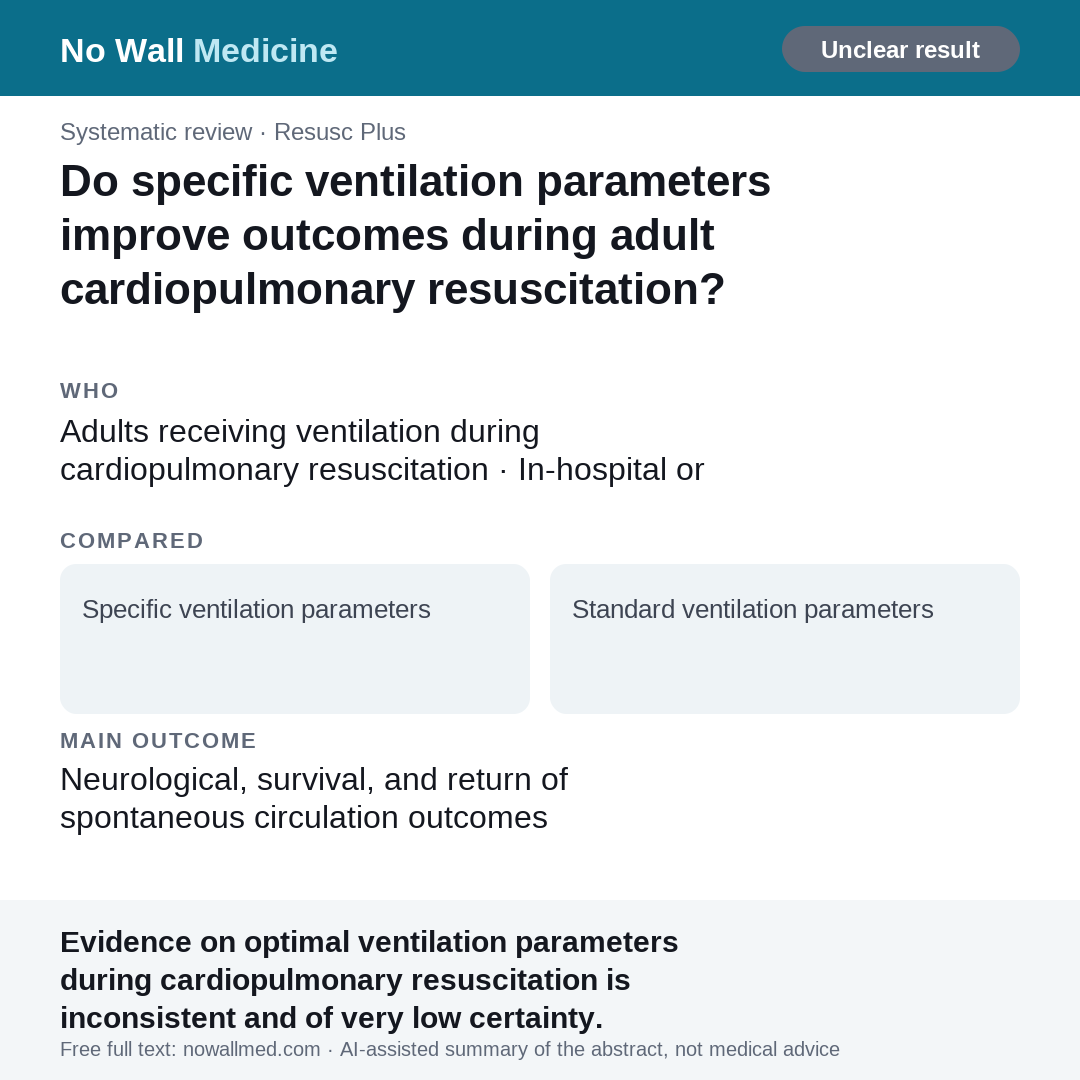
Do specific ventilation parameters improve outcomes during adult cardiopulmonary resuscitation?
Who
Adults receiving ventilation during cardiopulmonary resuscitation · In-hospital or out-of-hospital cardiac arrest
Compared
Specific ventilation parameters
Standard ventilation parameters
Main outcome
Neurological, survival, and return of spontaneous circulation outcomes
Bottom line: Evidence on optimal ventilation parameters during cardiopulmonary resuscitation is inconsistent and of very low certainty.
Limitation: Very low certainty limited by bias, inconsistency, indirectness, and imprecision.
Resusc Plus · 2026-03-27Download image
Clinical question: Do specific ventilation parameters improve outcomes during adult cardiopulmonary resuscitation?
Why it matters: There is limited evidence to guide the optimal respiratory rates, tidal volumes, inspiratory times, or positive end-expiratory pressure during cardiopulmonary resuscitation.
Key points
- Researchers reviewed 11 studies, including 3 randomized trials and 8 observational studies, to examine the effects of different ventilation rates, volumes, and pressures during adult cardiac arrest.
- Ventilation rates showed mixed associations with survival and neurological outcomes, while very low tidal volumes, which is the amount of air moved in one breath, were associated with worse outcomes in some studies.
- Higher survival and return of spontaneous circulation, which is the resumption of a heartbeat, were associated with impedance-detected ventilations occurring in ≥50% of chest compression pauses during 30:2 CPR.
Limitation the authors note: The certainty of evidence was very low due to bias, inconsistency, indirectness, and imprecision.
Headline and key points written with AI from the paper’s abstract, with every number checked against it. Read the paper before relying on them.
Was this summary helpful?
Cite this article
Johnson NJ, Debaty G, Yang BY, et al. Ventilation parameters during adult cardiopulmonary resuscitation: a systematic review. Resusc Plus. 2026. doi:10.1016/j.resplu.2026.101299
Spotted a mistake? Suggest a correction