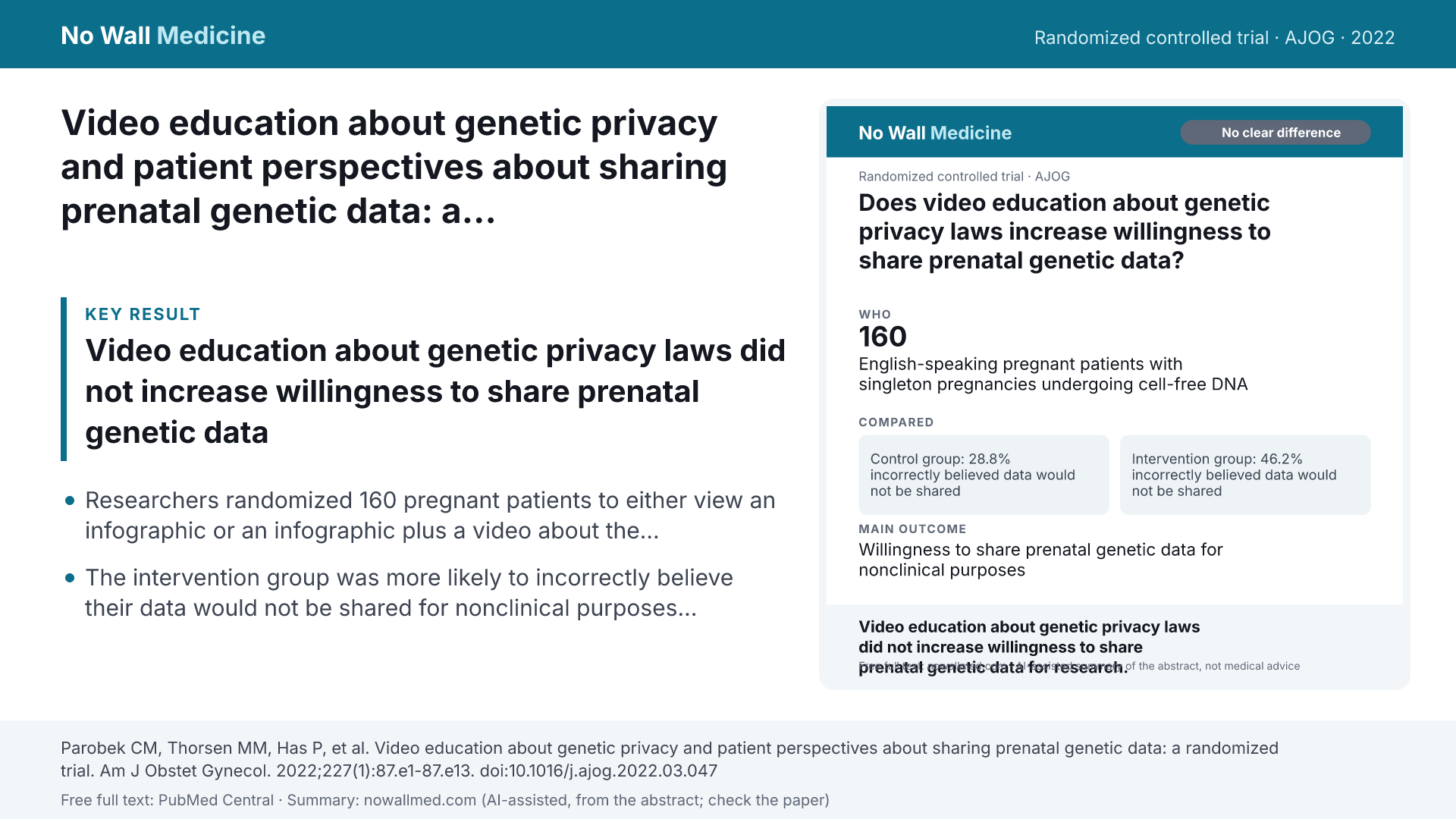
Video education about genetic privacy laws did not increase willingness to share prenatal genetic data
Video education about genetic privacy and patient perspectives about sharing prenatal genetic data: a randomized trial
Randomized controlled trialNo clear difference
Does video education about genetic privacy laws increase willingness to share prenatal genetic data?
Who
160
English-speaking pregnant patients with singleton pregnancies undergoing cell-free DNA screening
Compared
Control group: 28.8% incorrectly believed data would not be shared
Intervention group: 46.2% incorrectly believed data would not be shared
Main outcome
Willingness to share prenatal genetic data for nonclinical purposes
Bottom line: Video education about genetic privacy laws did not increase willingness to share prenatal genetic data for research.
AJOG · 2022-03-26Download image
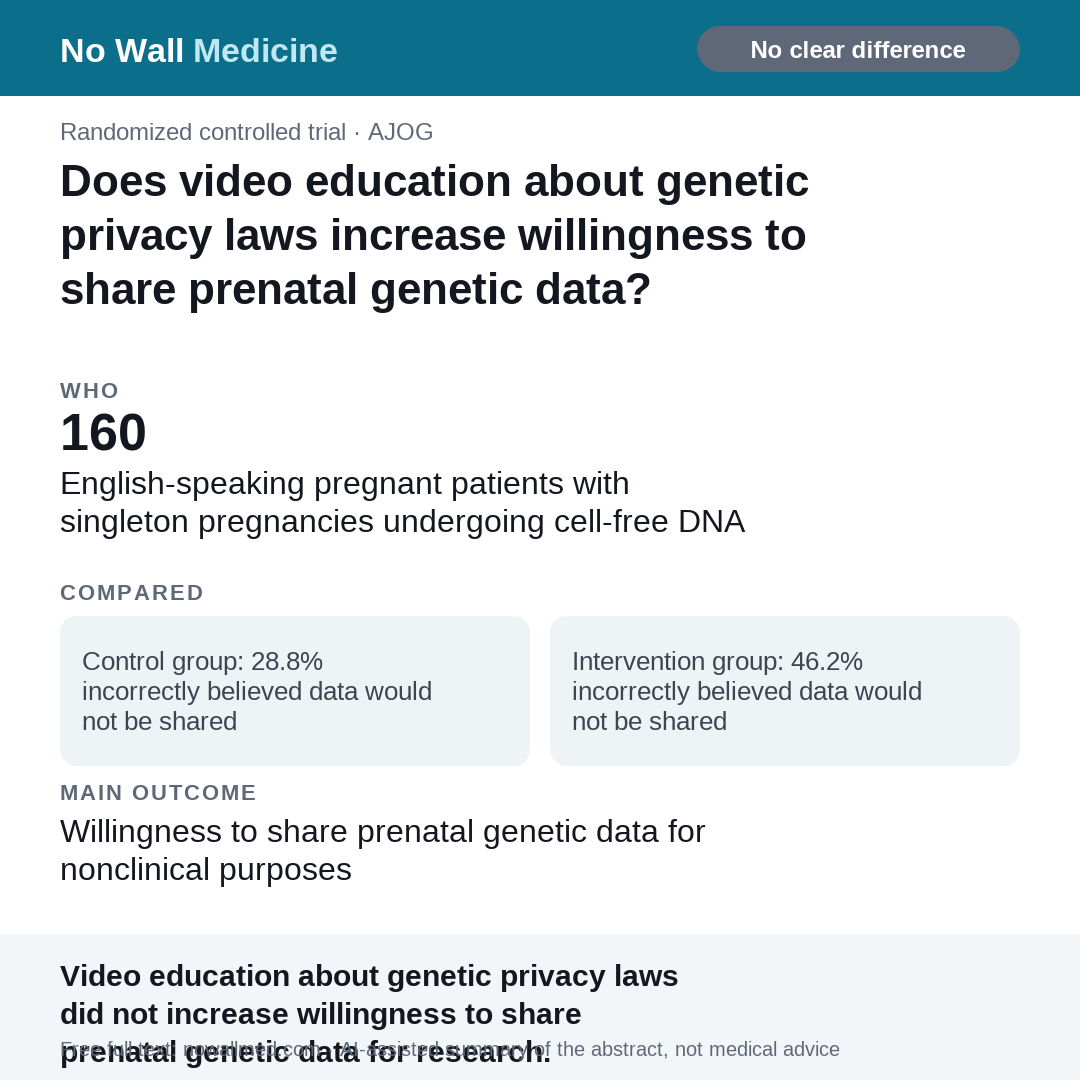
Clinical question: Does video education about genetic privacy laws increase willingness to share prenatal genetic data?
Key points
- Researchers randomized 160 pregnant patients to either view an infographic or an infographic plus a video about the Genetic Information Nondiscrimination Act.
- The intervention group was more likely to incorrectly believe their data would not be shared for nonclinical purposes than the control group (46.2% vs 28.8%).
- Video education did not increase participant willingness to share genetic data in multiple scenarios, and Non-White participants were less willing to allow sharing for academic research.
Headline and key points written with AI from the paper’s abstract, with every number checked against it. Read the paper before relying on them.
Was this summary helpful?
Subject terms
Cite this article
Parobek CM, Thorsen MM, Has P, et al. Video education about genetic privacy and patient perspectives about sharing prenatal genetic data: a randomized trial. AJOG. 2022. doi:10.1016/j.ajog.2022.03.047
Spotted a mistake? Suggest a correction