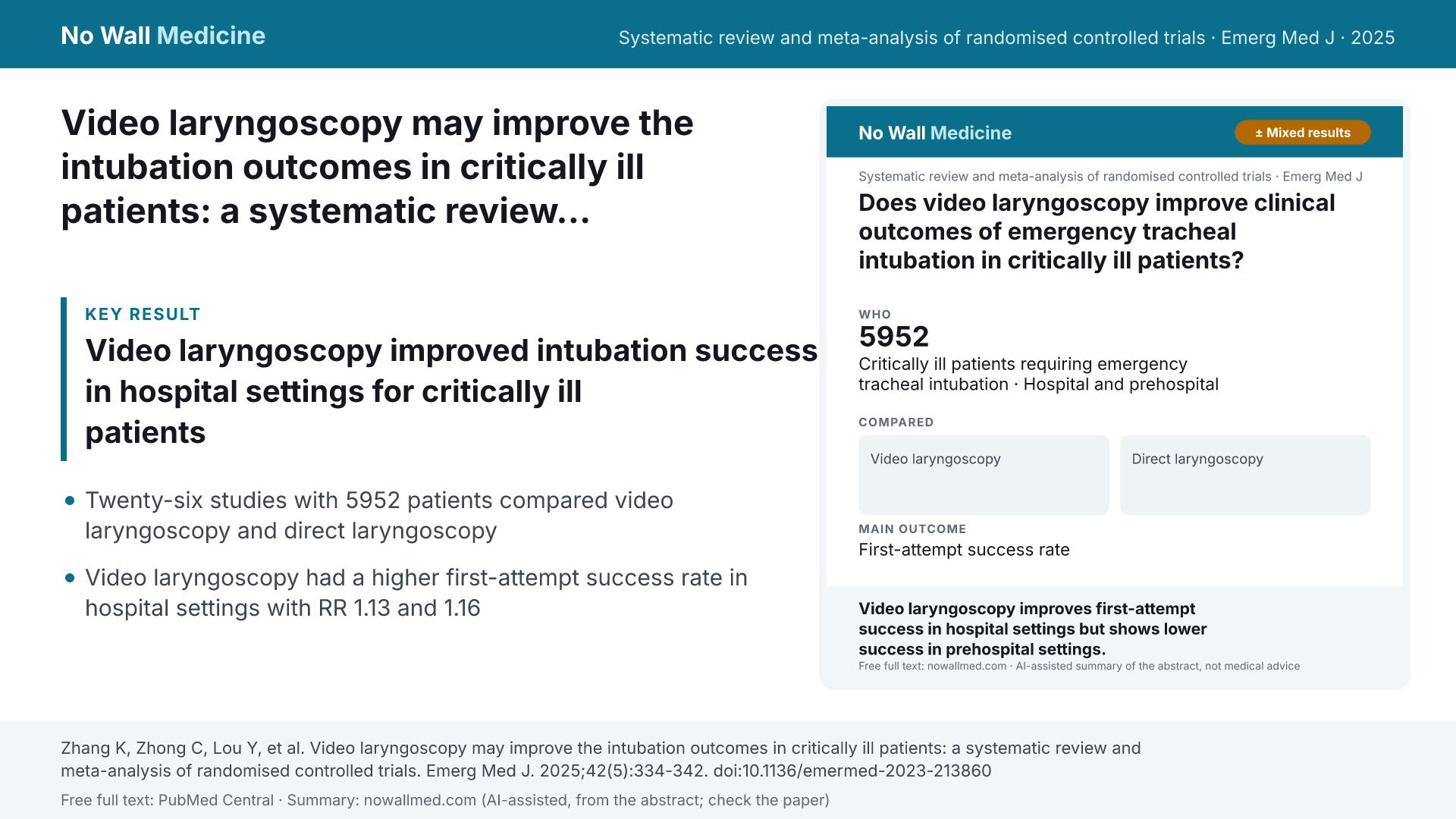
Video laryngoscopy improved intubation success in hospital settings for critically ill patients
Video laryngoscopy may improve the intubation outcomes in critically ill patients: a systematic review and meta-analysis of randomised controlled trials
Systematic review and meta-analysis of randomised controlled trialsMixed results
Does video laryngoscopy improve clinical outcomes of emergency tracheal intubation in critically ill patients?
Who
5952
Critically ill patients requiring emergency tracheal intubation · Hospital and prehospital settings
Compared
Video laryngoscopy
Direct laryngoscopy
Main outcome
First-attempt success rate
Result: RR 1.05, 95% CI 0.97 to 1.13
Bottom line: Video laryngoscopy improves first-attempt success in hospital settings but shows lower success in prehospital settings.
Limitation: High heterogeneity was observed in several outcomes (I2 up to 95%).
Emerg Med J · 2025-04-22 · Save PNG
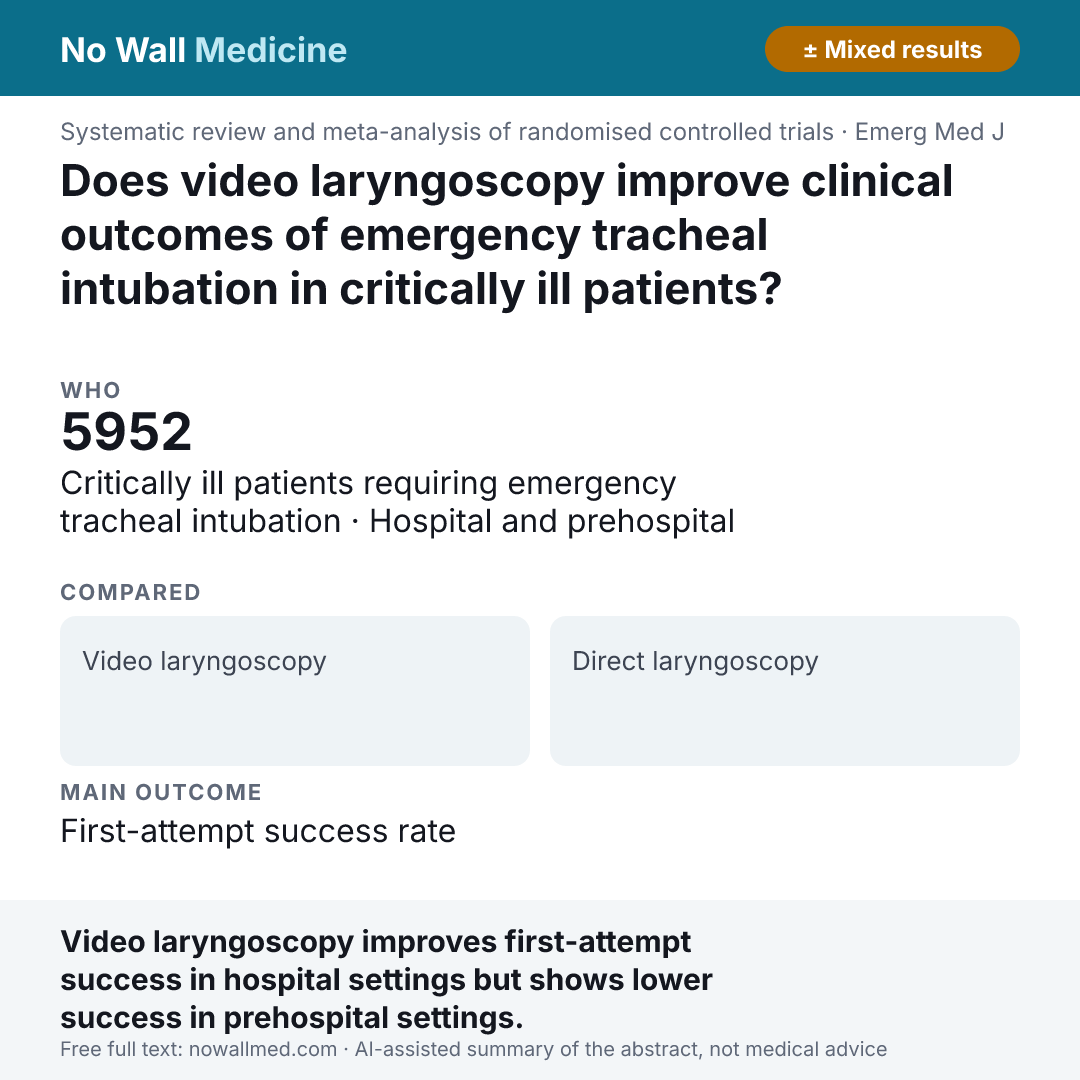
Clinical question: Does video laryngoscopy improve clinical outcomes of emergency tracheal intubation in critically ill patients?
Why it matters: The role of video laryngoscopy in critically ill patients remains controversial
Key points
- Twenty-six studies with 5952 patients compared video laryngoscopy and direct laryngoscopy.
- Video laryngoscopy had a higher first-attempt success rate in hospital settings with RR 1.13 and 1.16.
- Video laryngoscopy also provided better glottic visualisation and reduced oesophageal intubation.
Limitation the authors note: The analysis had high heterogeneity with I2 values ranging from 68% to 95%
Headline and key points written with AI from the paper’s abstract, with every number checked against it. Read the paper before relying on them.
Was this summary helpful?
Abstract
Background
The role of video laryngoscopy in critically ill patients requiring emergency tracheal intubation remains controversial. This systematic review and meta-analysis aimed to evaluate whether video laryngoscopy could improve the clinical outcomes of emergency tracheal intubation. Methods
We searched the PubMed, Embase, Scopus and Cochrane databases up to 5 September 2024. Randomised controlled trials comparing video laryngoscopy with direct laryngoscopy for emergency tracheal intubation were analysed. The primary outcome was the first-attempt success rate, while secondary outcomes included intubation time, glottic visualisation, in-hospital mortality and complications. Results
Twenty-six studies (6 in prehospital settings and 20 in hospital settings) involving 5952 patients were analysed in this study. Fifteen studies had low risk of bias. Overall, there was no significant difference in first-attempt success rate between two groups (RR 1.05, 95% CI 0.97 to 1.13, p=0.24, I2=89%). However, video laryngoscopy was associated with a higher first-attempt success rate in hospital settings (emergency department: RR 1.13, 95% CI 1.03 to 1.23, p=0.007, I2=85%; intensive care unit: RR 1.16, 95% CI 1.05 to 1.29, p=0.003, I2=68%) and among inexperienced operators (RR 1.15, 95% CI 1.03 to 1.28, p=0.01, I2=72%). Conversely, the first-attempt success rate with video laryngoscopy was lower in prehospital settings (RR 0.75, 95% CI 0.57 to 0.99, p=0.04, I2=95%). There were no differences for other outcomes except for better glottic visualisation (RR 1.11, 95% CI 1.03 to 1.20, p=0.005, I2=91%) and a lower incidence of oesophageal intubation (RR 0.42, 95% CI 0.24 to 0.71, p=0.001, I2=0%) when using video laryngoscopy. Conclusions
In hospital settings, video laryngoscopy improved first-attempt success rate of emergency intubation, provided superior glottic visualisation and reduced incidence of oesophageal intubation in critically ill patients. Our findings support the routine use of video laryngoscopy in the emergency department and intensive care units. Prospero registration number
CRD 42023461887.
Abstract reproduced under the article’s CC BY NC licence.
Subject terms
Headline, design, result, key points, caveat and citation as plain text.
Cite this article
Zhang K, Zhong C, Lou Y, et al. Video laryngoscopy may improve the intubation outcomes in critically ill patients: a systematic review and meta-analysis of randomised controlled trials. Emerg Med J. 2025;42(5):334-342. doi:10.1136/emermed-2023-213860
Spotted a mistake? Suggest a correction