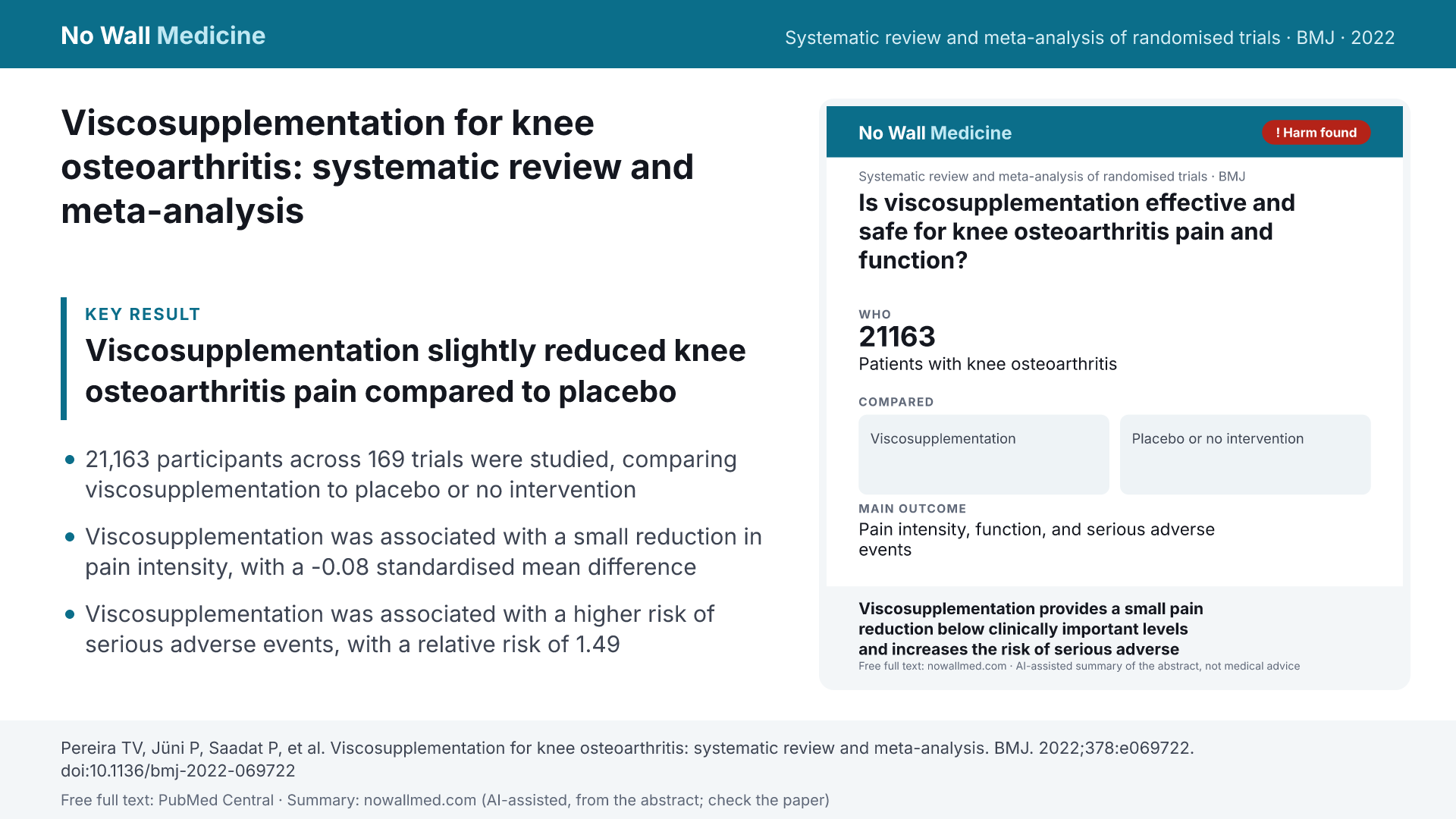
Viscosupplementation slightly reduced knee osteoarthritis pain compared to placebo
Viscosupplementation for knee osteoarthritis: systematic review and meta-analysis
Systematic review and meta-analysis of randomised trialsHarm found
Is viscosupplementation effective and safe for knee osteoarthritis pain and function?
Who
21163
Patients with knee osteoarthritis
Compared
Viscosupplementation
Placebo or no intervention
Main outcome
Pain intensity, function, and serious adverse events
Result: SMD -0.08 (95% confidence interval -0.15 to -0.02)
Bottom line: Viscosupplementation provides a small pain reduction below clinically important levels and increases the risk of serious adverse events.
Limitation: Evidence of small study effects and publication biases was observed for pain and function.
BMJ · 2022-07-06 · Save PNG
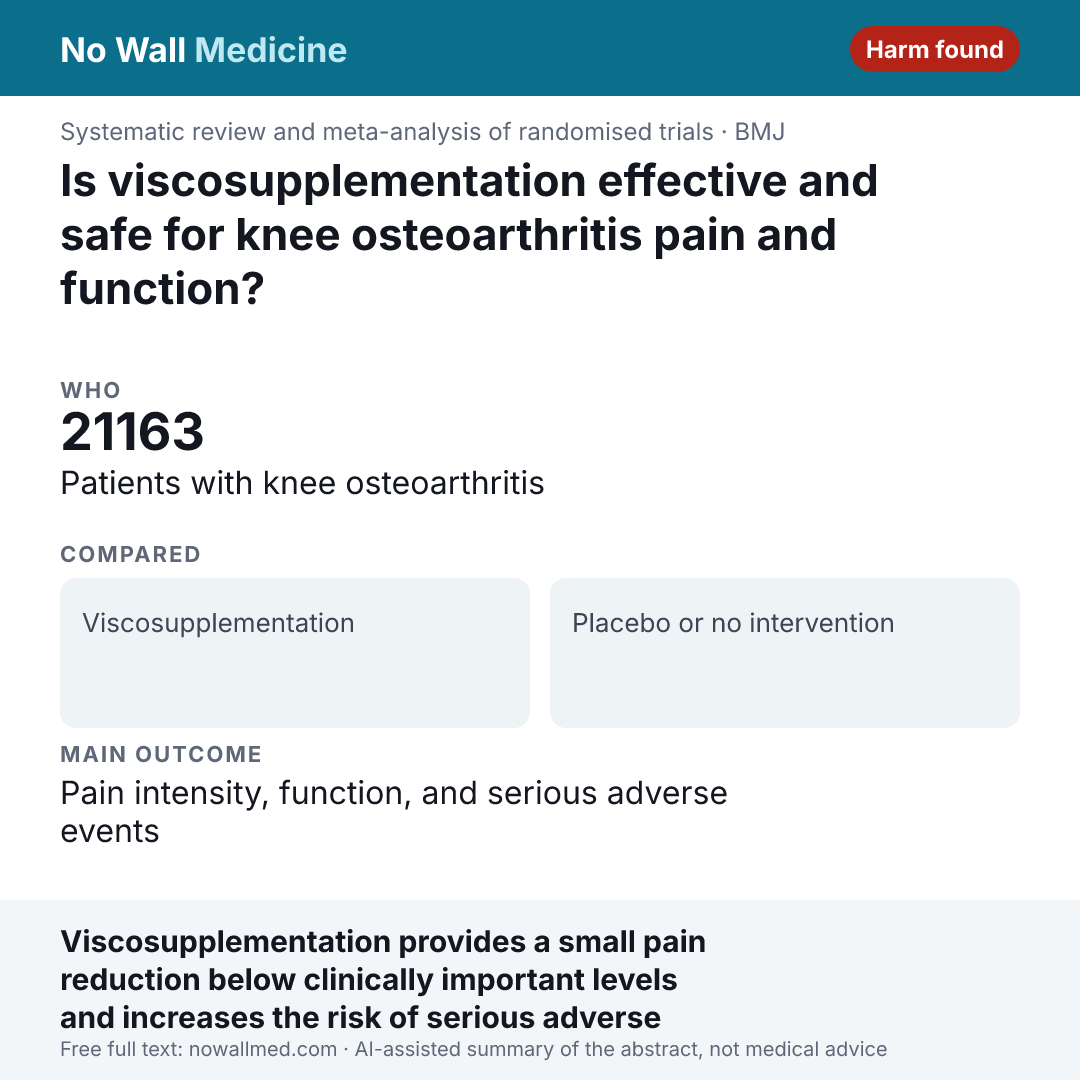
Clinical question: Is viscosupplementation effective and safe for knee osteoarthritis pain and function?
Key points
- 21,163 participants across 169 trials were studied, comparing viscosupplementation to placebo or no intervention.
- Viscosupplementation was associated with a small reduction in pain intensity, with a -0.08 standardised mean difference.
- Viscosupplementation was associated with a higher risk of serious adverse events, with a relative risk of 1.49.
Limitation the authors note: Evidence of small study effects and publication biases was observed for pain and function
Headline and key points written with AI from the paper’s abstract, with every number checked against it. Read the paper before relying on them.
Was this summary helpful?
Abstract
Objective
To evaluate the effectiveness and safety of viscosupplementation for pain and function in patients with knee osteoarthritis. Design
Systematic review and meta-analysis of randomised trials. Data sources
Searches were conducted of Medline, Embase, and the Cochrane Central Register of Controlled Trials (CENTRAL) databases from inception to 11 September 2021. Unpublished trials were identified from the grey literature and trial registries. Eligibility criteria for study selection
Randomised trials comparing viscosupplementation with placebo or no intervention for knee osteoarthritis treatment. Main outcome measures
The prespecified primary outcome was pain intensity. Secondary outcomes were function and serious adverse events. Pain and function were analysed as standardised mean differences (SMDs). The prespecified minimal clinically important between group difference was -0.37 SMD. Serious adverse events were analysed as relative risks. Methods
Two reviewers independently extracted relevant data and assessed the risk of bias of trials using the Cochrane risk of bias tool. The predefined main analysis was based only on large, placebo controlled trials with ≥100 participants per group. Summary results were obtained through a random effects meta-analysis model. Cumulative meta-analysis and trial sequential analysis under a random effects model were also performed. Results
169 trials provided data on 21 163 randomised participants. Evidence of small study effects and publication biases was observed for pain and function (Egger's tests with P<0.001 and asymmetric funnel plots). Twenty four large, placebo controlled trials (8997 randomised participants) included in the main analysis of pain indicated that viscosupplementation was associated with a small reduction in pain intensity compared with placebo (SMD -0.08, 95% confidence interval -0.15 to -0.02), with the lower bound of the 95% confidence interval excluding the minimal clinically important between group difference. This effect corresponds to a difference in pain scores of -2.0 mm (95% confidence interval -3.8 to -0.5 mm) on a 100 mm visual analogue scale. Trial sequential analysis for pain indicated that since 2009 there has been conclusive evidence of clinical equivalence between viscosupplementation and placebo. Similar conclusions were obtained for function. Based on 15 large, placebo controlled trials on 6462 randomised participants, viscosupplementation was associated with a statistically significant higher risk of serious adverse events than placebo (relative risk 1.49, 95% confidence interval 1.12 to 1.98). Conclusion
Strong conclusive evidence indicates that viscosupplementation leads to a small reduction in knee osteoarthritis pain compared with placebo, but the difference is less than the minimal clinically important between group difference. Strong conclusive evidence indicates that viscosupplementation is also associated with an increased risk of serious adverse events compared with placebo. The findings do not support broad use of viscosupplementation for the treatment of knee osteoarthritis. Systematic review registration
PROSPERO CRD42021236894.
Abstract reproduced under the article’s CC BY NC licence.
Subject terms
Headline, design, result, key points, caveat and citation as plain text.
Cite this article
Pereira TV, Jüni P, Saadat P, et al. Viscosupplementation for knee osteoarthritis: systematic review and meta-analysis. BMJ. 2022. doi:10.1136/bmj-2022-069722
Spotted a mistake? Suggest a correction