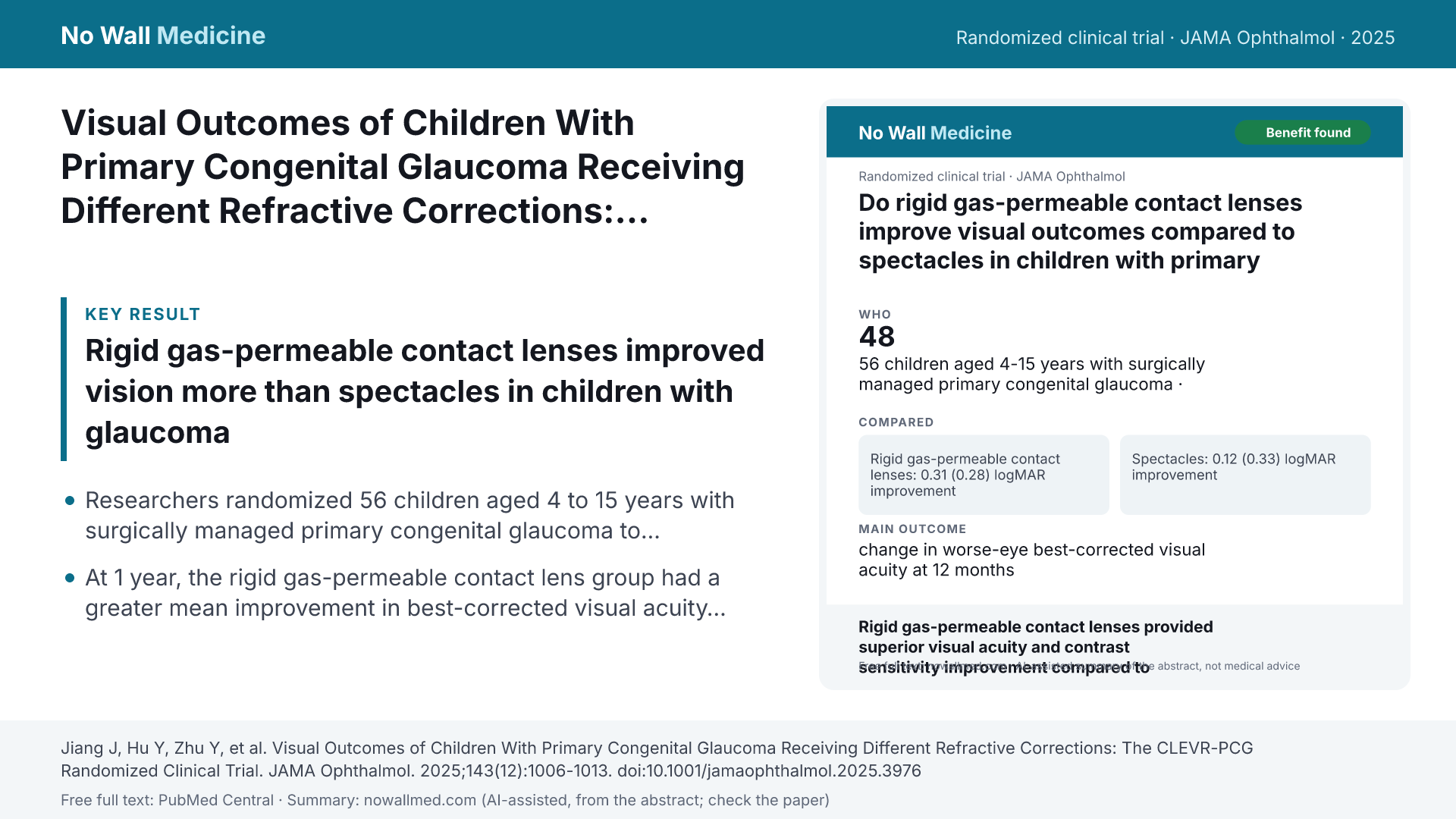
Rigid gas-permeable contact lenses improved vision more than spectacles in children with glaucoma
Visual Outcomes of Children With Primary Congenital Glaucoma Receiving Different Refractive Corrections: The CLEVR-PCG Randomized Clinical Trial
Randomized clinical trialBenefit found
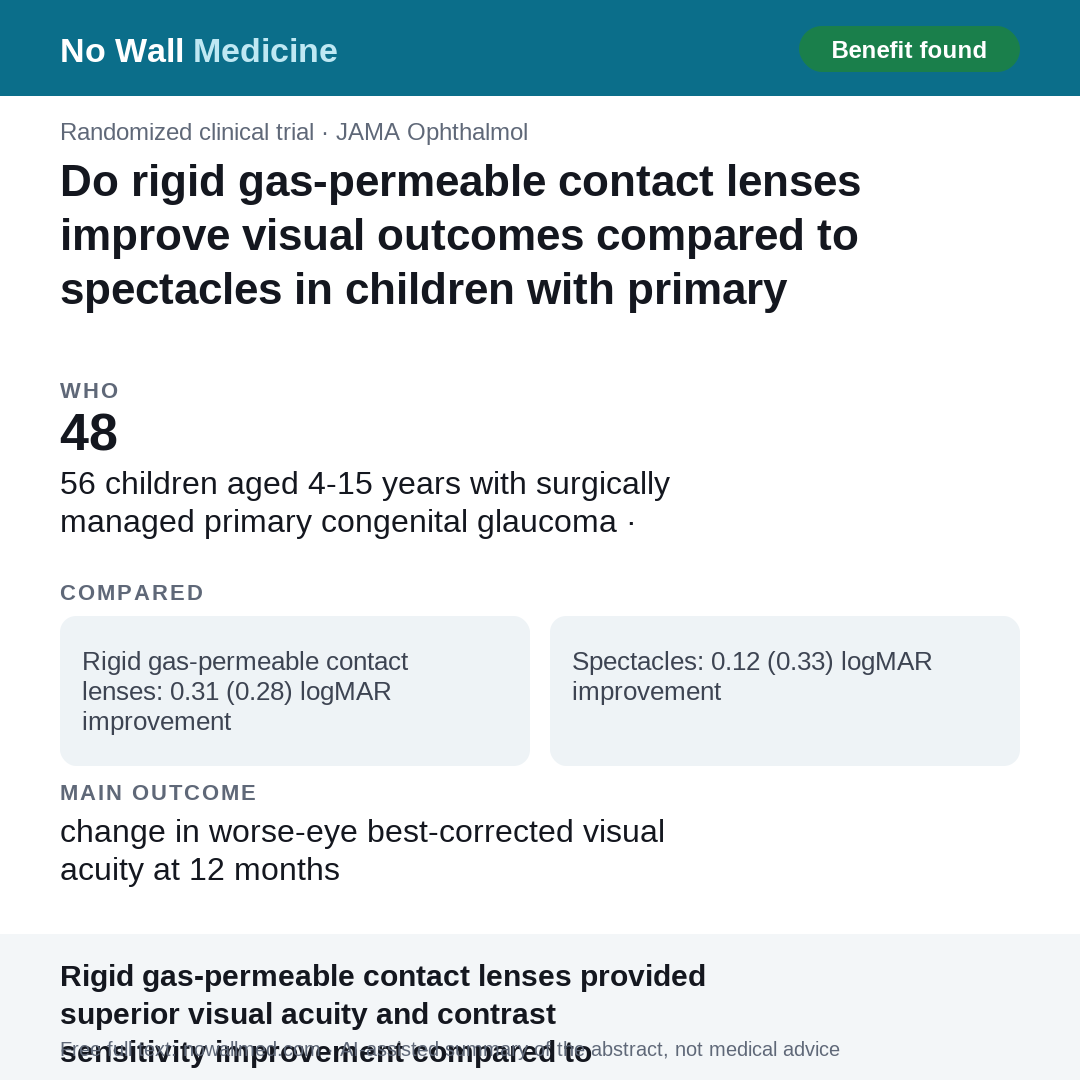
Do rigid gas-permeable contact lenses improve visual outcomes compared to spectacles in children with primary congenital glaucoma?
Who
48
56 children aged 4-15 years with surgically managed primary congenital glaucoma · Guangzhou, China
Compared
Rigid gas-permeable contact lenses: 0.31 (0.28) logMAR improvement
Spectacles: 0.12 (0.33) logMAR improvement
Main outcome
change in worse-eye best-corrected visual acuity at 12 months
Result: adjusted treatment difference, -0.19 logMAR; 95% CI, -0.36 to -0.02 logMAR
Bottom line: Rigid gas-permeable contact lenses provided superior visual acuity and contrast sensitivity improvement compared to spectacles for children after primary congenital glaucoma surgery.
JAMA Ophthalmol · 2025-11-06Download image
Clinical question: Do rigid gas-permeable contact lenses improve visual outcomes compared to spectacles in children with primary congenital glaucoma?
Why it matters: Children with primary congenital glaucoma often have residual visual impairment after surgery, and evidence is needed to compare rigid gas-permeable contact lenses to spectacles for rehabilitation.
Key points
- Researchers randomized 56 children aged 4 to 15 years with surgically managed primary congenital glaucoma to receive either rigid gas-permeable contact lenses or spectacles for 12 months.
- At 1 year, the rigid gas-permeable contact lens group had a greater mean improvement in best-corrected visual acuity of 0.31 logMAR compared to 0.12 logMAR in the spectacles group.
- The contact lens group also showed greater improvement in contrast sensitivity function and a higher rate of achieving near stereoacuity of 60 arcseconds or less.
Headline and key points written with AI from the paper’s abstract, with every number checked against it. Read the paper before relying on them.
Was this summary helpful?
Subject terms
Cite this article
Jiang J, Hu Y, Zhu Y, et al. Visual Outcomes of Children With Primary Congenital Glaucoma Receiving Different Refractive Corrections: The CLEVR-PCG Randomized Clinical Trial. JAMA Ophthalmol. 2025;143(12):1006-1013. doi:10.1001/jamaophthalmol.2025.3976
Spotted a mistake? Suggest a correction