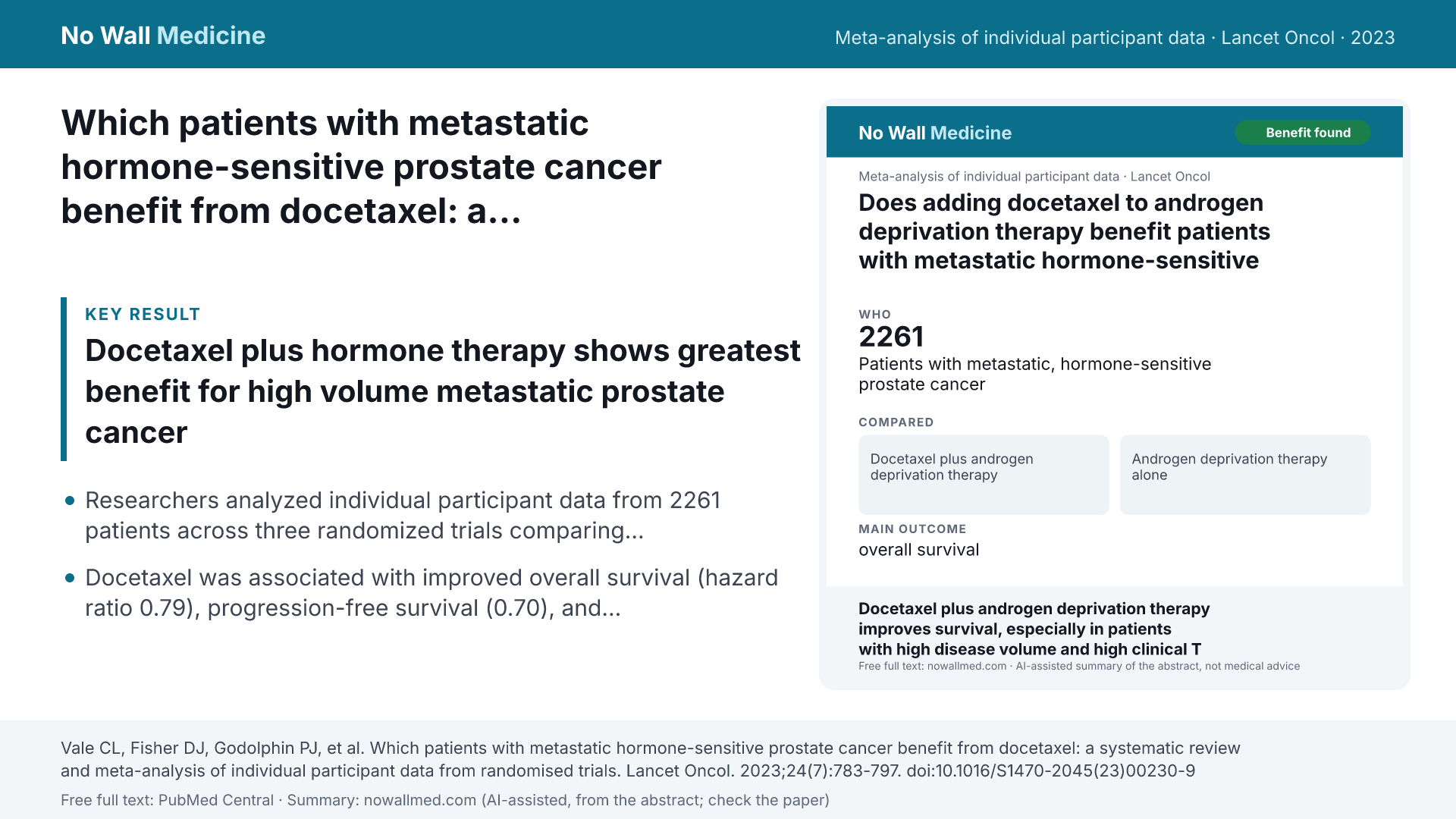
Docetaxel plus hormone therapy shows greatest benefit for high volume metastatic prostate cancer
Which patients with metastatic hormone-sensitive prostate cancer benefit from docetaxel: a systematic review and meta-analysis of individual participant data from randomised trials
Meta-analysis of individual participant dataBenefit found
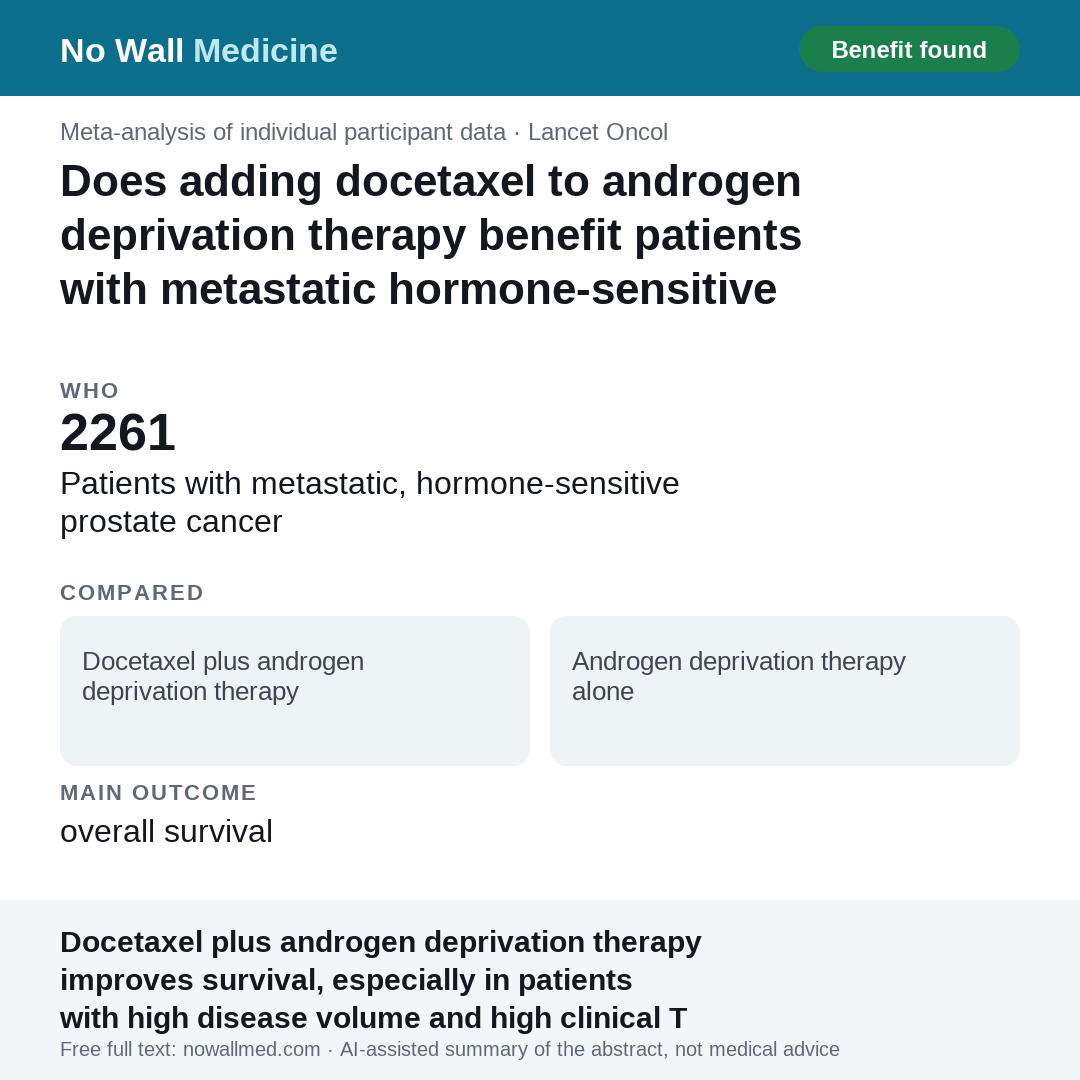
Does adding docetaxel to androgen deprivation therapy benefit patients with metastatic hormone-sensitive prostate cancer?
Who
2261
Patients with metastatic, hormone-sensitive prostate cancer
Compared
Docetaxel plus androgen deprivation therapy
Androgen deprivation therapy alone
Main outcome
overall survival
Result: hazard ratio 0·79, 95% CI 0·70 to 0·88
Bottom line: Docetaxel plus androgen deprivation therapy improves survival, especially in patients with high disease volume and high clinical T stage.
Limitation: Individual participant data were not obtained from two additional small trials.
Lancet Oncol · 2023-07-07Download image
Clinical question: Does adding docetaxel to androgen deprivation therapy benefit patients with metastatic hormone-sensitive prostate cancer?
Why it matters: It is unknown which specific patients with metastatic, hormone-sensitive prostate cancer benefit most from adding docetaxel to androgen deprivation therapy.
Key points
- Researchers analyzed individual participant data from 2261 patients across three randomized trials comparing docetaxel plus androgen deprivation therapy to androgen deprivation therapy alone.
- Docetaxel was associated with improved overall survival (hazard ratio 0.79), progression-free survival (0.70), and failure-free survival (0.64) with 5-year absolute improvements of approximately 9-11%.
- The largest 5-year absolute improvements occurred in patients with high-volume, clinical T stage 4 disease, showing 27% for progression-free survival and 35% for overall survival.
Limitation the authors note: Individual participant data were not obtained from two additional small trials.
Headline and key points written with AI from the paper’s abstract, with every number checked against it. Read the paper before relying on them.
Was this summary helpful?
Abstract
Background
Adding docetaxel to androgen deprivation therapy (ADT) improves survival in patients with metastatic, hormone-sensitive prostate cancer, but uncertainty remains about who benefits most. We therefore aimed to obtain up-to-date estimates of the overall effects of docetaxel and to assess whether these effects varied according to prespecified characteristics of the patients or their tumours. Methods
The STOPCAP M1 collaboration conducted a systematic review and meta-analysis of individual participant data. We searched MEDLINE (from database inception to March 31, 2022), Embase (from database inception to March 31, 2022), the Cochrane Central Register of Controlled Trials (from database inception to March 31, 2022), proceedings of relevant conferences (from Jan 1, 1990, to Dec 31, 2022), and ClinicalTrials.gov (from database inception to March 28, 2023) to identify eligible randomised trials that assessed docetaxel plus ADT compared with ADT alone in patients with metastatic, hormone-sensitive prostate cancer. Detailed and updated individual participant data were requested directly from study investigators or through relevant repositories. The primary outcome was overall survival. Secondary outcomes were progression-free survival and failure-free survival. Overall pooled effects were estimated using an adjusted, intention-to-treat, two-stage, fixed-effect meta-analysis, with one-stage and random-effects sensitivity analyses. Missing covariate values were imputed. Differences in effect by participant characteristics were estimated using adjusted two-stage, fixed-effect meta-analysis of within-trial interactions on the basis of progression-free survival to maximise power. Identified effect modifiers were also assessed on the basis of overall survival. To explore multiple subgroup interactions and derive subgroup-specific absolute treatment effects we used one-stage flexible parametric modelling and regression standardisation. We assessed the risk of bias using the Cochrane Risk of Bias 2 tool. This study is registered with PROSPERO, CRD42019140591. Findings
We obtained individual participant data from 2261 patients (98% of those randomised) from three eligible trials (GETUG-AFU15, CHAARTED, and STAMPEDE trials), with a median follow-up of 72 months (IQR 55-85). Individual participant data were not obtained from two additional small trials. Based on all included trials and patients, there were clear benefits of docetaxel on overall survival (hazard ratio [HR] 0·79, 95% CI 0·70 to 0·88; p<0·0001), progression-free survival (0·70, 0·63 to 0·77; p<0·0001), and failure-free survival (0·64, 0·58 to 0·71; p<0·0001), representing 5-year absolute improvements of around 9-11%. The overall risk of bias was assessed to be low, and there was no strong evidence of differences in effect between trials for all three main outcomes. The relative effect of docetaxel on progression-free survival appeared to be greater with increasing clinical T stage (pinteraction=0·0019), higher volume of metastases (pinteraction=0·020), and, to a lesser extent, synchronous diagnosis of metastatic disease (pinteraction=0·077). Taking into account the other interactions, the effect of docetaxel was independently modified by volume and clinical T stage, but not timing. There was no strong evidence that docetaxel improved absolute effects at 5 years for patients with low-volume, metachronous disease (-1%, 95% CI -15 to 12, for progression-free survival; 0%, -10 to 12, for overall survival). The largest absolute improvement at 5 years was observed for those with high-volume, clinical T stage 4 disease (27%, 95% CI 17 to 37, for progression-free survival; 35%, 24 to 47, for overall survival). Interpretation
The addition of docetaxel to hormone therapy is best suited to patients with poorer prognosis for metastatic, hormone-sensitive prostate cancer based on a high volume of disease and potentially the bulkiness of the primary tumour. There is no evidence of meaningful benefit for patients with metachronous, low-volume disease who should therefore be managed differently. These results will better characterise patients most and, importantly, least likely to gain benefit from docetaxel, potentially changing international practice, guiding clinical decision making, better informing treatment policy, and improving patient outcomes. Funding
UK Medical Research Council and Prostate Cancer UK.
Abstract reproduced under the article’s CC BY licence.
Subject terms
Cite this article
Vale CL, Fisher DJ, Godolphin PJ, Rydzewska LH, Boher JM, Burdett S. Which patients with metastatic hormone-sensitive prostate cancer benefit from docetaxel: a systematic review and meta-analysis of individual participant data from randomised trials. Lancet Oncol. 2023. doi:10.1016/S1470-2045(23)00230-9
Spotted a mistake? Suggest a correction
Top studies every Monday
The week’s key trials and guidelines in your specialties, plus any topics you follow. By email, free.
Get the weekly digest