Software engagement levels were associated with faster door-to-groin times for stroke patients
Workflow improvements from automated large vessel occlusion detection algorithms are dependent on care team engagement
Post-hoc analysis of a randomized prospective clinical trialBenefit found
Does machine learning software utilization improve door-to-groin time in large vessel occlusion patients?
Who
101
Patients undergoing endovascular thrombectomy for large vessel occlusion acute ischemic stroke · Four comprehensive stroke centers
Compared
Increased comment-to-patient ratio: decreased by 2.6 min
Increased number of users: not associated with a reduction
Main outcome
reduction in door-to-groin time
Result: 2.6 (95% CI -5.09 to -0.13) min
Bottom line: User engagement through comment-to-patient ratios, rather than total users, improved door-to-groin time.
J Neurointerv Surg · 2026-01-13Download image
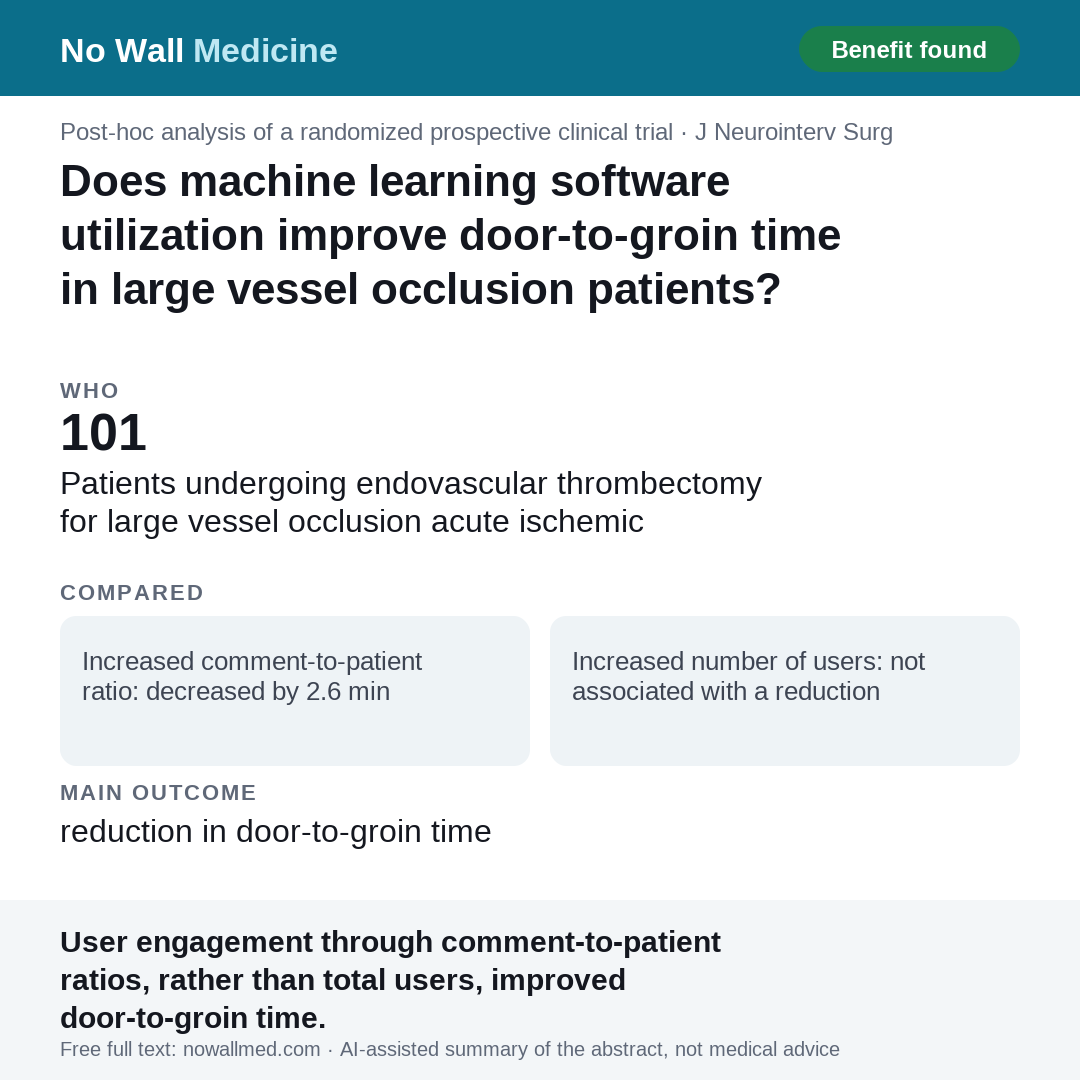
Clinical question: Does machine learning software utilization improve door-to-groin time in large vessel occlusion patients?
Why it matters: The degree to which care team engagement and interaction are required for the benefits of automated machine learning software remains incompletely characterized.
Key points
- Researchers analyzed 101 patients undergoing endovascular thrombectomy for large vessel occlusion, which is a major blockage in a brain artery.
- A higher ratio of comments made in the software per patient was associated with a 2.6 minute decrease in door-to-groin time.
- The total number of active users per week was not associated with a reduction in door-to-groin time.
Headline and key points written with AI from the paper’s abstract, with every number checked against it. Read the paper before relying on them.
Topics
Cite this article
Ebirim EC, Le NM, Samaha JN, Azeem H, Iyyangar A, Ballekere AN. Workflow improvements from automated large vessel occlusion detection algorithms are dependent on care team engagement. J Neurointerv Surg. 2026. doi:10.1136/jnis-2024-022896
Spotted a mistake? Suggest a correction