Visual abstracts
New randomized trials and meta-analyses from leading journals at a glance: who was studied, what was compared, and what was found. Every paper is free to read in full.
All specialtiesCardiology 4877Oncology 4138Gastroenterology & Hepatology 1942Infectious Disease 3837Neurology 1905Psychiatry & Mental Health 2273Pulmonology 2143Critical Care 1365Endocrinology & Diabetes 2580Pediatrics 2980Surgery 2559Orthopedics & Sports Medicine 931Neurosurgery 537Cardiothoracic & Vascular Surgery 674Plastic & Reconstructive Surgery 591Nephrology 1133Rheumatology 823Hematology 1109Dermatology 621Ophthalmology 543Obstetrics & Gynecology 1686Public & Global Health 1058Radiology & Imaging 648Anesthesiology 986Urology 764ENT (Otolaryngology) 503Emergency Medicine 511Allergy & Immunology 313Geriatrics 981Family Medicine & Primary Care 562Medical Genetics & Genomics 676Pathology & Laboratory Medicine 159Physical Medicine & Rehabilitation 757Palliative Care 444Nutrition 1588Digital Health & AI 2201General Medicine 321
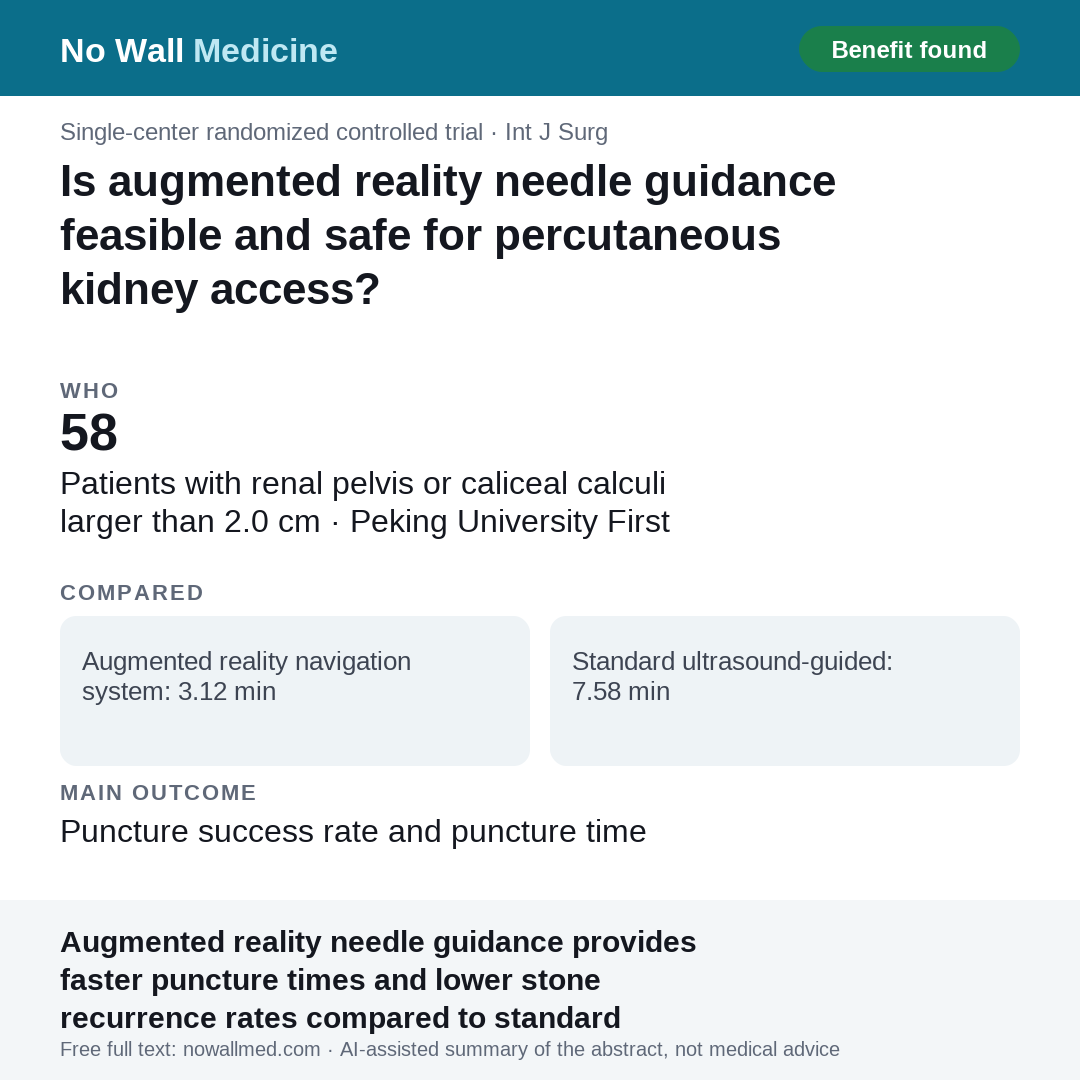
Conventional ultrasonography enabled with augmented reality needle guidance for percutaneous kidney access: an innovative methodologies randomized controlled trial
Single-center randomized controlled trialBenefit found
Is augmented reality needle guidance feasible and safe for percutaneous kidney access?
Who
58
Patients with renal pelvis or caliceal calculi larger than 2.0 cm · Peking University First Hospital, Beijing, China
Compared
Augmented reality navigation system: 3.12 min
Standard ultrasound-guided: 7.58 min
Main outcome
Puncture success rate and puncture time
Bottom line: Augmented reality needle guidance provides faster puncture times and lower stone recurrence rates compared to standard ultrasound guidance.
Int J Surg · 2025-01-01Download image
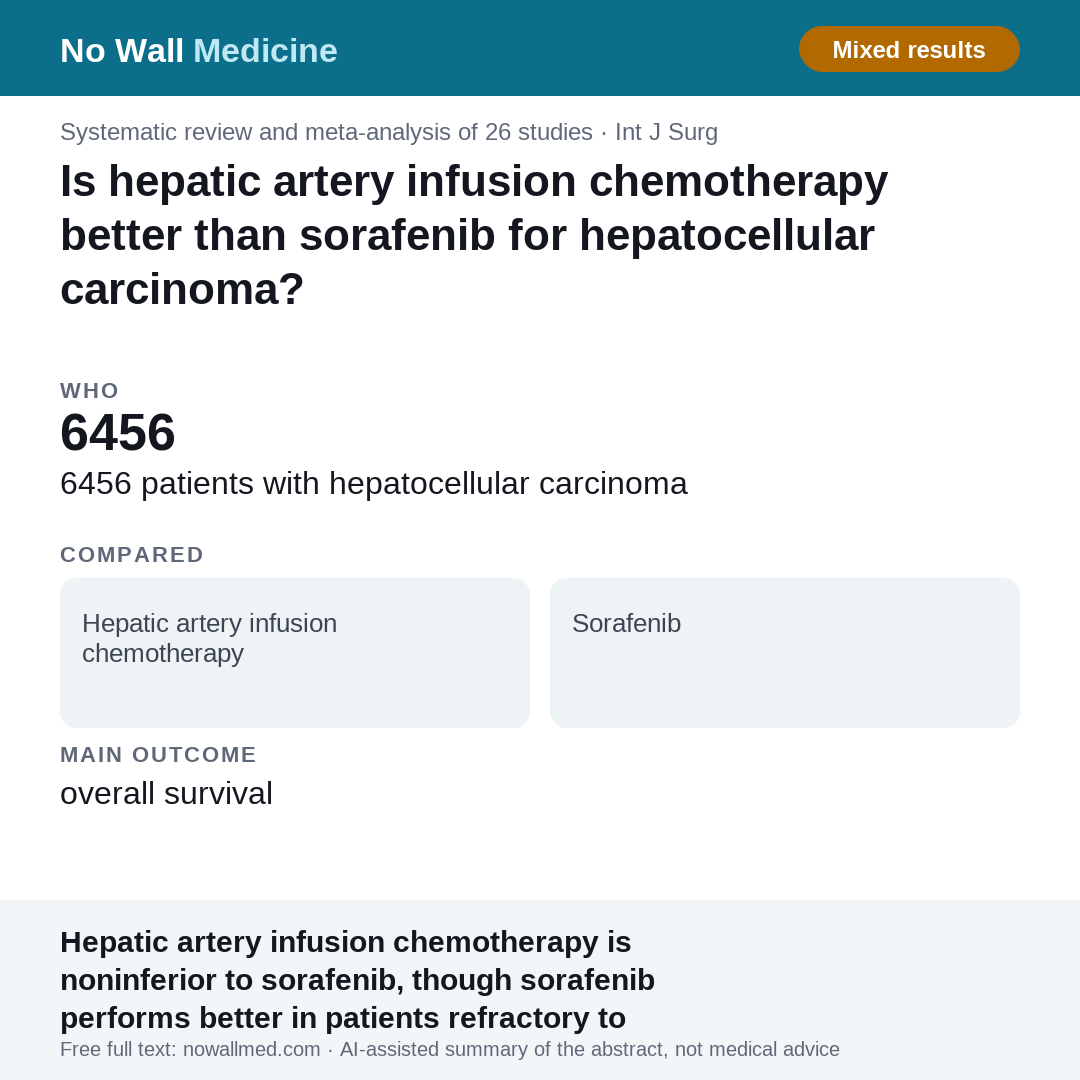
Optimal candidates and surrogate endpoints for HAIC versus Sorafenib in hepatocellular carcinoma: an updated systematic review and meta-analysis
Systematic review and meta-analysis of 26 studiesMixed results
Is hepatic artery infusion chemotherapy better than sorafenib for hepatocellular carcinoma?
Who
6456
6456 patients with hepatocellular carcinoma
Compared
Hepatic artery infusion chemotherapy
Sorafenib
Main outcome
overall survival
Bottom line: Hepatic artery infusion chemotherapy is noninferior to sorafenib, though sorafenib performs better in patients refractory to trans-arterial chemoembolization.
Int J Surg · 2025-01-01Download image
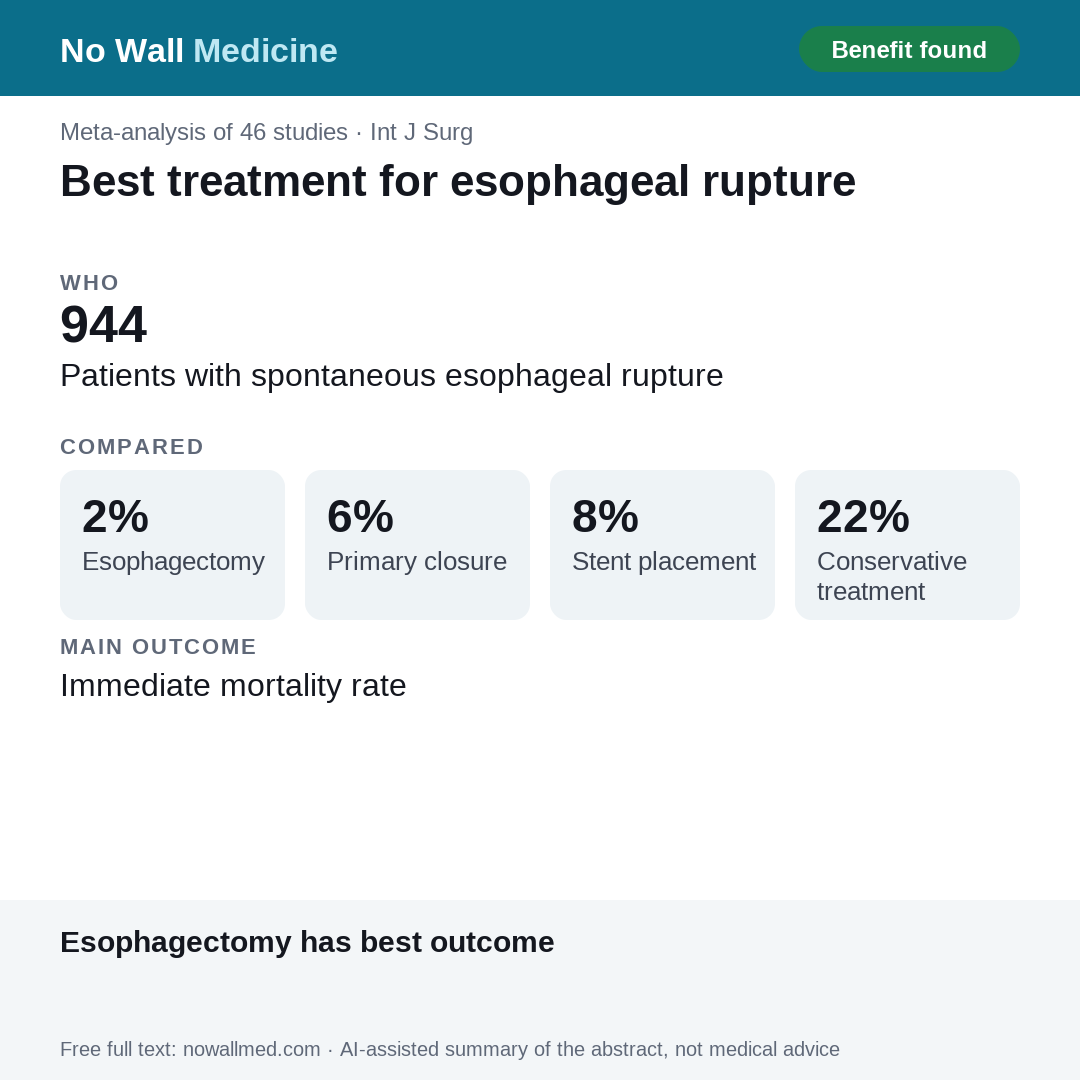
Outcome of treatment modalities for spontaneous esophageal rupture: a meta-analysis and case series
Meta-analysis of 46 studiesBenefit found
Best treatment for esophageal rupture
Who
944
Patients with spontaneous esophageal rupture
Compared
2%Esophagectomy (95% CI: 0.00-0.15)
6%Primary closure (95% CI: 0.04-0.09)
8%Stent placement (95% CI: 0.03-0.15)
22%Conservative treatment (95% CI: 0.03-0.47)
Main outcome
Immediate mortality rate
Bottom line: Esophagectomy has best outcome
Int J Surg · 2025-01-01Download image
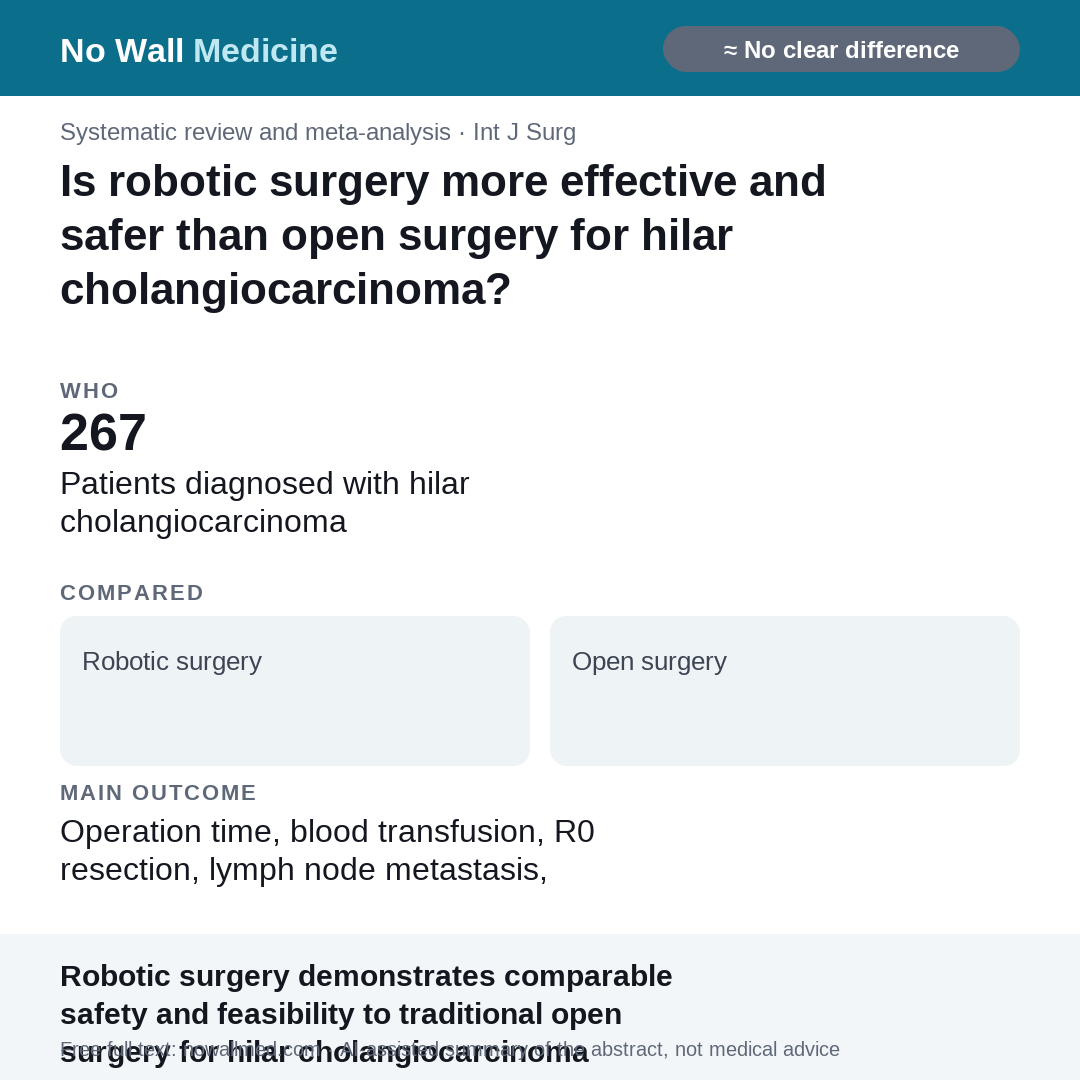
Efficacy and safety of robotic surgery versus open surgery for hilar cholangiocarcinoma: a systematic review and meta-analysis
Systematic review and meta-analysisNo clear difference
Is robotic surgery more effective and safer than open surgery for hilar cholangiocarcinoma?
Who
267
Patients diagnosed with hilar cholangiocarcinoma
Compared
Robotic surgery
Open surgery
Main outcome
Operation time, blood transfusion, R0 resection, lymph node metastasis, complications, and hospital stay
Result: no significant differences observed across all primary outcomes
Bottom line: Robotic surgery demonstrates comparable safety and feasibility to traditional open surgery for hilar cholangiocarcinoma treatment.
Limitation: Limited quantity and quality of the included studies.
Int J Surg · 2025-01-01Download image
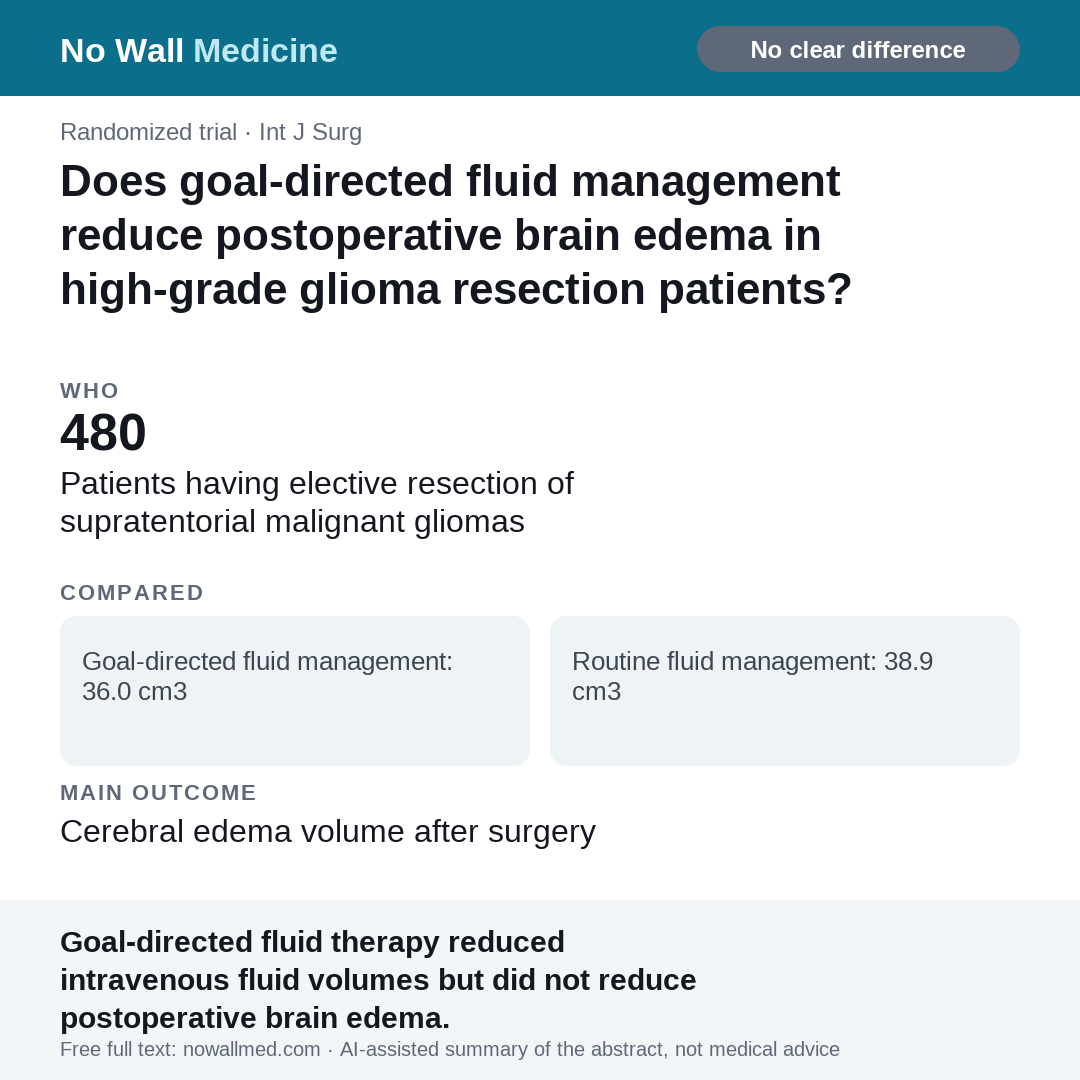
Intraoperative goal-directed fluid management and postoperative brain edema in patients having high-grade gliomas resections: a randomized trial
Randomized trialNo clear difference
Does goal-directed fluid management reduce postoperative brain edema in high-grade glioma resection patients?
Who
480
Patients having elective resection of supratentorial malignant gliomas
Compared
Goal-directed fluid management: 36.0 cm3
Routine fluid management: 38.9 cm3
Main outcome
Cerebral edema volume after surgery
Result: mean difference: 0.18 cm3, 95% CI: -5.7 to 5.9
Bottom line: Goal-directed fluid therapy reduced intravenous fluid volumes but did not reduce postoperative brain edema.
Int J Surg · 2025-01-01Download image
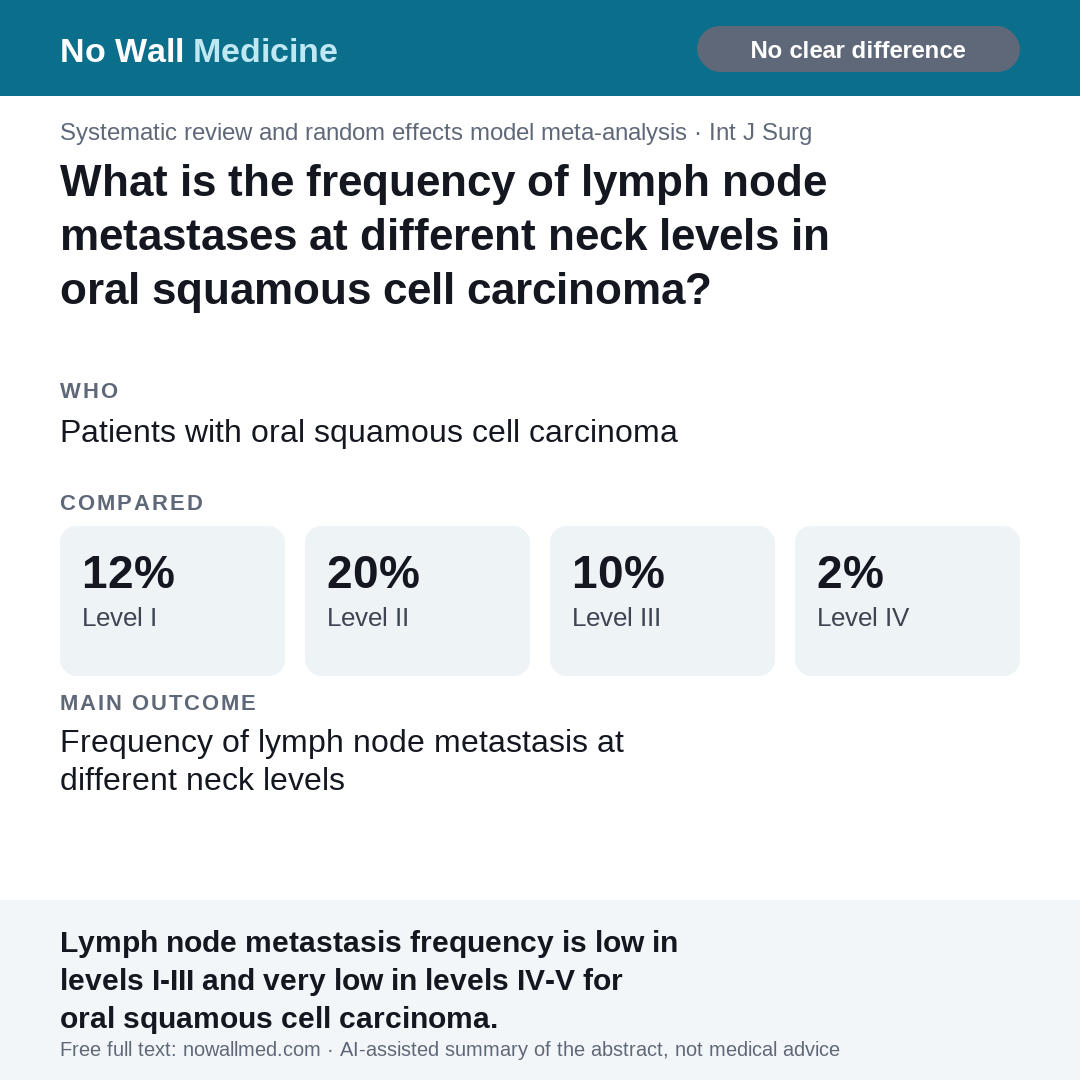
Frequency of lymph node metastases at different neck levels in patients with oral squamous cell carcinoma: a systematic review and meta-analysis
Systematic review and random effects model meta-analysisNo clear difference
What is the frequency of lymph node metastases at different neck levels in oral squamous cell carcinoma?
Who
Patients with oral squamous cell carcinoma
Compared
12%Level I (95% CI: 0.11-0.15)
20%Level II (95% CI: 0.17-0.22)
10%Level III (95% CI: 0.08-0.12)
2%Level IV (95% CI: 0.01-0.03)
Main outcome
Frequency of lymph node metastasis at different neck levels
Bottom line: Lymph node metastasis frequency is low in levels I-III and very low in levels IV-V for oral squamous cell carcinoma.
Int J Surg · 2025-01-01Download image
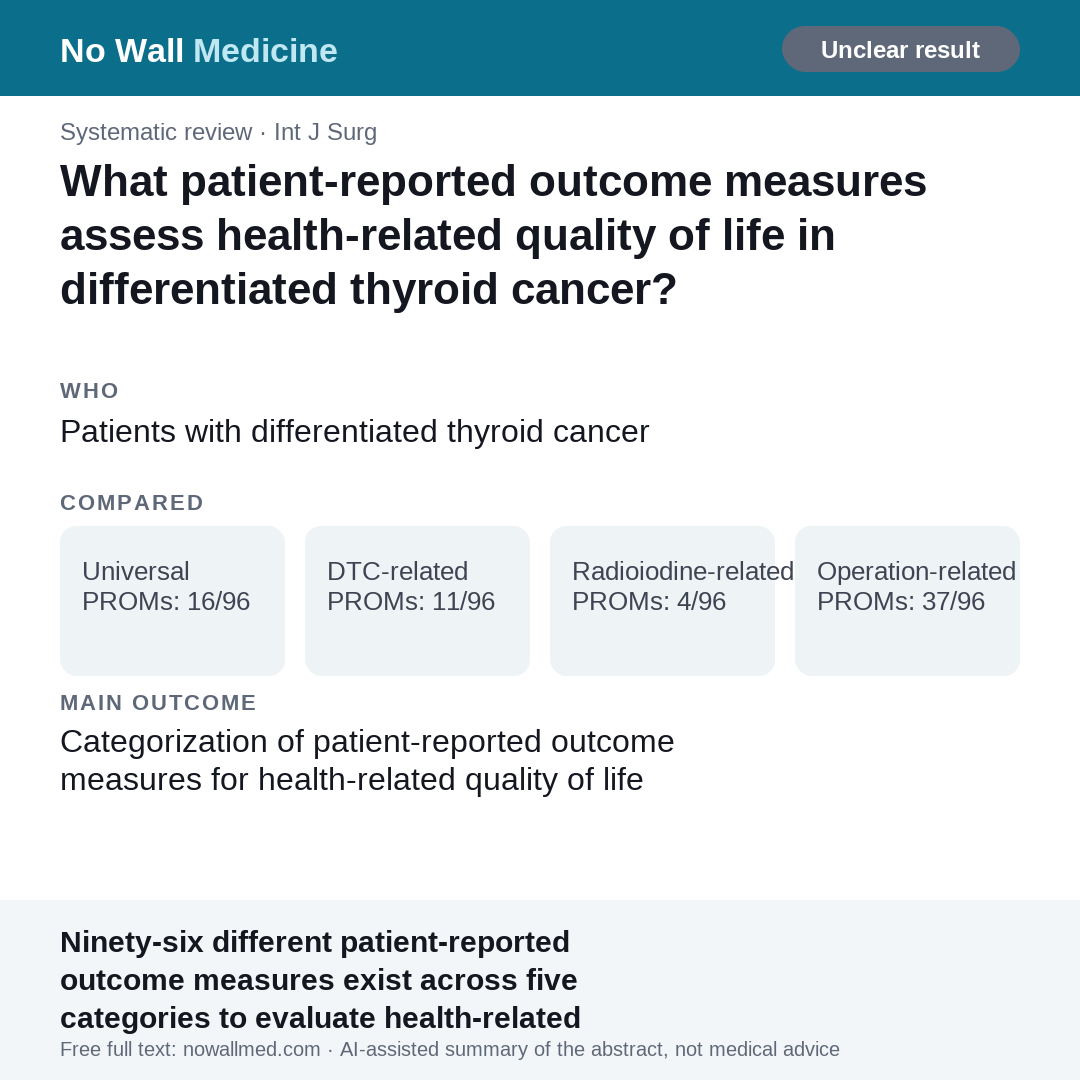
Patient‑reported outcome measures for assessing health‑related quality of life in patients with differentiated thyroid cancer: a systematic review
Systematic reviewUnclear result
What patient-reported outcome measures assess health-related quality of life in differentiated thyroid cancer?
Who
Patients with differentiated thyroid cancer
Compared
Universal PROMs: 16/96
DTC-related PROMs: 11/96
Radioiodine-related PROMs: 4/96
Operation-related PROMs: 37/96
Main outcome
Categorization of patient-reported outcome measures for health-related quality of life
Bottom line: Ninety-six different patient-reported outcome measures exist across five categories to evaluate health-related quality of life in differentiated thyroid cancer.
Limitation: A more detailed critical appraisal of the measures used in various clinical scenarios is required.
Int J Surg · 2025-01-01Download image
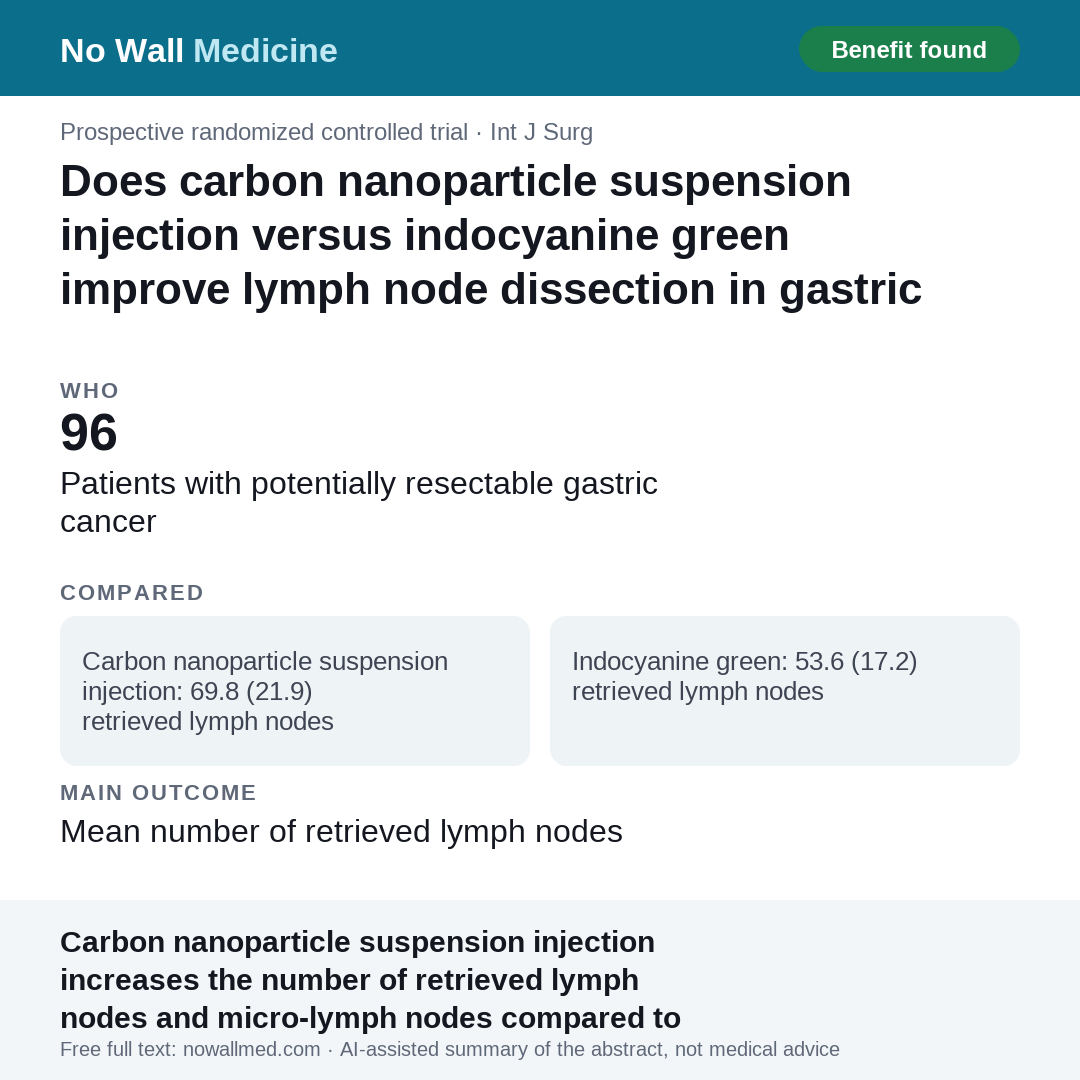
Effect of carbon nanoparticle suspension injection versus indocyanine green tracer in guiding lymph node dissection during radical gastrectomy (FUTURE-01): a randomized clinical trial
Prospective randomized controlled trialBenefit found
Does carbon nanoparticle suspension injection versus indocyanine green improve lymph node dissection in gastric cancer?
Who
96
Patients with potentially resectable gastric cancer
Compared
Carbon nanoparticle suspension injection: 69.8 (21.9) retrieved lymph nodes
Indocyanine green: 53.6 (17.2) retrieved lymph nodes
Main outcome
Mean number of retrieved lymph nodes
Bottom line: Carbon nanoparticle suspension injection increases the number of retrieved lymph nodes and micro-lymph nodes compared to indocyanine green.
Int J Surg · 2025-01-01Download image
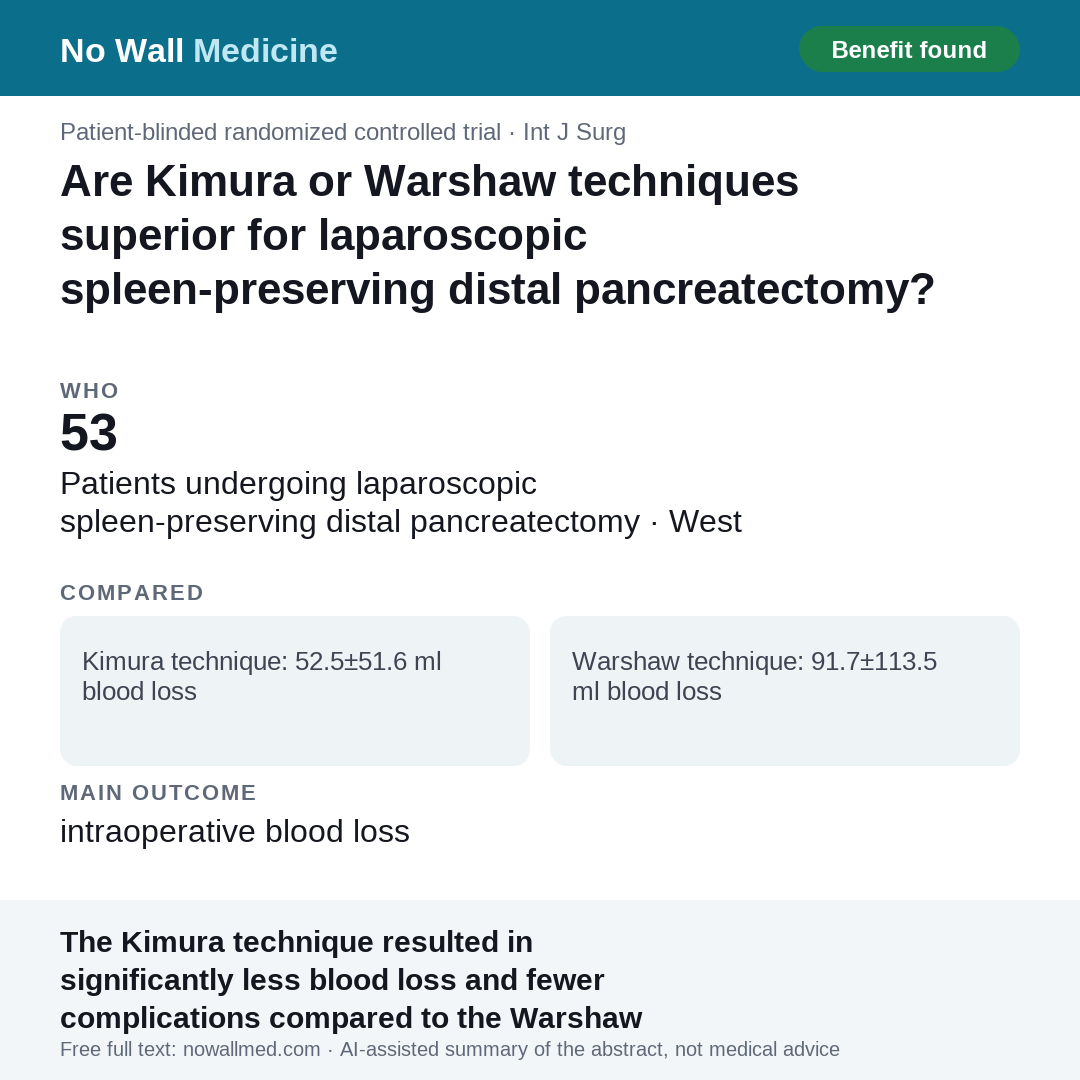
Interim analysis of short-term outcomes after laparoscopic spleen-preserving distal pancreatectomy with or without preservation of splenic vessels: a randomised controlled trial
Patient-blinded randomized controlled trialBenefit found
Are Kimura or Warshaw techniques superior for laparoscopic spleen-preserving distal pancreatectomy?
Who
53
Patients undergoing laparoscopic spleen-preserving distal pancreatectomy · West China Hospital of Sichuan University
Compared
Kimura technique: 52.5±51.6 ml blood loss
Warshaw technique: 91.7±113.5 ml blood loss
Main outcome
intraoperative blood loss
Result: P =0.007
Bottom line: The Kimura technique resulted in significantly less blood loss and fewer complications compared to the Warshaw technique.
Limitation: This is an interim analysis of short-term outcomes.
Int J Surg · 2025-01-01Download image
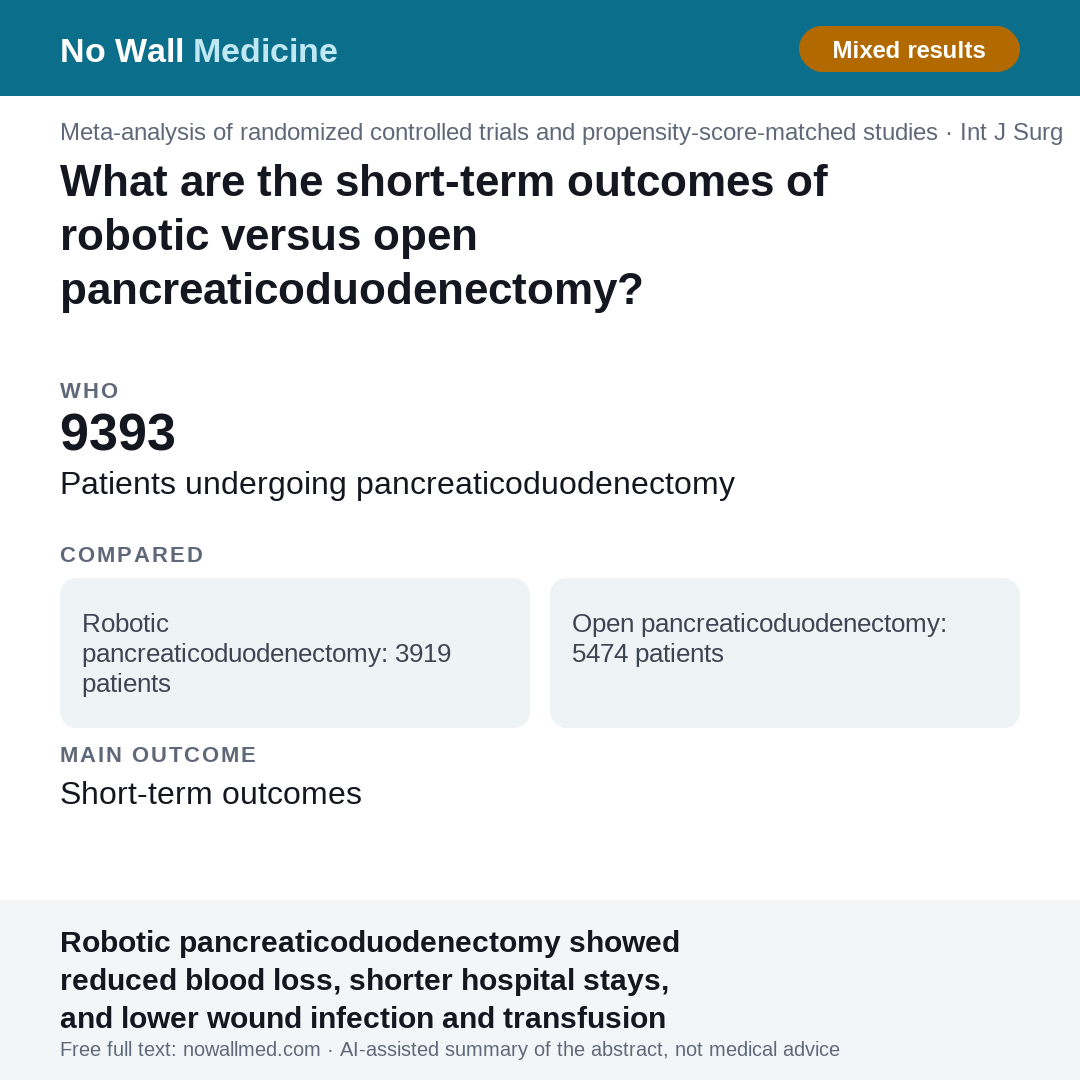
Comparison of short-term outcomes of robotic versus open pancreaticoduodenectomy: a meta-analysis of randomized controlled trials and propensity-score-matched studies
Meta-analysis of randomized controlled trials and propensity-score-matched studiesMixed results
What are the short-term outcomes of robotic versus open pancreaticoduodenectomy?
Who
9393
Patients undergoing pancreaticoduodenectomy
Compared
Robotic pancreaticoduodenectomy: 3919 patients
Open pancreaticoduodenectomy: 5474 patients
Main outcome
Short-term outcomes
Bottom line: Robotic pancreaticoduodenectomy showed reduced blood loss, shorter hospital stays, and lower wound infection and transfusion rates.
Int J Surg · 2025-01-01Download image
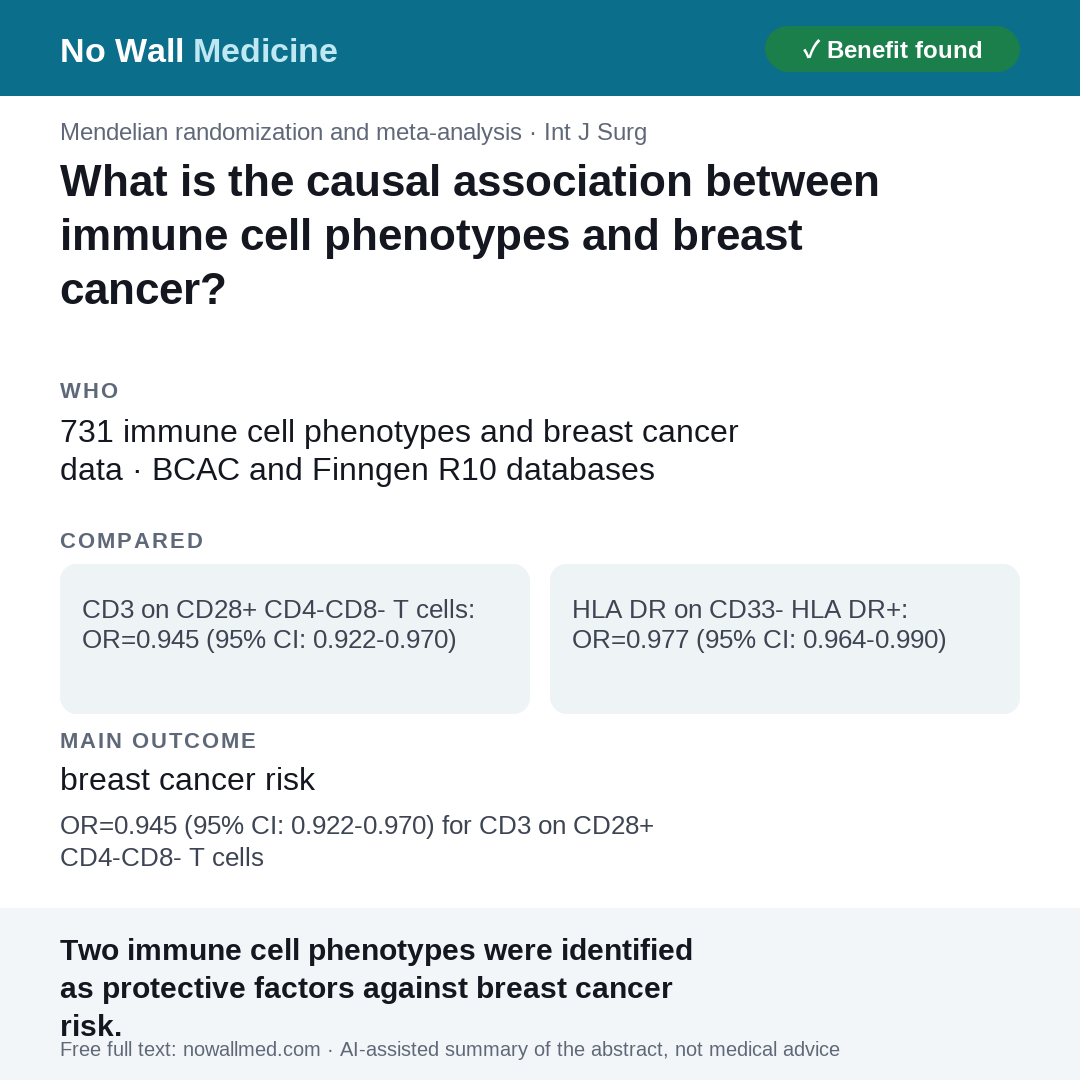
The association between immune cells and breast cancer: insights from Mendelian randomization and meta-analysis
Mendelian randomization and meta-analysisBenefit found
What is the causal association between immune cell phenotypes and breast cancer?
Who
731 immune cell phenotypes and breast cancer data · BCAC and Finngen R10 databases
Compared
CD3 on CD28+ CD4-CD8- T cells: OR=0.945 (95% CI: 0.922-0.970)
HLA DR on CD33- HLA DR+: OR=0.977 (95% CI: 0.964-0.990)
Main outcome
breast cancer risk
Result: OR=0.945 (95% CI: 0.922-0.970) for CD3 on CD28+ CD4-CD8- T cells
Bottom line: Two immune cell phenotypes were identified as protective factors against breast cancer risk.
Int J Surg · 2025-01-01Download image
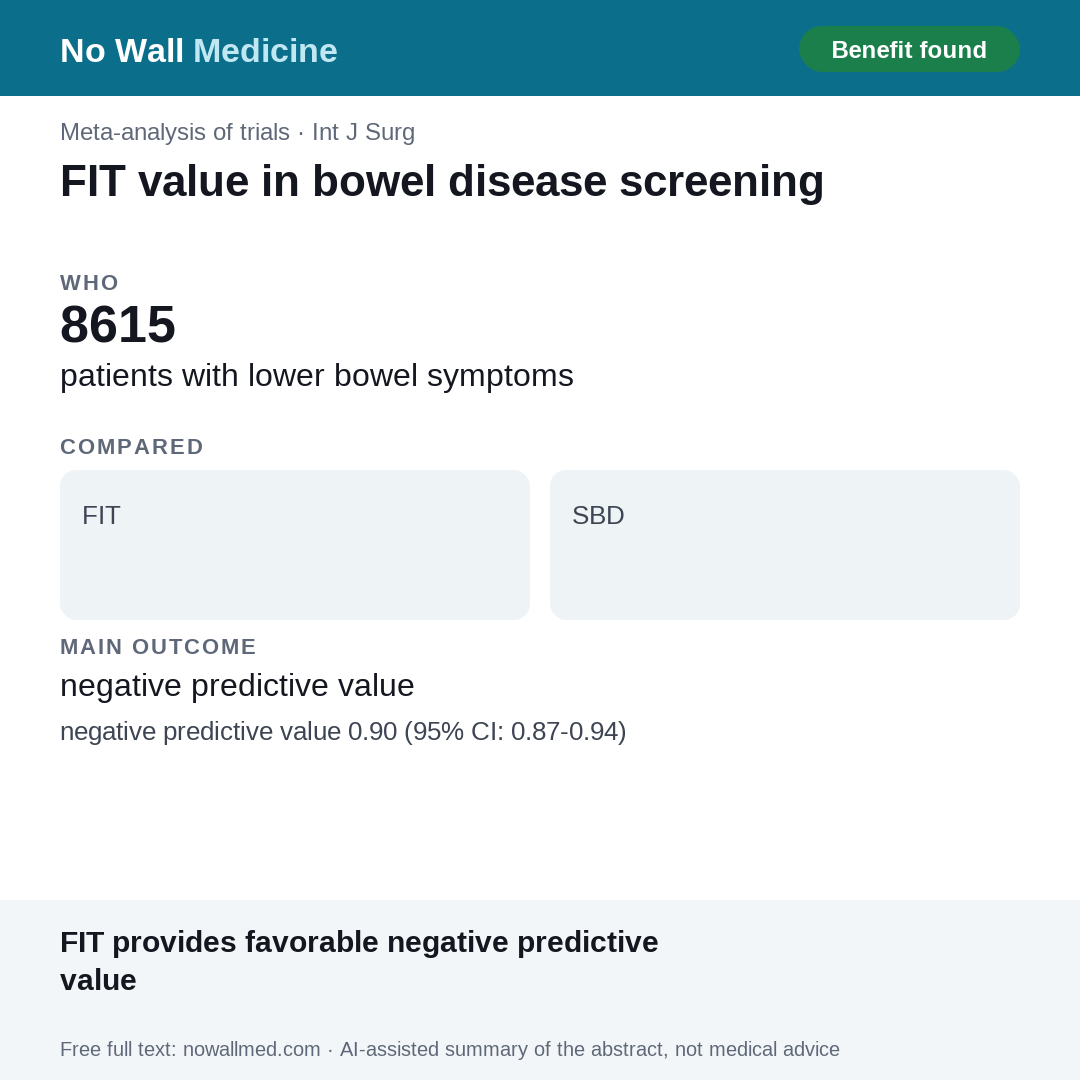
Negative predictive value of fecal immunochemical testing in significant bowel disease screening: a systematic review and meta-analysis
Meta-analysis of trialsBenefit found
FIT value in bowel disease screening
Who
8615
patients with lower bowel symptoms
Compared
FIT
SBD
Main outcome
negative predictive value
Result: negative predictive value 0.90 (95% CI: 0.87-0.94)
Bottom line: FIT provides favorable negative predictive value
Int J Surg · 2025-01-01Download image
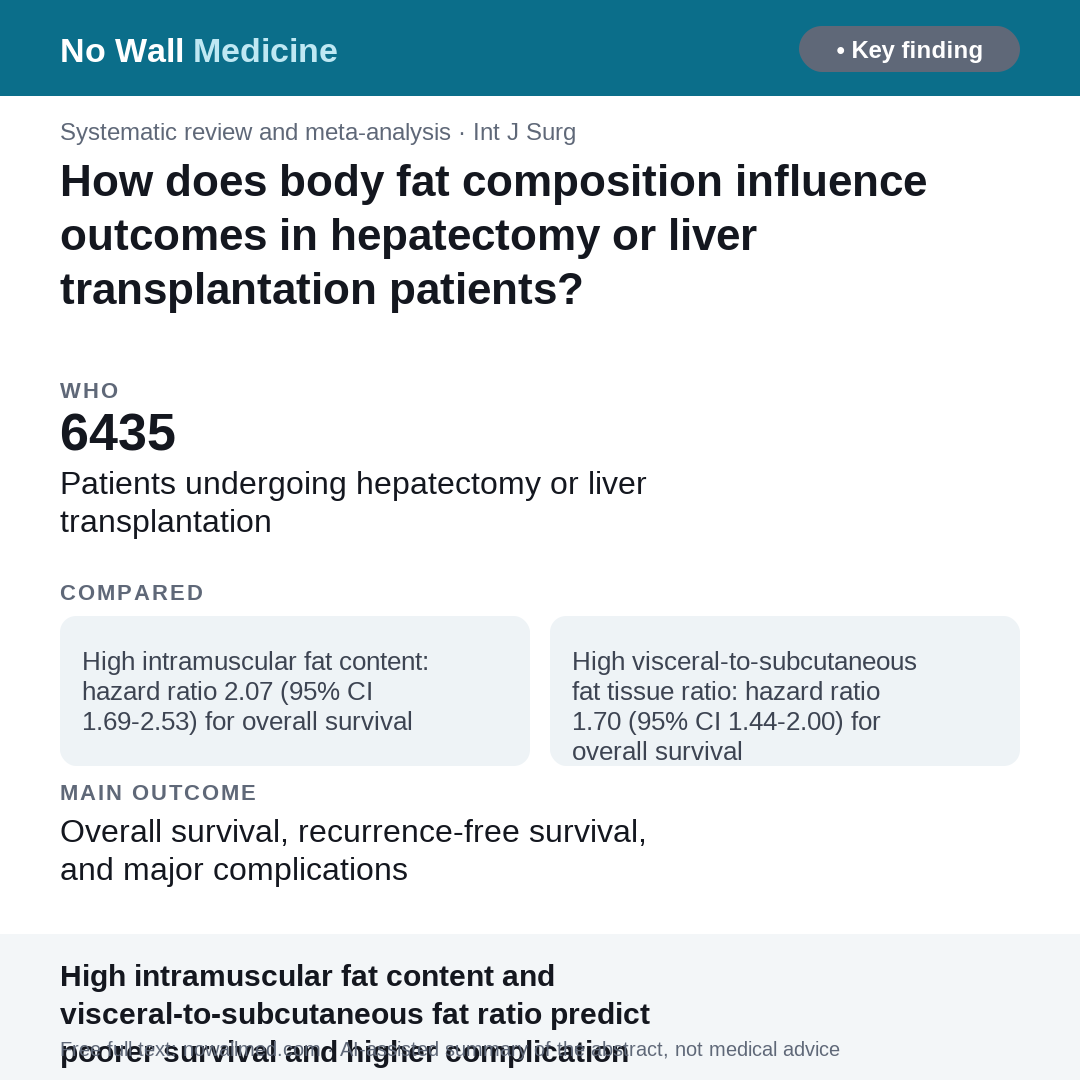
Influence of body fat tissue on outcomes in patients undergoing hepatectomy or liver transplantation: a systematic review and meta-analysis
Systematic review and meta-analysisHarm found
How does body fat composition influence outcomes in hepatectomy or liver transplantation patients?
Who
6435
Patients undergoing hepatectomy or liver transplantation
Compared
High intramuscular fat content: hazard ratio 2.07 (95% CI 1.69-2.53) for overall survival
High visceral-to-subcutaneous fat tissue ratio: hazard ratio 1.70 (95% CI 1.44-2.00) for overall survival
Main outcome
Overall survival, recurrence-free survival, and major complications
Result: hazard ratio 2.07 (95% CI 1.69-2.53) for overall survival
Bottom line: High intramuscular fat content and visceral-to-subcutaneous fat ratio predict poorer survival and higher complication risks after liver surgery.
Int J Surg · 2025-01-01Download image
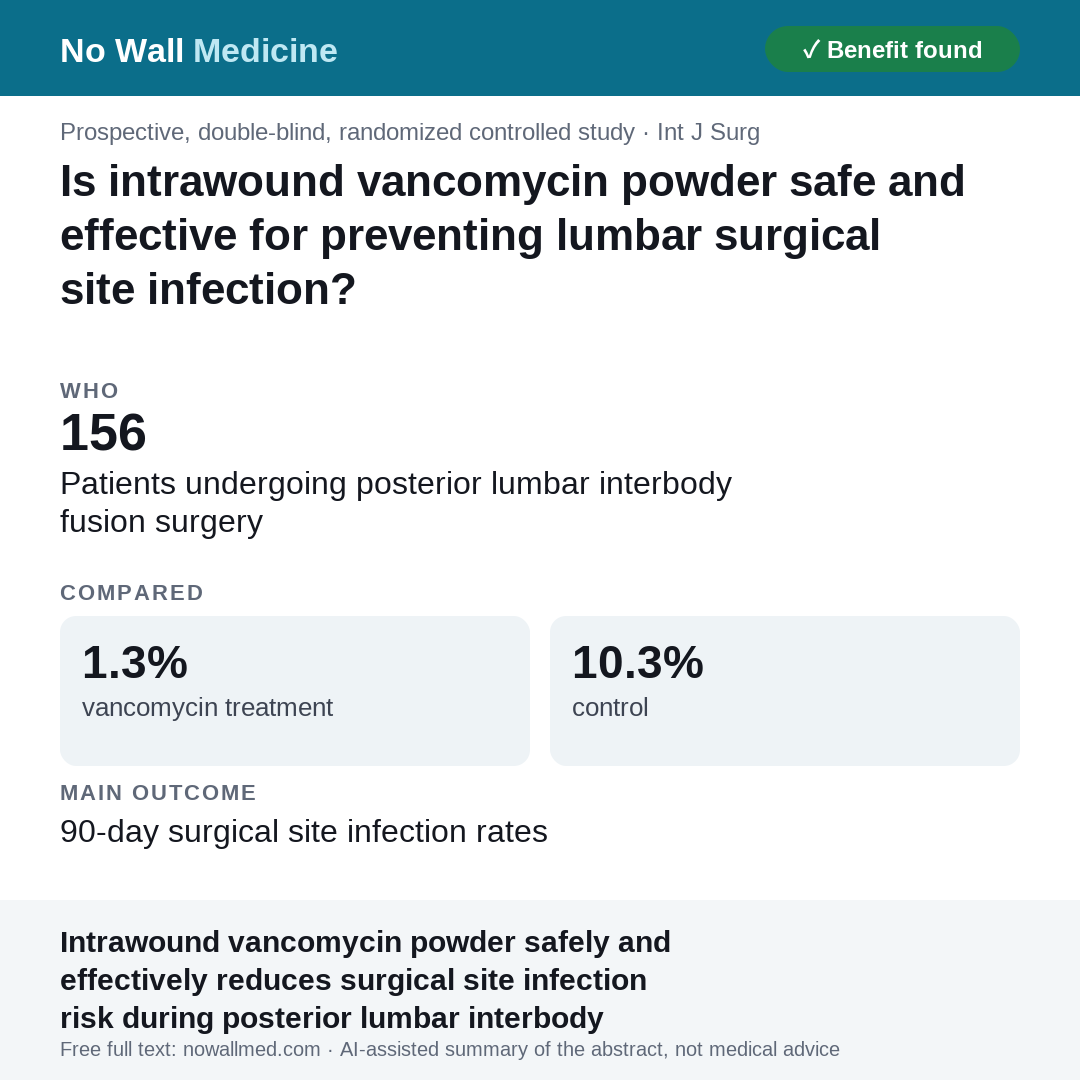
Safety and efficacy of intrawound vancomycin powder in the prevention of lumbar surgical site infection: a prospective, double-blind, randomized controlled study
Prospective, double-blind, randomized controlled studyBenefit found
Is intrawound vancomycin powder safe and effective for preventing lumbar surgical site infection?
Who
156
Patients undergoing posterior lumbar interbody fusion surgery
Compared
1.3%vancomycin treatment (1/78)
10.3%control (8/78)
Main outcome
90-day surgical site infection rates
Result: RR=0.125, 95% CI=0.016-0.976
Bottom line: Intrawound vancomycin powder safely and effectively reduces surgical site infection risk during posterior lumbar interbody fusion surgery.
Int J Surg · 2025-01-01Download image
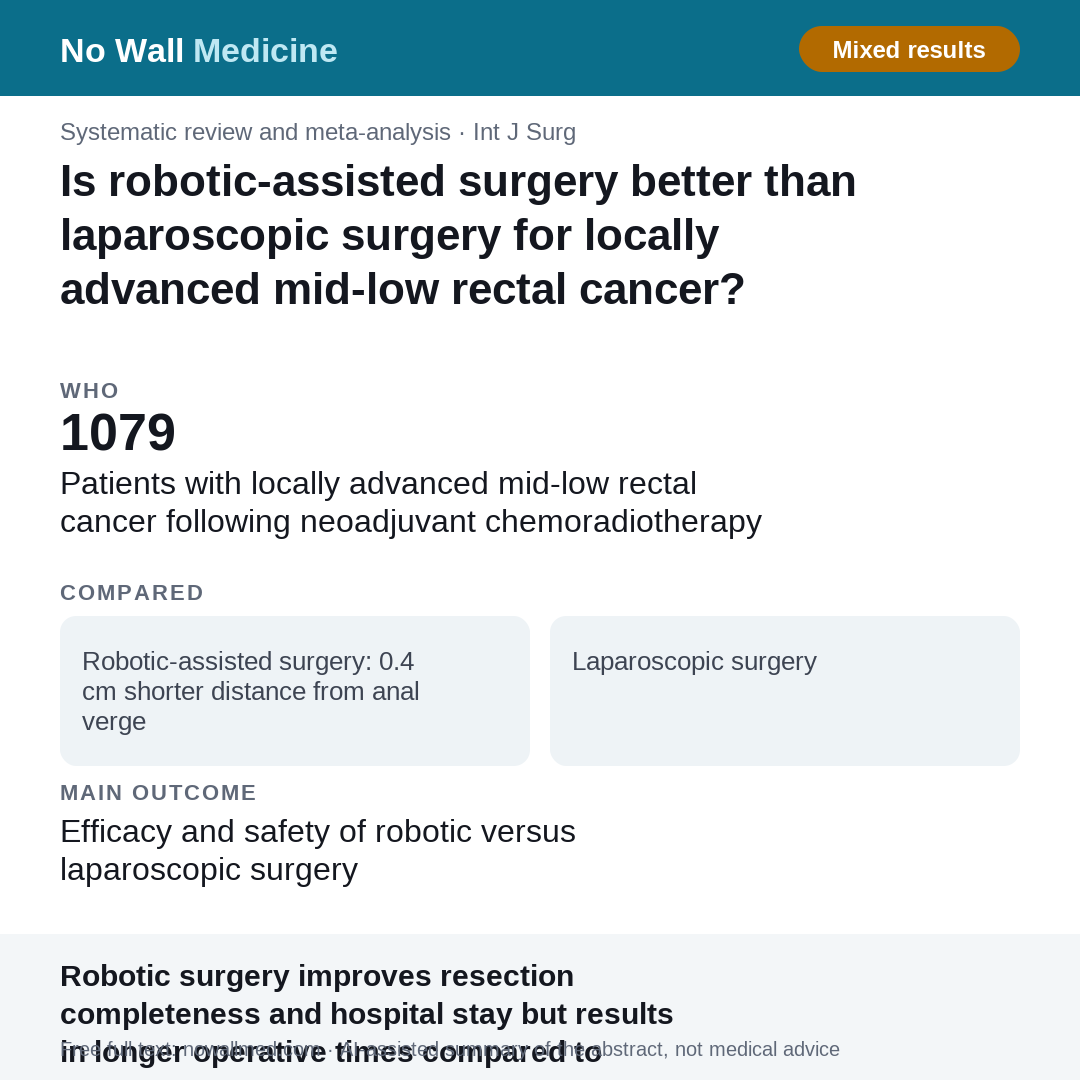
Comparison of efficacy and safety between robotic-assisted versus laparoscopic surgery for locally advanced mid-low rectal cancer following neoadjuvant chemoradiotherapy: a systematic review and meta-analysis
Systematic review and meta-analysisMixed results
Is robotic-assisted surgery better than laparoscopic surgery for locally advanced mid-low rectal cancer?
Who
1079
Patients with locally advanced mid-low rectal cancer following neoadjuvant chemoradiotherapy
Compared
Robotic-assisted surgery: 0.4 cm shorter distance from anal verge
Laparoscopic surgery
Main outcome
Efficacy and safety of robotic versus laparoscopic surgery
Bottom line: Robotic surgery improves resection completeness and hospital stay but results in longer operative times compared to laparoscopic surgery.
Int J Surg · 2025-01-01Download image
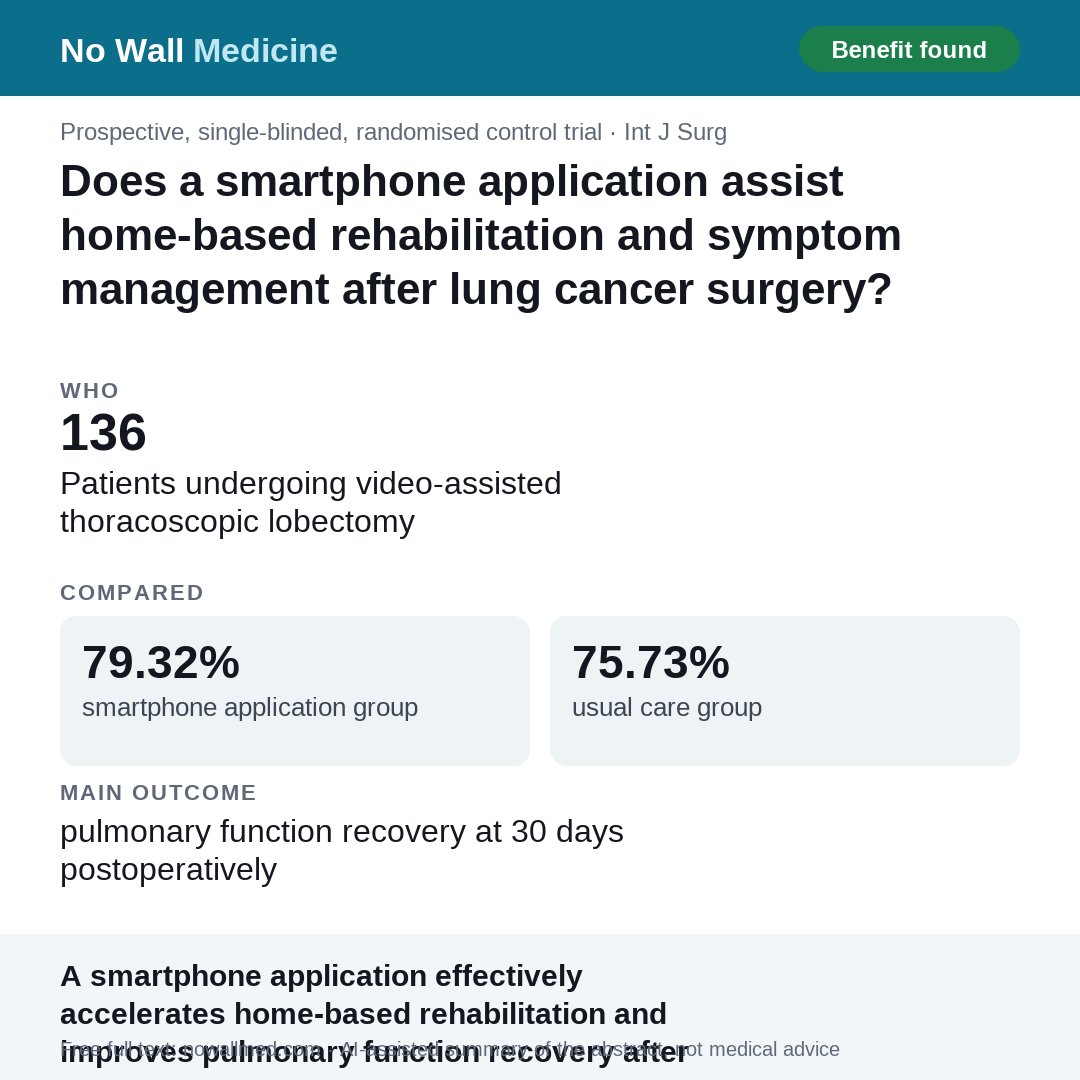
Efficacy of a smartphone application assisting home-based rehabilitation and symptom management for patients with lung cancer undergoing video-assisted thoracoscopic lobectomy: a prospective, single-blinded, randomised control trial (POPPER study)
Prospective, single-blinded, randomised control trialBenefit found
Does a smartphone application assist home-based rehabilitation and symptom management after lung cancer surgery?
Who
136
Patients undergoing video-assisted thoracoscopic lobectomy
Compared
79.32%smartphone application group
75.73%usual care group
Main outcome
pulmonary function recovery at 30 days postoperatively
Result: P =0.040
Bottom line: A smartphone application effectively accelerates home-based rehabilitation and improves pulmonary function recovery after video-assisted thoracoscopic lobectomy.
Int J Surg · 2025-01-01Download image
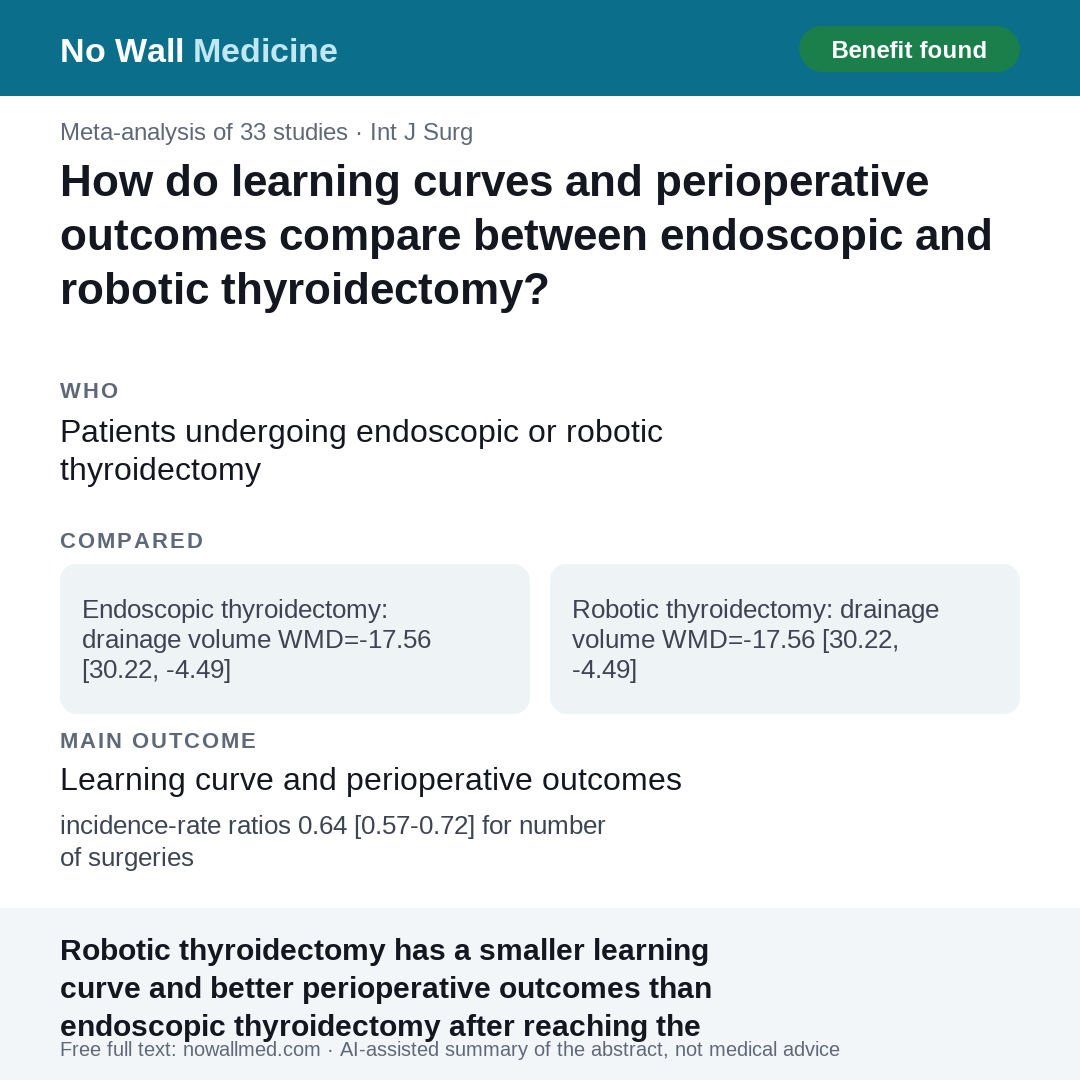
Comparison of learning curves and related postoperative indicators between endoscopic and robotic thyroidectomy: a systematic review and meta-analysis
Meta-analysis of 33 studiesBenefit found
How do learning curves and perioperative outcomes compare between endoscopic and robotic thyroidectomy?
Who
Patients undergoing endoscopic or robotic thyroidectomy
Compared
Endoscopic thyroidectomy: drainage volume WMD=-17.56 [30.22, -4.49]
Robotic thyroidectomy: drainage volume WMD=-17.56 [30.22, -4.49]
Main outcome
Learning curve and perioperative outcomes
Result: incidence-rate ratios 0.64 [0.57-0.72] for number of surgeries
Bottom line: Robotic thyroidectomy has a smaller learning curve and better perioperative outcomes than endoscopic thyroidectomy after reaching the stable stage.
Int J Surg · 2025-01-01Download image
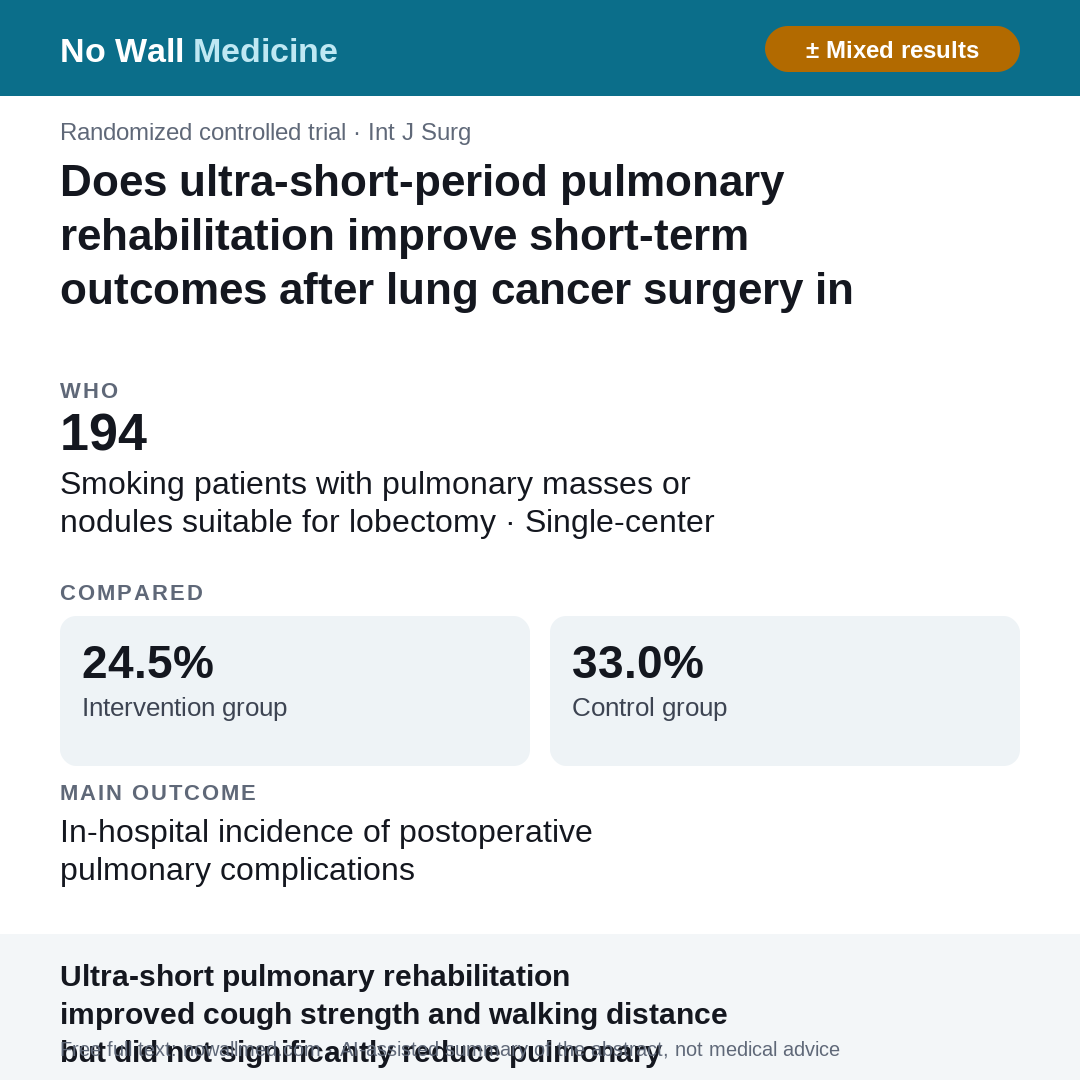
Ultra-short-period perioperative pulmonary rehabilitation on short-term outcomes after surgery in smoking patients with lung cancer: a randomized clinical trial
Randomized controlled trialMixed results
Does ultra-short-period pulmonary rehabilitation improve short-term outcomes after lung cancer surgery in smokers?
Who
194
Smoking patients with pulmonary masses or nodules suitable for lobectomy · Single-center
Compared
24.5%Intervention group
33.0%Control group
Main outcome
In-hospital incidence of postoperative pulmonary complications
Bottom line: Ultra-short pulmonary rehabilitation improved cough strength and walking distance but did not significantly reduce pulmonary complications.
Int J Surg · 2025-01-01Download image
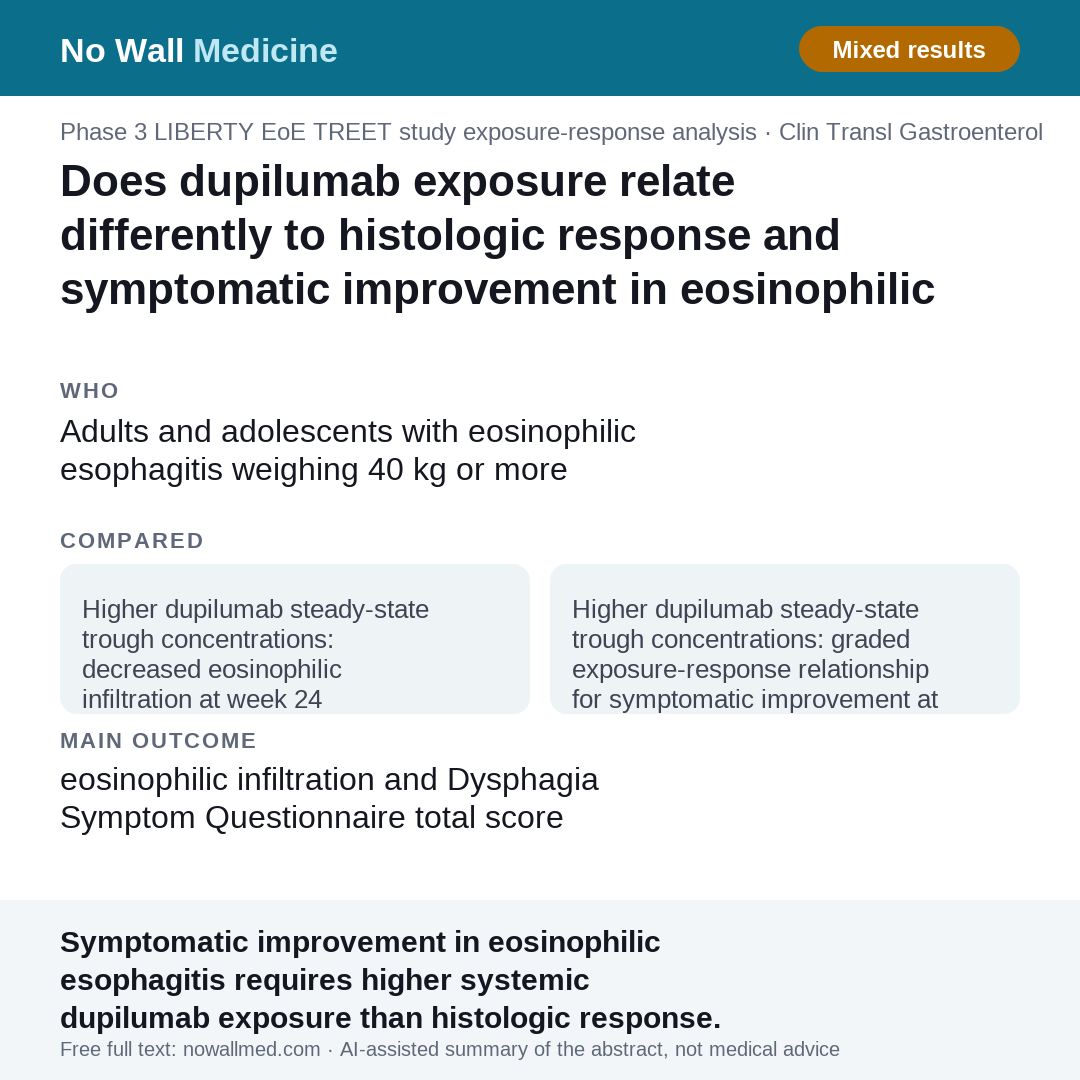
Symptomatic Improvement in Adults and Adolescents With Eosinophilic Esophagitis Requires Higher Systemic Dupilumab Exposure Than Histologic Response
Phase 3 LIBERTY EoE TREET study exposure-response analysisMixed results
Does dupilumab exposure relate differently to histologic response and symptomatic improvement in eosinophilic esophagitis?
Who
Adults and adolescents with eosinophilic esophagitis weighing 40 kg or more
Compared
Higher dupilumab steady-state trough concentrations: decreased eosinophilic infiltration at week 24
Higher dupilumab steady-state trough concentrations: graded exposure-response relationship for symptomatic improvement at week 24
Main outcome
eosinophilic infiltration and Dysphagia Symptom Questionnaire total score
Bottom line: Symptomatic improvement in eosinophilic esophagitis requires higher systemic dupilumab exposure than histologic response.
Clin Transl Gastroenterol · 2025-01-01Download image
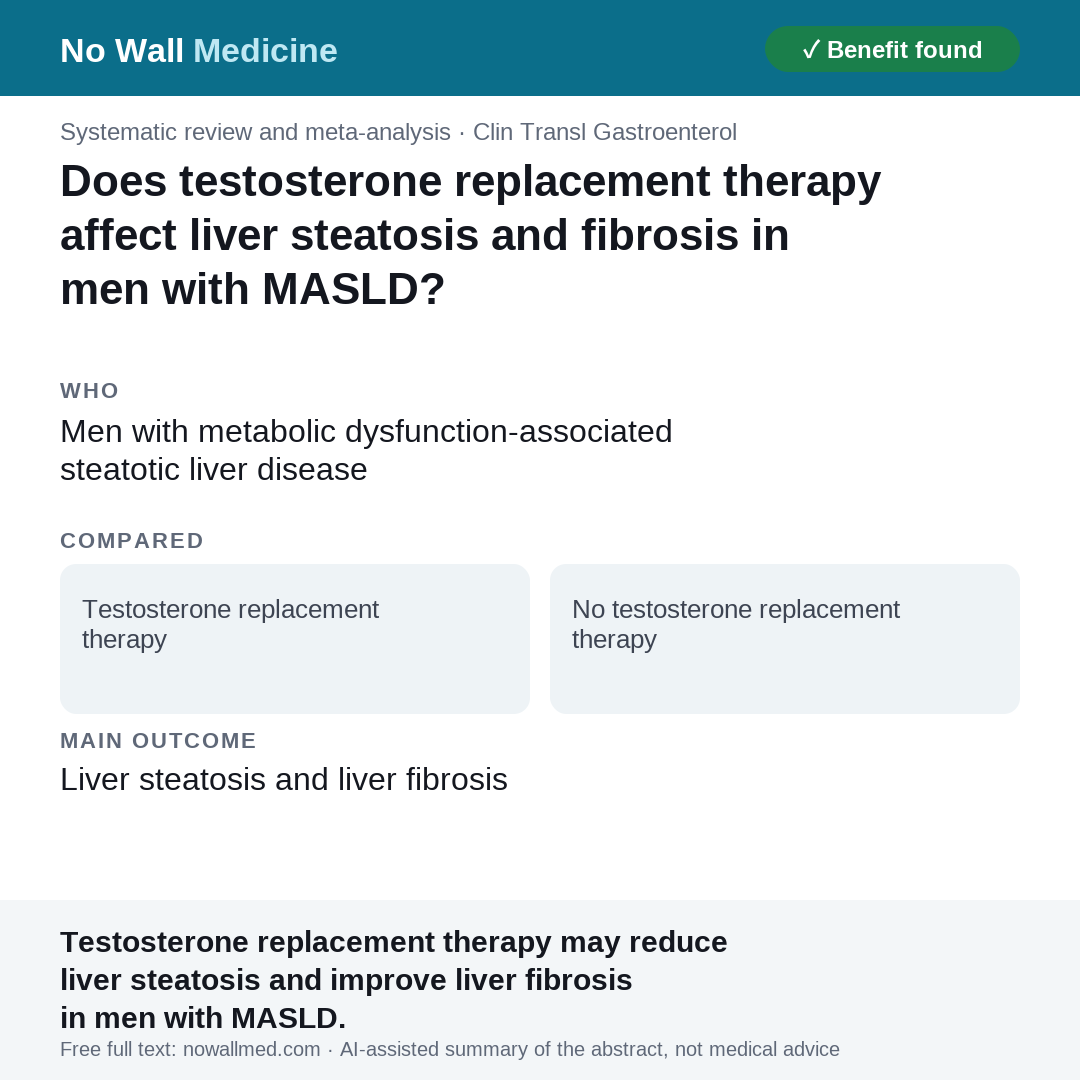
The Effects of Testosterone Replacement Therapy in Adult Men With Metabolic Dysfunction-Associated Steatotic Liver Disease: A Systematic Review and Meta-analysis
Systematic review and meta-analysisBenefit found
Does testosterone replacement therapy affect liver steatosis and fibrosis in men with MASLD?
Who
Men with metabolic dysfunction-associated steatotic liver disease
Compared
Testosterone replacement therapy
No testosterone replacement therapy
Main outcome
Liver steatosis and liver fibrosis
Bottom line: Testosterone replacement therapy may reduce liver steatosis and improve liver fibrosis in men with MASLD.
Limitation: Studies were heterogeneous in population characteristics, treatment modalities, endpoints, and follow-up.
Clin Transl Gastroenterol · 2025-01-01Download image