Visual abstracts
New randomized trials and meta-analyses from leading journals at a glance: who was studied, what was compared, and what was found. Every paper is free to read in full.
All specialtiesCardiology 842Oncology 763Gastroenterology & Hepatology 307Infectious Disease 626Neurology 350Psychiatry & Mental Health 430Pulmonology 366Critical Care 245Endocrinology & Diabetes 480Pediatrics 536Surgery 324Orthopedics & Sports Medicine 162Neurosurgery 93Cardiothoracic & Vascular Surgery 87Plastic & Reconstructive Surgery 124Nephrology 197Rheumatology 108Hematology 182Dermatology 80Ophthalmology 97Obstetrics & Gynecology 261Public & Global Health 167Radiology & Imaging 98Anesthesiology 114Urology 162ENT (Otolaryngology) 91Emergency Medicine 73Allergy & Immunology 58Geriatrics 160Family Medicine & Primary Care 111Medical Genetics & Genomics 91Pathology & Laboratory Medicine 24Physical Medicine & Rehabilitation 148Palliative Care 81Nutrition 223Digital Health & AI 460General Medicine 101
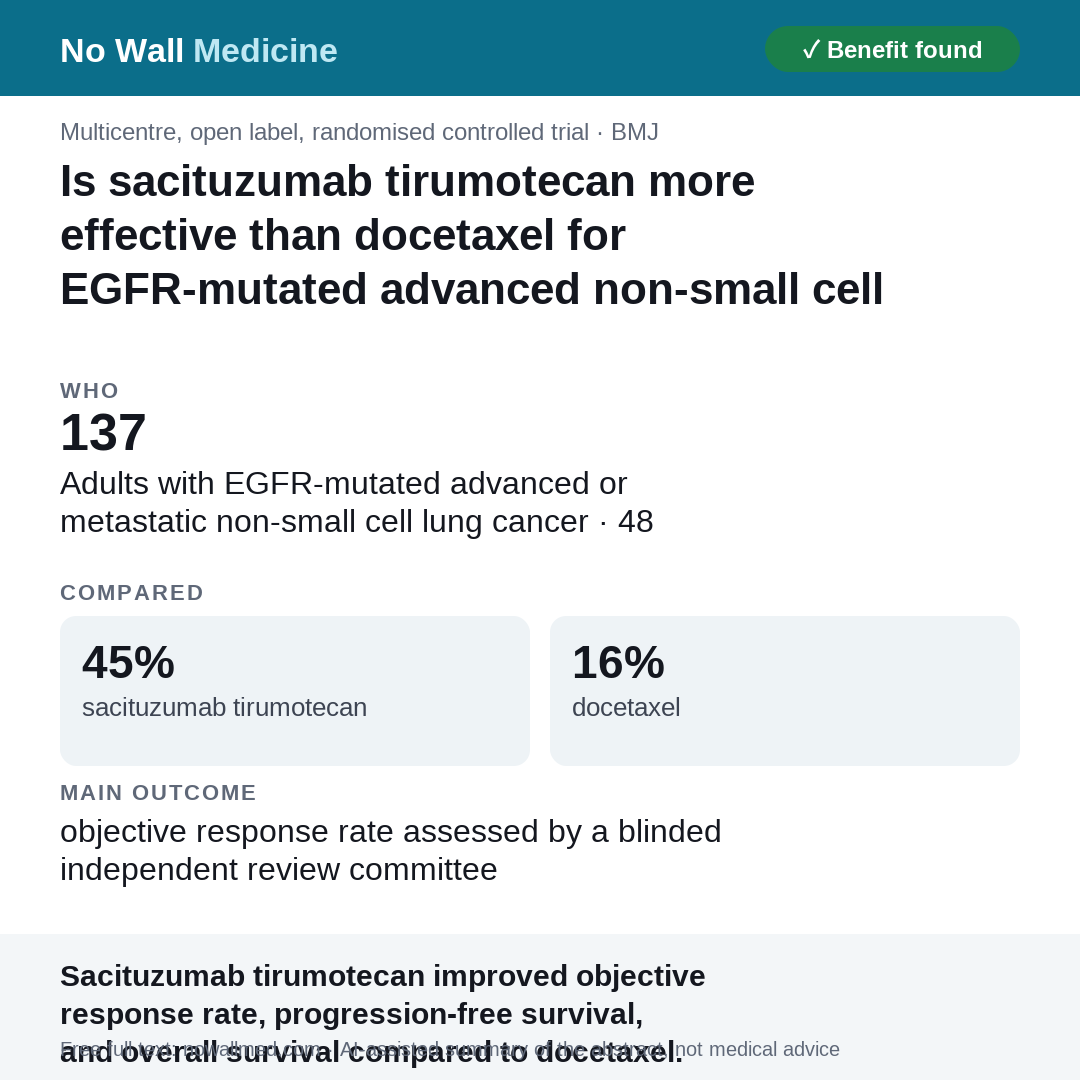
Sacituzumab tirumotecan versus docetaxel for previously treated EGFR-mutated advanced non-small cell lung cancer: multicentre, open label, randomised controlled trial
Multicentre, open label, randomised controlled trialBenefit found
Is sacituzumab tirumotecan more effective than docetaxel for EGFR-mutated advanced non-small cell lung cancer?
Who
137
Adults with EGFR-mutated advanced or metastatic non-small cell lung cancer · 48 centres in China
Compared
45%sacituzumab tirumotecan (41/91)
16%docetaxel (7/45)
Main outcome
objective response rate assessed by a blinded independent review committee
Result: hazard ratio 0.30, 95% CI 0.20 to 0.46
Bottom line: Sacituzumab tirumotecan improved objective response rate, progression-free survival, and overall survival compared to docetaxel.
BMJ · 2025-06-05Download image
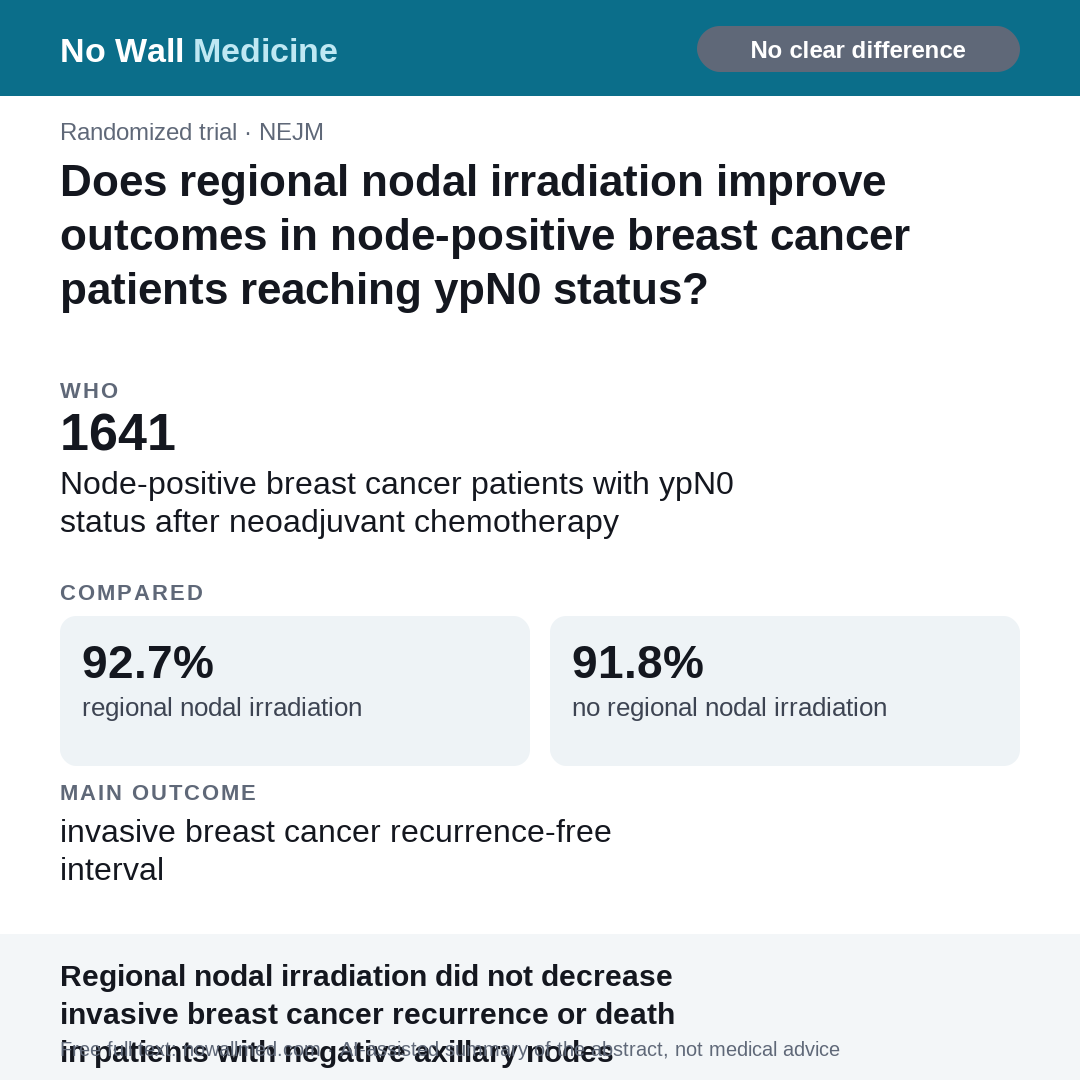
Omitting Regional Nodal Irradiation after Response to Neoadjuvant Chemotherapy
Randomized trialNo clear difference
Does regional nodal irradiation improve outcomes in node-positive breast cancer patients reaching ypN0 status?
Who
1641
Node-positive breast cancer patients with ypN0 status after neoadjuvant chemotherapy
Compared
92.7%regional nodal irradiation
91.8%no regional nodal irradiation
Main outcome
invasive breast cancer recurrence-free interval
Result: hazard ratio 0.88 (95% confidence interval 0.60 to 1.28)
Bottom line: Regional nodal irradiation did not decrease invasive breast cancer recurrence or death in patients with negative axillary nodes after chemotherapy.
Funded by: National Institutes of Health
NEJM · 2025-06-04Download image
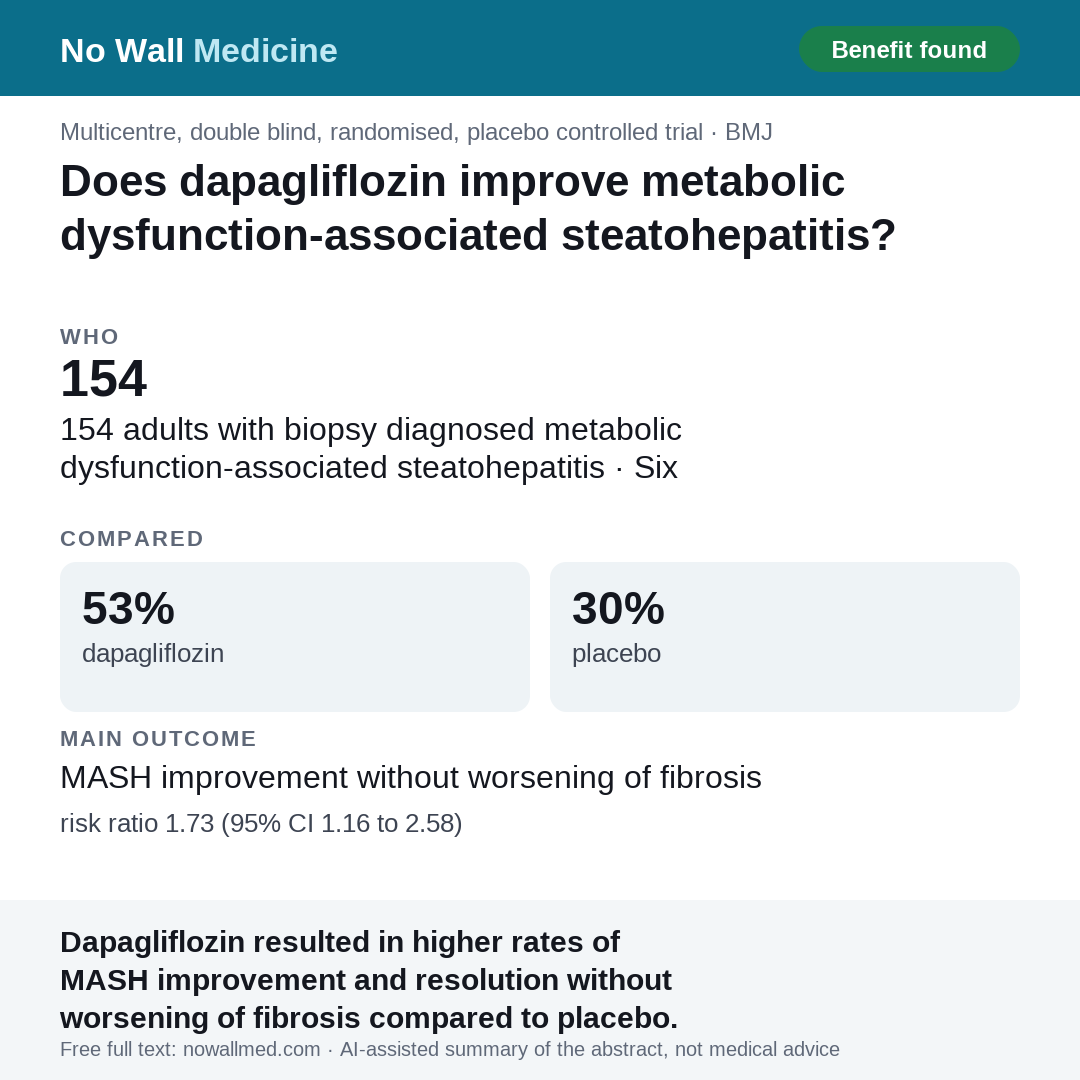
Effect of dapagliflozin on metabolic dysfunction-associated steatohepatitis: multicentre, double blind, randomised, placebo controlled trial
Multicentre, double blind, randomised, placebo controlled trialBenefit found
Does dapagliflozin improve metabolic dysfunction-associated steatohepatitis?
Who
154
154 adults with biopsy diagnosed metabolic dysfunction-associated steatohepatitis · Six tertiary hospitals in China
Compared
53%dapagliflozin (41/78)
30%placebo (23/76)
Main outcome
MASH improvement without worsening of fibrosis
Result: risk ratio 1.73 (95% CI 1.16 to 2.58)
Bottom line: Dapagliflozin resulted in higher rates of MASH improvement and resolution without worsening of fibrosis compared to placebo.
BMJ · 2025-06-04Download image
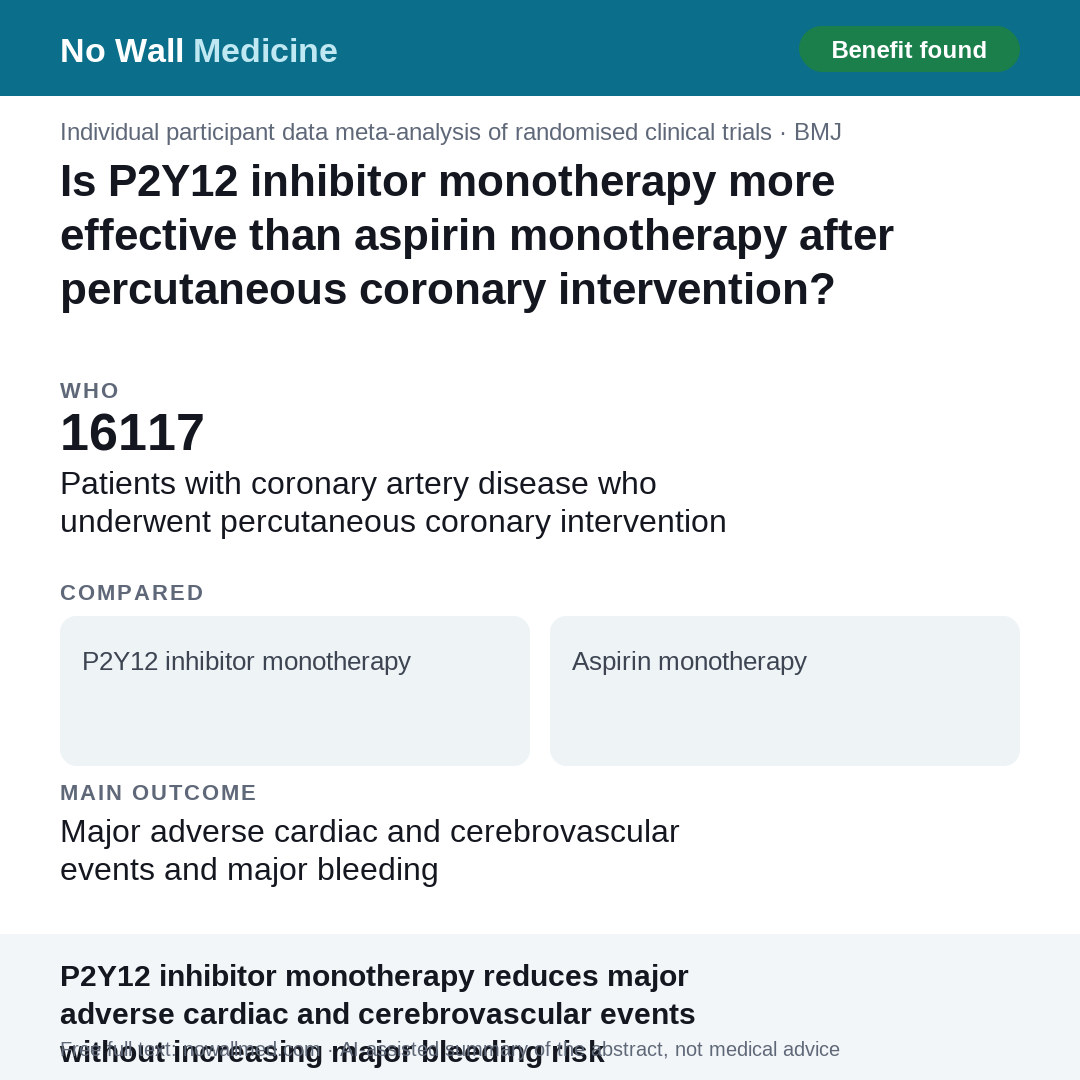
P2Y12 inhibitor or aspirin after percutaneous coronary intervention: individual patient data meta-analysis of randomised clinical trials
Individual participant data meta-analysis of randomised clinical trialsBenefit found
Is P2Y12 inhibitor monotherapy more effective than aspirin monotherapy after percutaneous coronary intervention?
Who
16117
Patients with coronary artery disease who underwent percutaneous coronary intervention
Compared
P2Y12 inhibitor monotherapy
Aspirin monotherapy
Main outcome
Major adverse cardiac and cerebrovascular events and major bleeding
Result: hazard ratio 0.77 (95% CI 0.67 to 0.89)
Bottom line: P2Y12 inhibitor monotherapy reduces major adverse cardiac and cerebrovascular events without increasing major bleeding risk compared to aspirin.
BMJ · 2025-06-04Download image
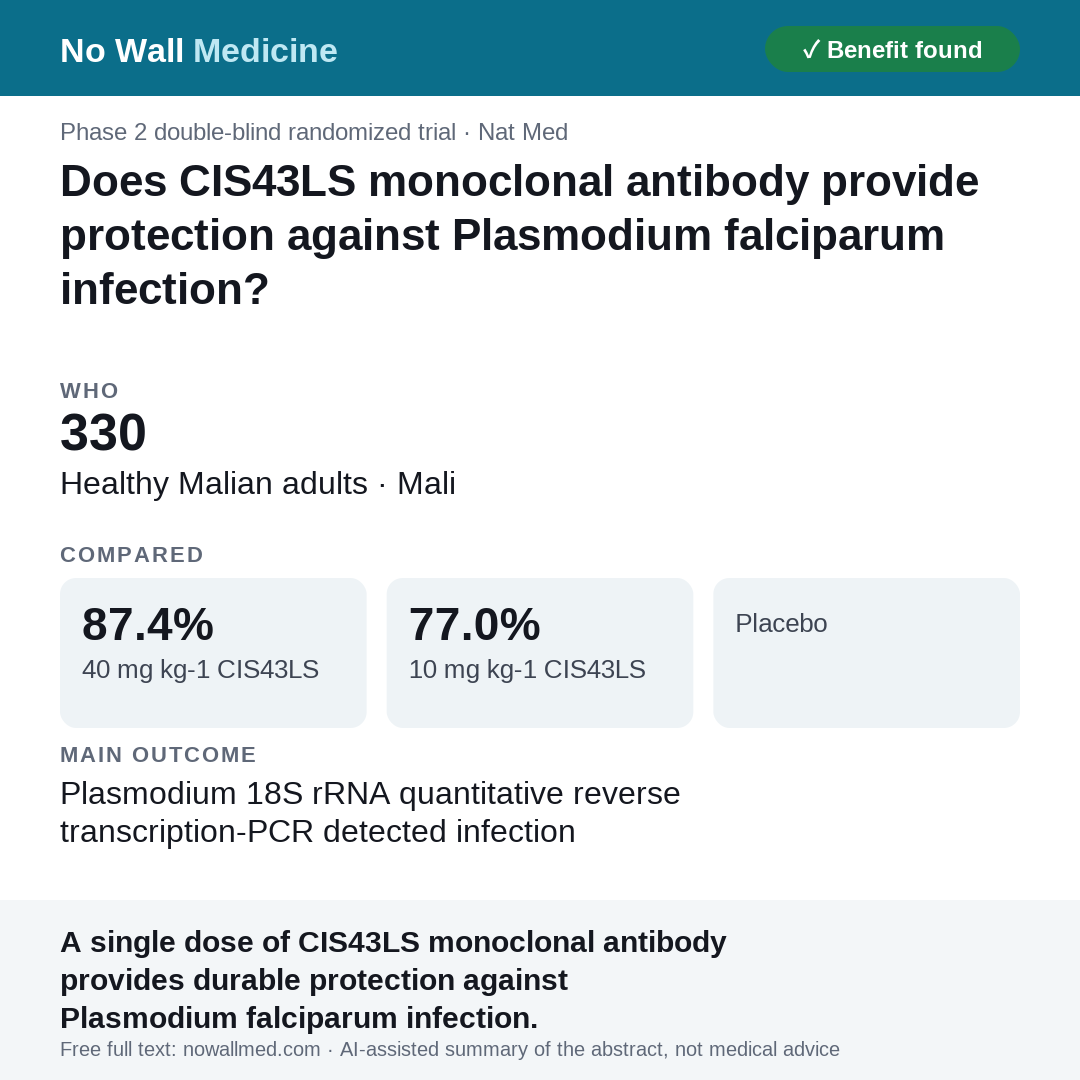
Anti-sporozoite monoclonal antibody for malaria prevention: secondary efficacy outcome of a phase 2 randomized trial
Phase 2 double-blind randomized trialBenefit found
Does CIS43LS monoclonal antibody provide protection against Plasmodium falciparum infection?
Who
330
Healthy Malian adults · Mali
Compared
87.4%40 mg kg-1 CIS43LS
77.0%10 mg kg-1 CIS43LS
Placebo
Main outcome
Plasmodium 18S rRNA quantitative reverse transcription-PCR detected infection
Result: 87.4% (adjusted 95% CI, 79.5-92.3) and 77.0% (adjusted 95% CI, 65.0-84.0)
Bottom line: A single dose of CIS43LS monoclonal antibody provides durable protection against Plasmodium falciparum infection.
Nat Med · 2025-06-03Download image
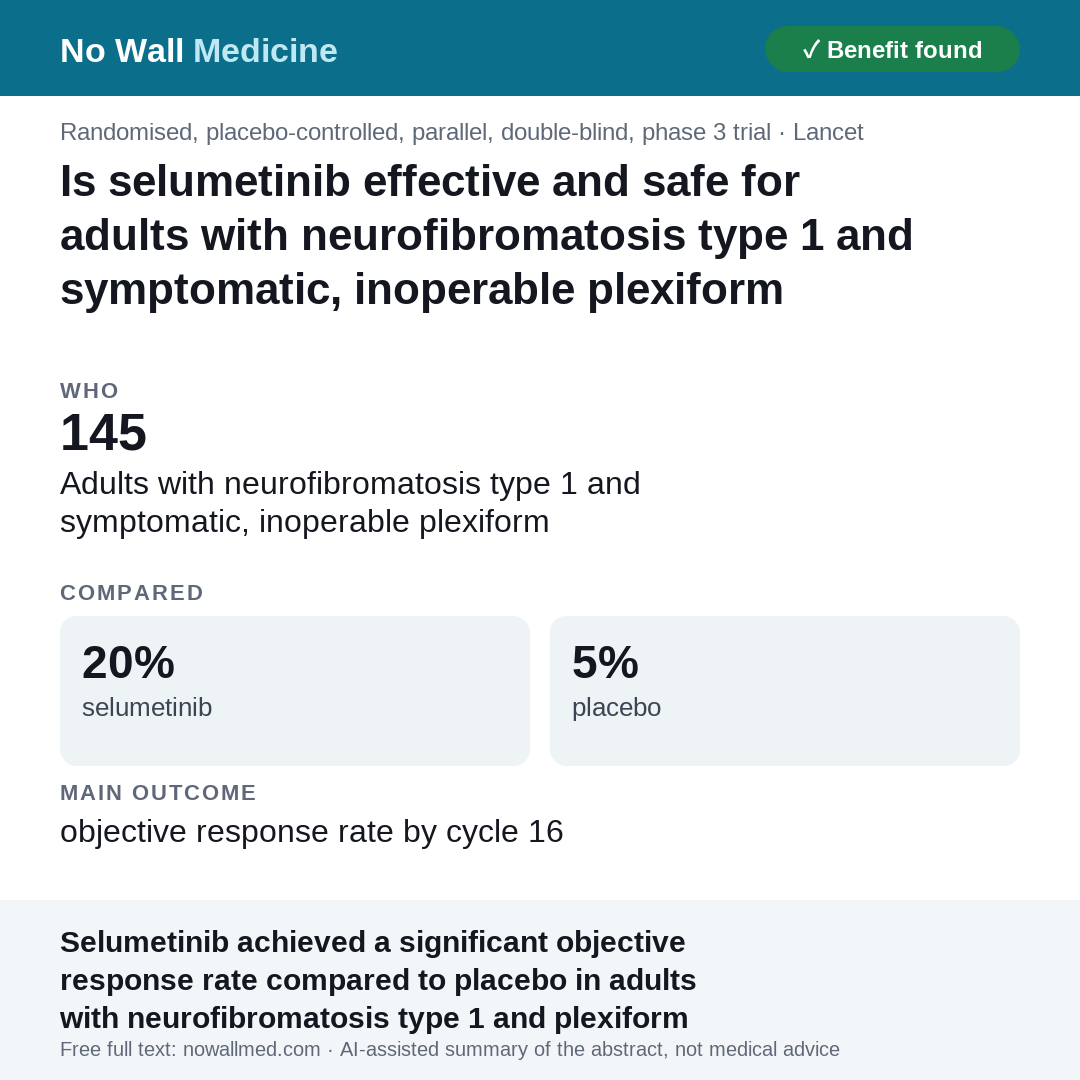
Efficacy and safety of selumetinib in adults with neurofibromatosis type 1 and symptomatic, inoperable plexiform neurofibromas (KOMET): a multicentre, international, randomised, placebo-controlled, parallel, double-blind, phase 3 study
Randomised, placebo-controlled, parallel, double-blind, phase 3 trialBenefit found
Is selumetinib effective and safe for adults with neurofibromatosis type 1 and symptomatic, inoperable plexiform neurofibromas?
Who
145
Adults with neurofibromatosis type 1 and symptomatic, inoperable plexiform neurofibromas · Multicentre, international
Compared
20%selumetinib (14/71)
5%placebo (4/74)
Main outcome
objective response rate by cycle 16
Result: 20% (95% CI 11·2 to 30·9) vs 5% (95% CI 1·5 to 13·3)
Bottom line: Selumetinib achieved a significant objective response rate compared to placebo in adults with neurofibromatosis type 1 and plexiform neurofibromas.
Funded by: AstraZeneca and Merck Sharp & Dohme
Lancet · 2025-06-02Download image
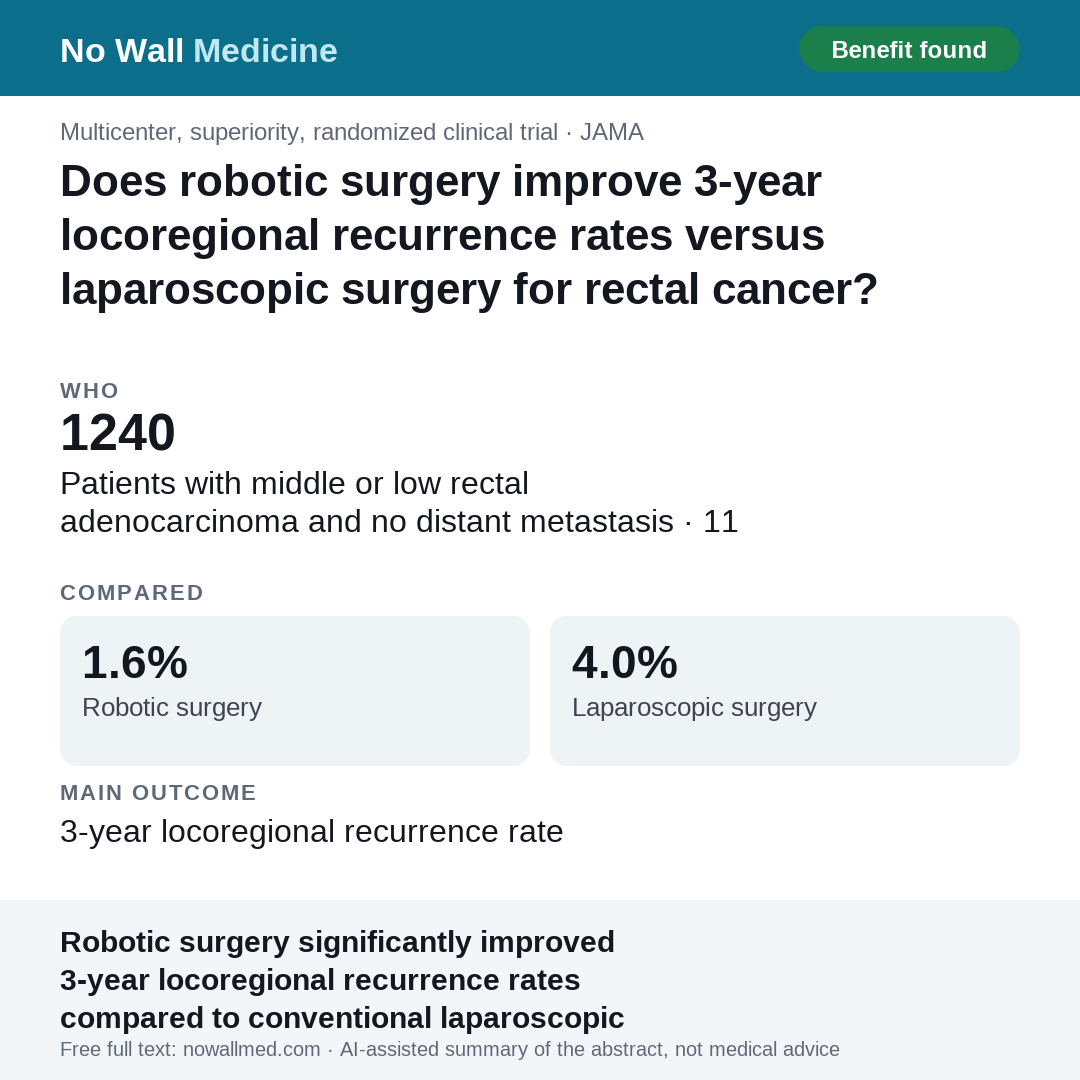
Robotic vs Laparoscopic Surgery for Middle and Low Rectal Cancer: The REAL Randomized Clinical Trial
Multicenter, superiority, randomized clinical trialBenefit found
Does robotic surgery improve 3-year locoregional recurrence rates versus laparoscopic surgery for rectal cancer?
Who
1240
Patients with middle or low rectal adenocarcinoma and no distant metastasis · 11 centers across 8 provinces in China
Compared
1.6%Robotic surgery (95% CI, 0.6%-2.6%)
4.0%Laparoscopic surgery (95% CI, 2.4%-5.6%)
Main outcome
3-year locoregional recurrence rate
Result: hazard ratio 0.45 (95% CI, 0.22-0.92)
Bottom line: Robotic surgery significantly improved 3-year locoregional recurrence rates compared to conventional laparoscopic surgery for rectal cancer.
JAMA · 2025-06-02Download image
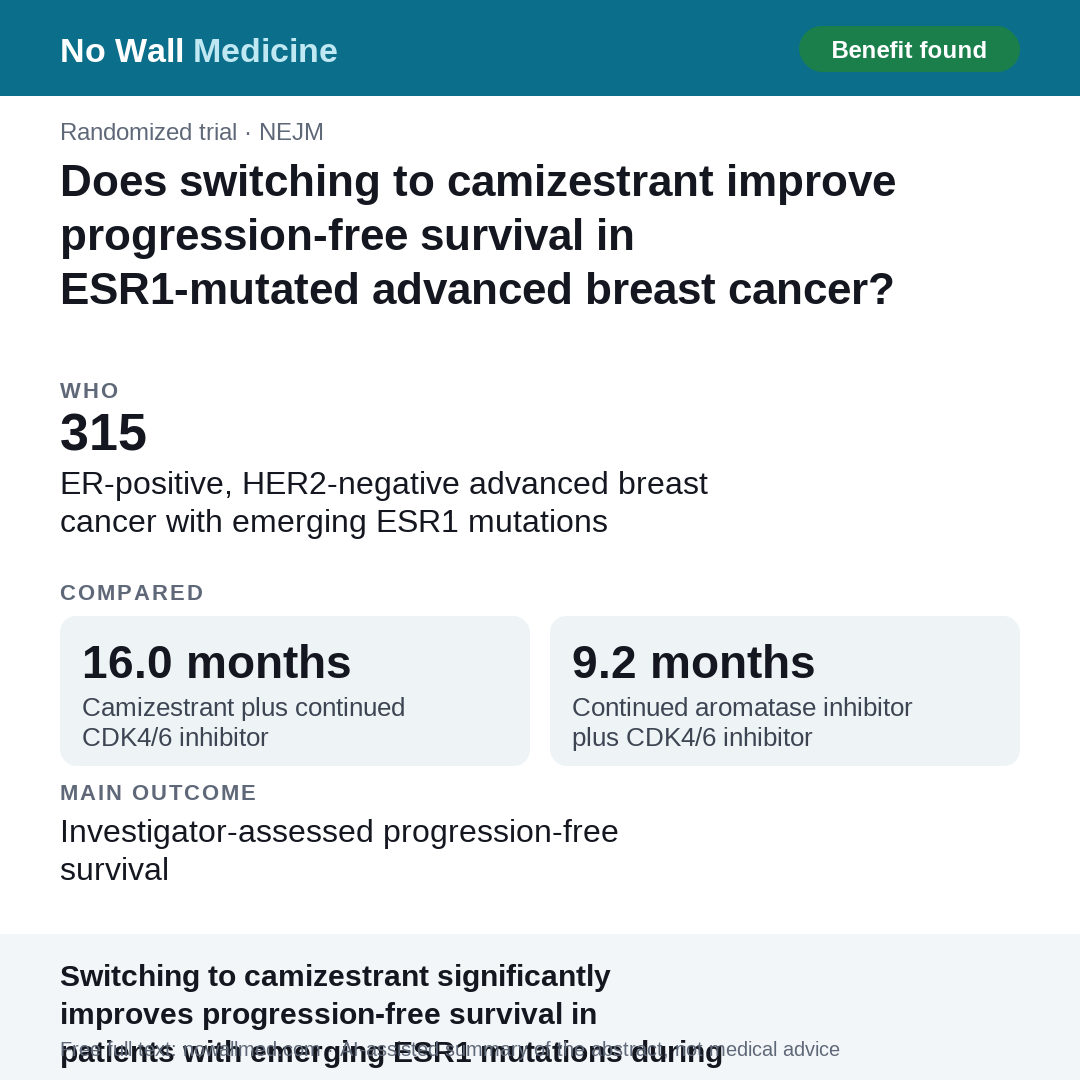
First-Line Camizestrant for Emerging ESR1-Mutated Advanced Breast Cancer
Randomized trialBenefit found
Does switching to camizestrant improve progression-free survival in ESR1-mutated advanced breast cancer?
Who
315
ER-positive, HER2-negative advanced breast cancer with emerging ESR1 mutations
Compared
16.0 monthsCamizestrant plus continued CDK4/6 inhibitor (95% CI, 12.7 to 18.2)
9.2 monthsContinued aromatase inhibitor plus CDK4/6 inhibitor (95% CI, 7.2 to 9.5)
Main outcome
Investigator-assessed progression-free survival
Result: hazard ratio 0.44 (95% CI 0.31 to 0.60)
Bottom line: Switching to camizestrant significantly improves progression-free survival in patients with emerging ESR1 mutations during first-line therapy.
Funded by: AstraZeneca
NEJM · 2025-06-01Download image
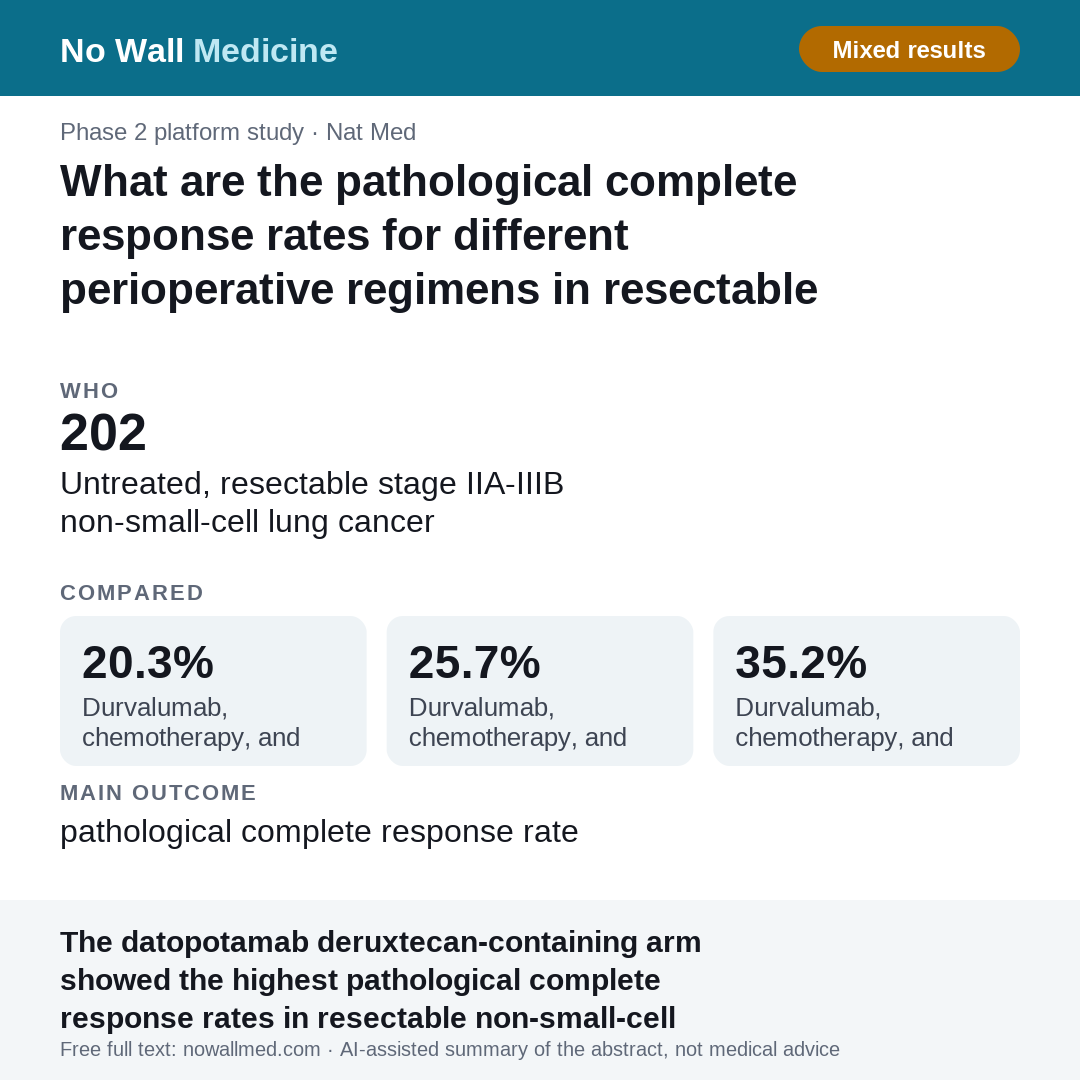
Perioperative durvalumab plus chemotherapy plus new agents for resectable non-small-cell lung cancer: the platform phase 2 NeoCOAST-2 trial
Phase 2 platform studyMixed results
What are the pathological complete response rates for different perioperative regimens in resectable non-small-cell lung cancer?
Who
202
Untreated, resectable stage IIA-IIIB non-small-cell lung cancer
Compared
20.3%Durvalumab, chemotherapy, and oleclumab (15/74; 95% CI, 11.8-31.2)
25.7%Durvalumab, chemotherapy, and monalizumab (18/70; 95% CI, 16.0-37.6)
35.2%Durvalumab, chemotherapy, and datopotamab deruxtecan (19/54; 95% CI, 22.7-49.4)
Main outcome
pathological complete response rate
Bottom line: The datopotamab deruxtecan-containing arm showed the highest pathological complete response rates in resectable non-small-cell lung cancer.
Nat Med · 2025-05-31Download image
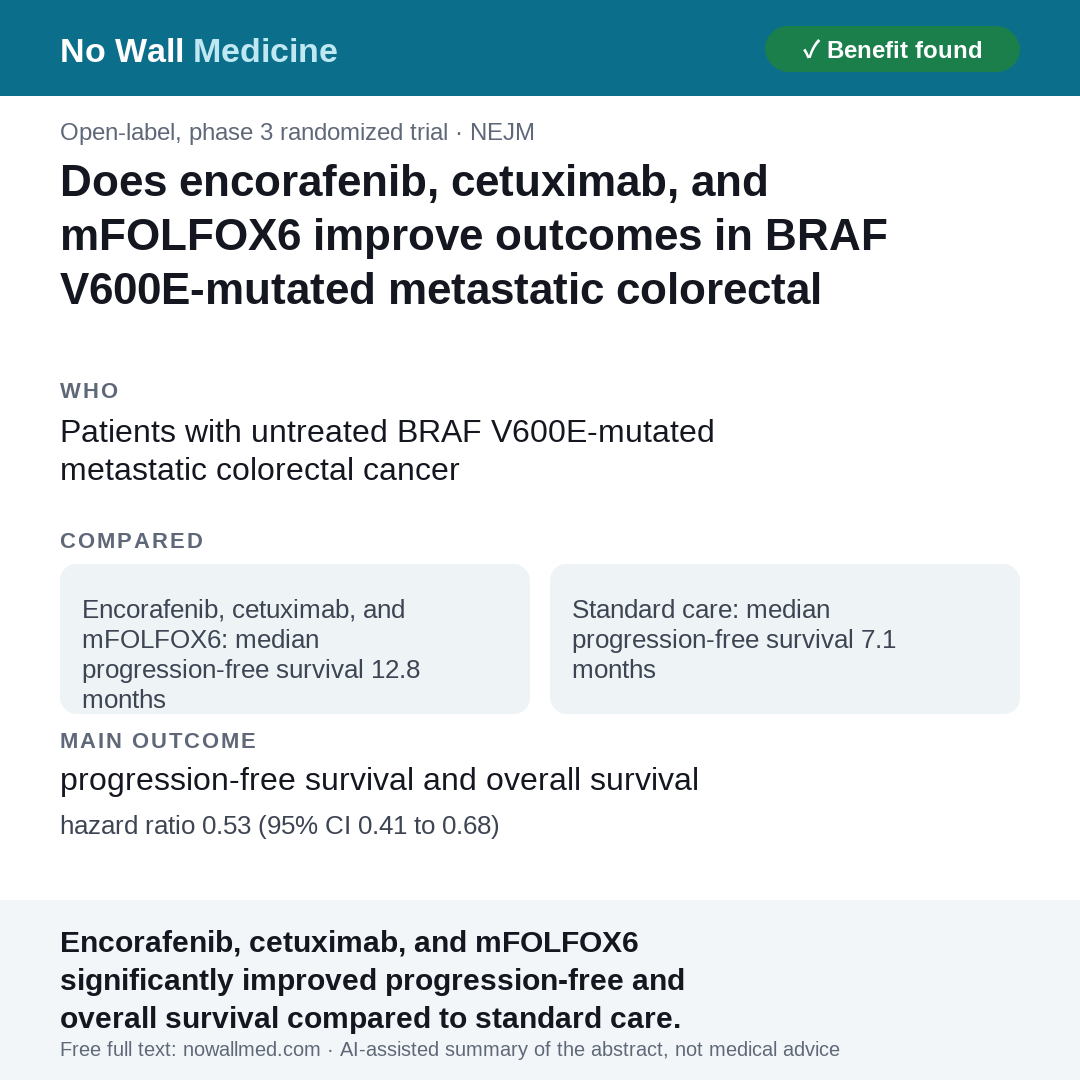
Encorafenib, Cetuximab, and mFOLFOX6 in BRAF-Mutated Colorectal Cancer
Open-label, phase 3 randomized trialBenefit found
Does encorafenib, cetuximab, and mFOLFOX6 improve outcomes in BRAF V600E-mutated metastatic colorectal cancer?
Who
Patients with untreated BRAF V600E-mutated metastatic colorectal cancer
Compared
Encorafenib, cetuximab, and mFOLFOX6: median progression-free survival 12.8 months
Standard care: median progression-free survival 7.1 months
Main outcome
progression-free survival and overall survival
Result: hazard ratio 0.53 (95% CI 0.41 to 0.68)
Bottom line: Encorafenib, cetuximab, and mFOLFOX6 significantly improved progression-free and overall survival compared to standard care.
Funded by: Pfizer and others
NEJM · 2025-05-30Download image
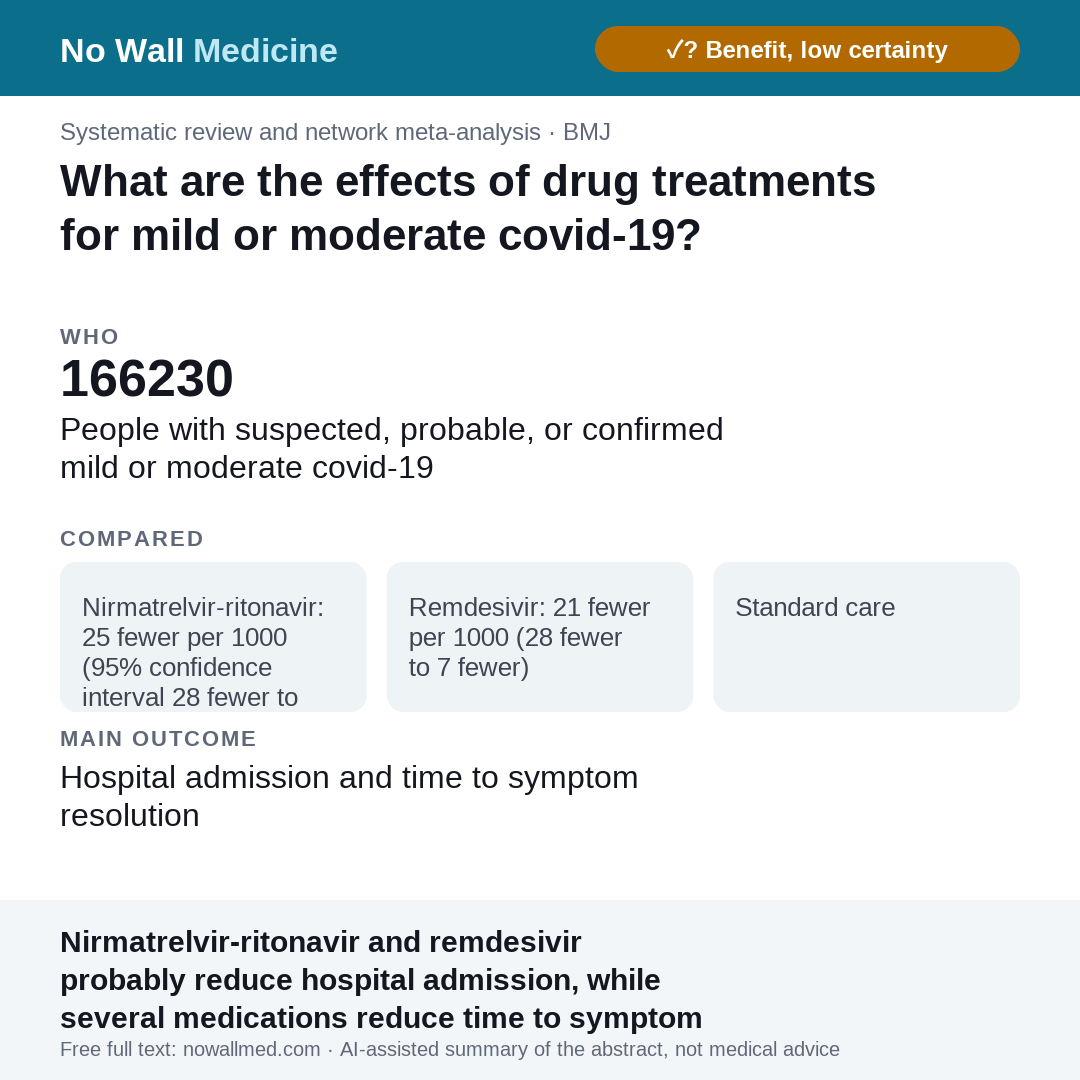
Drug treatments for mild or moderate covid-19: systematic review and network meta-analysis
Systematic review and network meta-analysisBenefit found
What are the effects of drug treatments for mild or moderate covid-19?
Who
166230
People with suspected, probable, or confirmed mild or moderate covid-19
Compared
Nirmatrelvir-ritonavir: 25 fewer per 1000 (95% confidence interval 28 fewer to 20 fewer)
Remdesivir: 21 fewer per 1000 (28 fewer to 7 fewer)
Standard care
Main outcome
Hospital admission and time to symptom resolution
Bottom line: Nirmatrelvir-ritonavir and remdesivir probably reduce hospital admission, while several medications reduce time to symptom resolution.
BMJ · 2025-05-29Download image
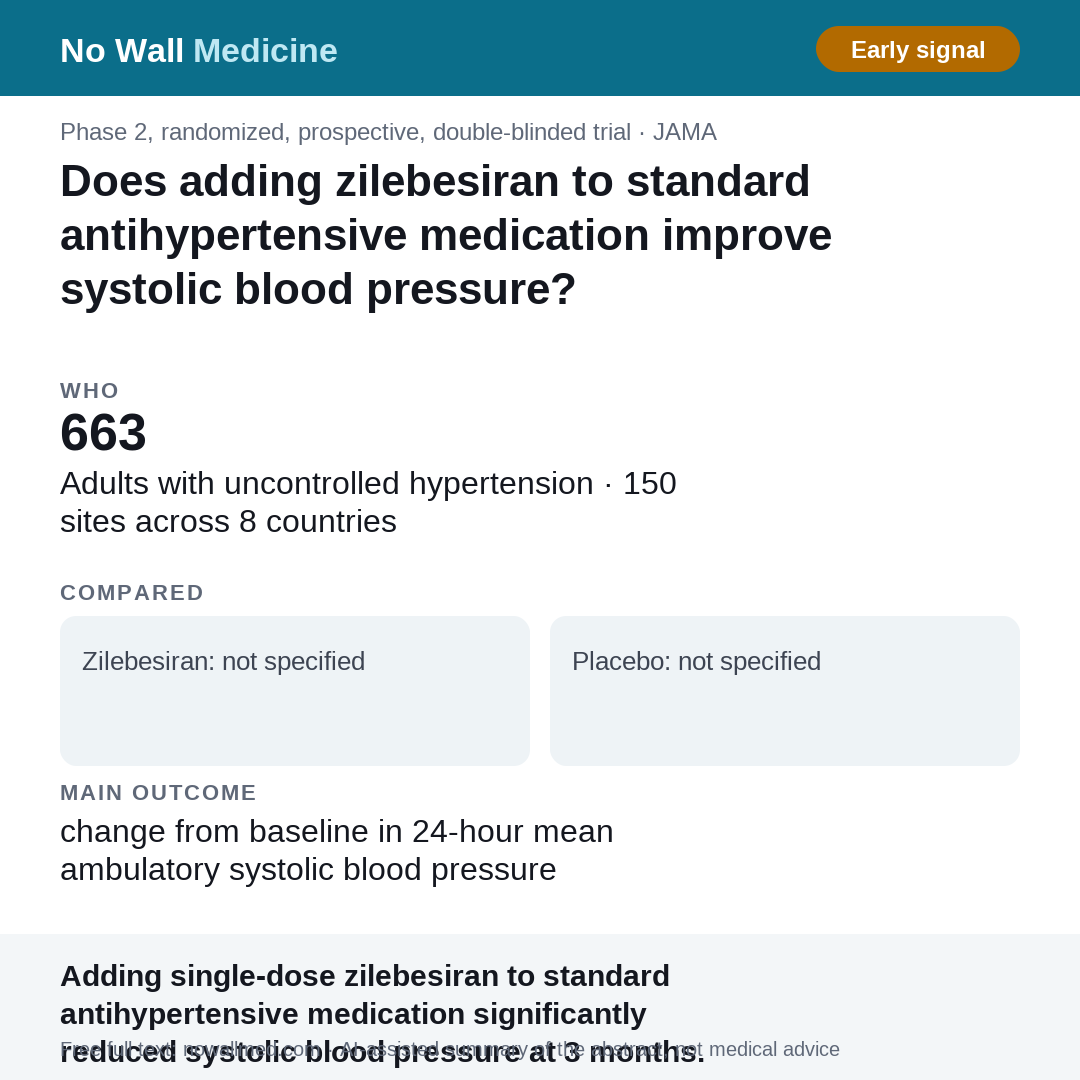
Add-On Treatment With Zilebesiran for Inadequately Controlled Hypertension: The KARDIA-2 Randomized Clinical Trial
Phase 2, randomized, prospective, double-blinded trialBenefit found
Does adding zilebesiran to standard antihypertensive medication improve systolic blood pressure?
Who
663
Adults with uncontrolled hypertension · 150 sites across 8 countries
Compared
Zilebesiran: not specified
Placebo: not specified
Main outcome
change from baseline in 24-hour mean ambulatory systolic blood pressure
Result: -12.1 mm Hg (95% CI, -16.5 to -7.6)
Bottom line: Adding single-dose zilebesiran to standard antihypertensive medication significantly reduced systolic blood pressure at 3 months.
JAMA · 2025-05-28Download image
A village doctor-led mobile health intervention for cardiovascular risk reduction in rural China: cluster randomised controlled trial
Cluster randomised controlled trialBenefit found
Does a village doctor-led mobile health intervention reduce cardiovascular risk in rural China?
Who
4533
Residents aged 35+ with 10 year atherosclerotic cardiovascular disease risk ≥10% · 127 villages from five provinces and autonomous regions in China
Compared
11.7%intervention group
13.6%control group
Main outcome
Mean change in predicted 10 year risk of atherosclerotic cardiovascular disease
Result: absolute difference -1.88% (95% CI -2.57% to -1.19%)
Bottom line: A village doctor-led mobile health intervention effectively reduced predicted 10 year cardiovascular disease risk in rural China.
BMJ · 2025-05-27Download image

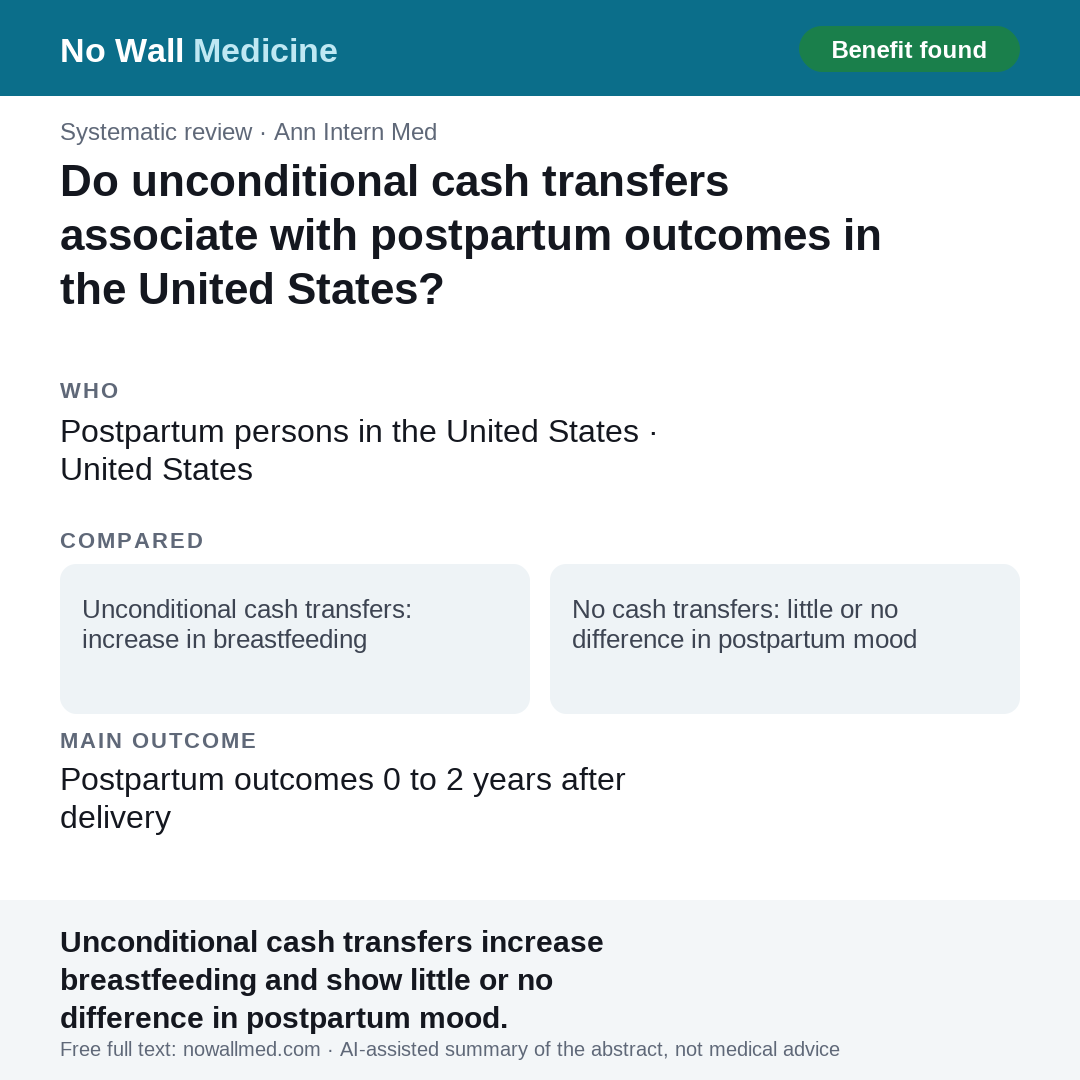
Associations Between Unconditional Cash Transfers and Postpartum Outcomes in the United States : A Systematic Review
Systematic reviewBenefit found
Do unconditional cash transfers associate with postpartum outcomes in the United States?
Who
Postpartum persons in the United States · United States
Compared
Unconditional cash transfers: increase in breastfeeding
No cash transfers: little or no difference in postpartum mood
Main outcome
Postpartum outcomes 0 to 2 years after delivery
Bottom line: Unconditional cash transfers increase breastfeeding and show little or no difference in postpartum mood.
Limitation: Unpublished studies, non-English studies, and nonrandomized study bias may have been present.
Ann Intern Med · 2025-05-27Download image
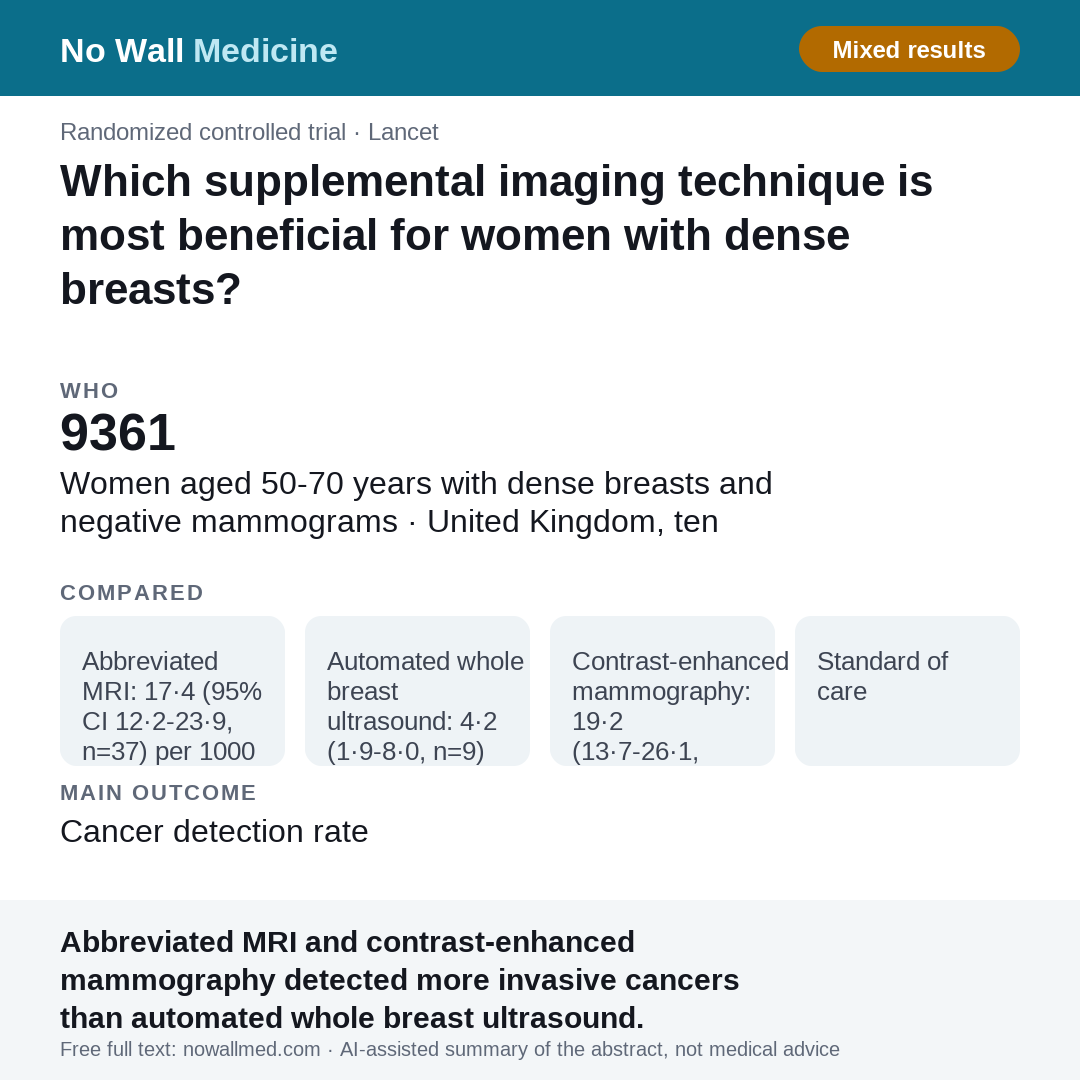
Comparison of supplemental breast cancer imaging techniques-interim results from the BRAID randomised controlled trial
Randomized controlled trialMixed results
Which supplemental imaging technique is most beneficial for women with dense breasts?
Who
9361
Women aged 50-70 years with dense breasts and negative mammograms · United Kingdom, ten breast screening sites
Compared
Abbreviated MRI: 17·4 (95% CI 12·2-23·9, n=37) per 1000 examinations
Automated whole breast ultrasound: 4·2 (1·9-8·0, n=9) per 1000 examinations
Contrast-enhanced mammography: 19·2 (13·7-26·1, n=39) per 1000 examinations
Standard of care
Main outcome
Cancer detection rate
Bottom line: Abbreviated MRI and contrast-enhanced mammography detected more invasive cancers than automated whole breast ultrasound.
Funded by: Cancer Research UK, GE Healthcare, and Bayer Healthcare
Lancet · 2025-05-21Download image
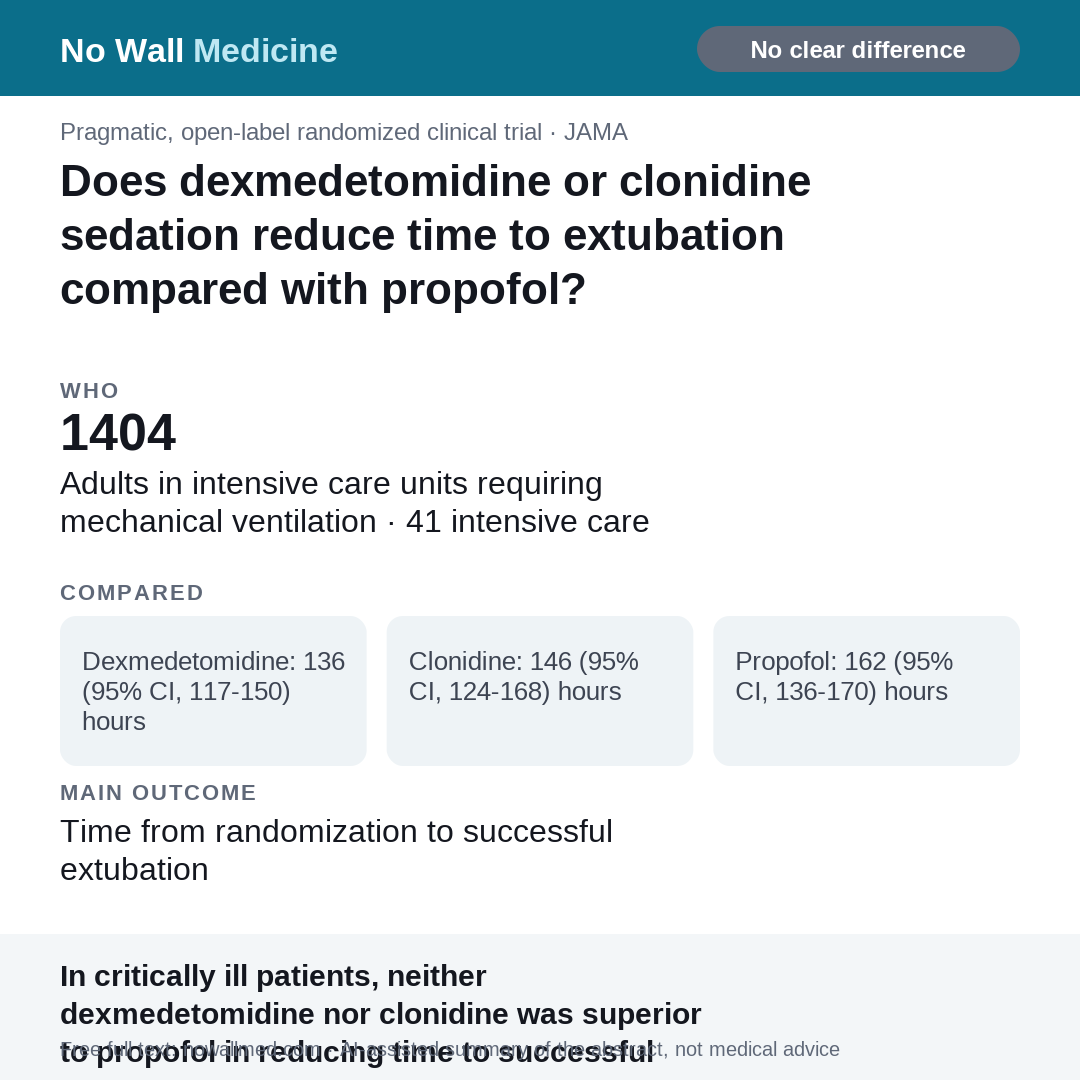
Dexmedetomidine- or Clonidine-Based Sedation Compared With Propofol in Critically Ill Patients: The A2B Randomized Clinical Trial
Pragmatic, open-label randomized clinical trialNo clear difference
Does dexmedetomidine or clonidine sedation reduce time to extubation compared with propofol?
Who
1404
Adults in intensive care units requiring mechanical ventilation · 41 intensive care units in the United Kingdom
Compared
Dexmedetomidine: 136 (95% CI, 117-150) hours
Clonidine: 146 (95% CI, 124-168) hours
Propofol: 162 (95% CI, 136-170) hours
Main outcome
Time from randomization to successful extubation
Result: subdistribution hazard ratio 1.09 (95% CI, 0.96-1.25) for dexmedetomidine vs propofol
Bottom line: In critically ill patients, neither dexmedetomidine nor clonidine was superior to propofol in reducing time to successful extubation.
JAMA · 2025-05-20Download image
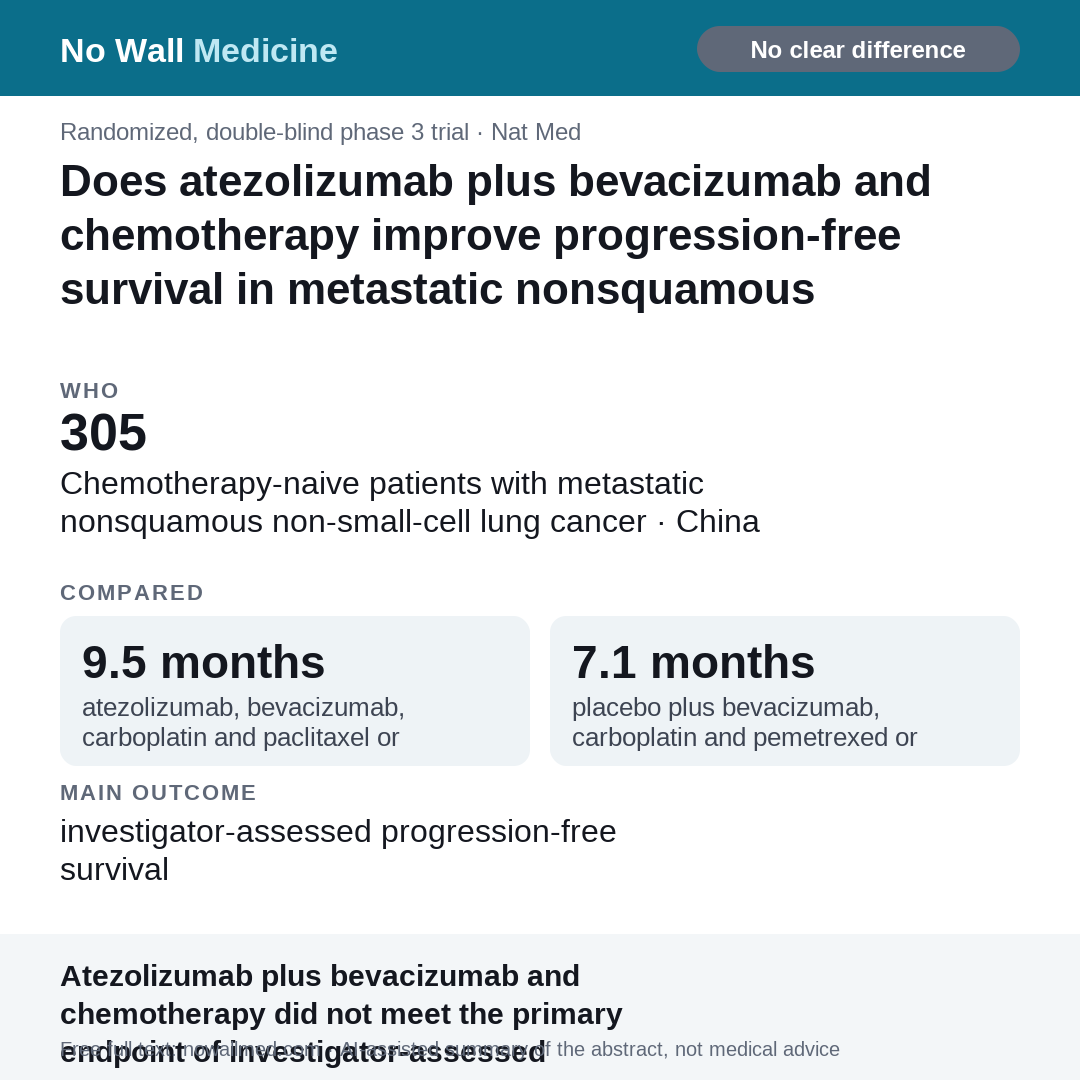
Atezolizumab plus bevacizumab and chemotherapy in metastatic nonsquamous NSCLC: the randomized double-blind phase 3 IMpower151 trial
Randomized, double-blind phase 3 trialNo clear difference
Does atezolizumab plus bevacizumab and chemotherapy improve progression-free survival in metastatic nonsquamous non-small-cell lung cancer?
Who
305
Chemotherapy-naive patients with metastatic nonsquamous non-small-cell lung cancer · China
Compared
9.5 monthsatezolizumab, bevacizumab, carboplatin and paclitaxel or pemetrexed
7.1 monthsplacebo plus bevacizumab, carboplatin and pemetrexed or paclitaxel
Main outcome
investigator-assessed progression-free survival
Result: stratified hazard ratio: 0.84 (95% confidence interval: 0.65, 1.09)
Bottom line: Atezolizumab plus bevacizumab and chemotherapy did not meet the primary endpoint of investigator-assessed progression-free survival.
Nat Med · 2025-05-16Download image
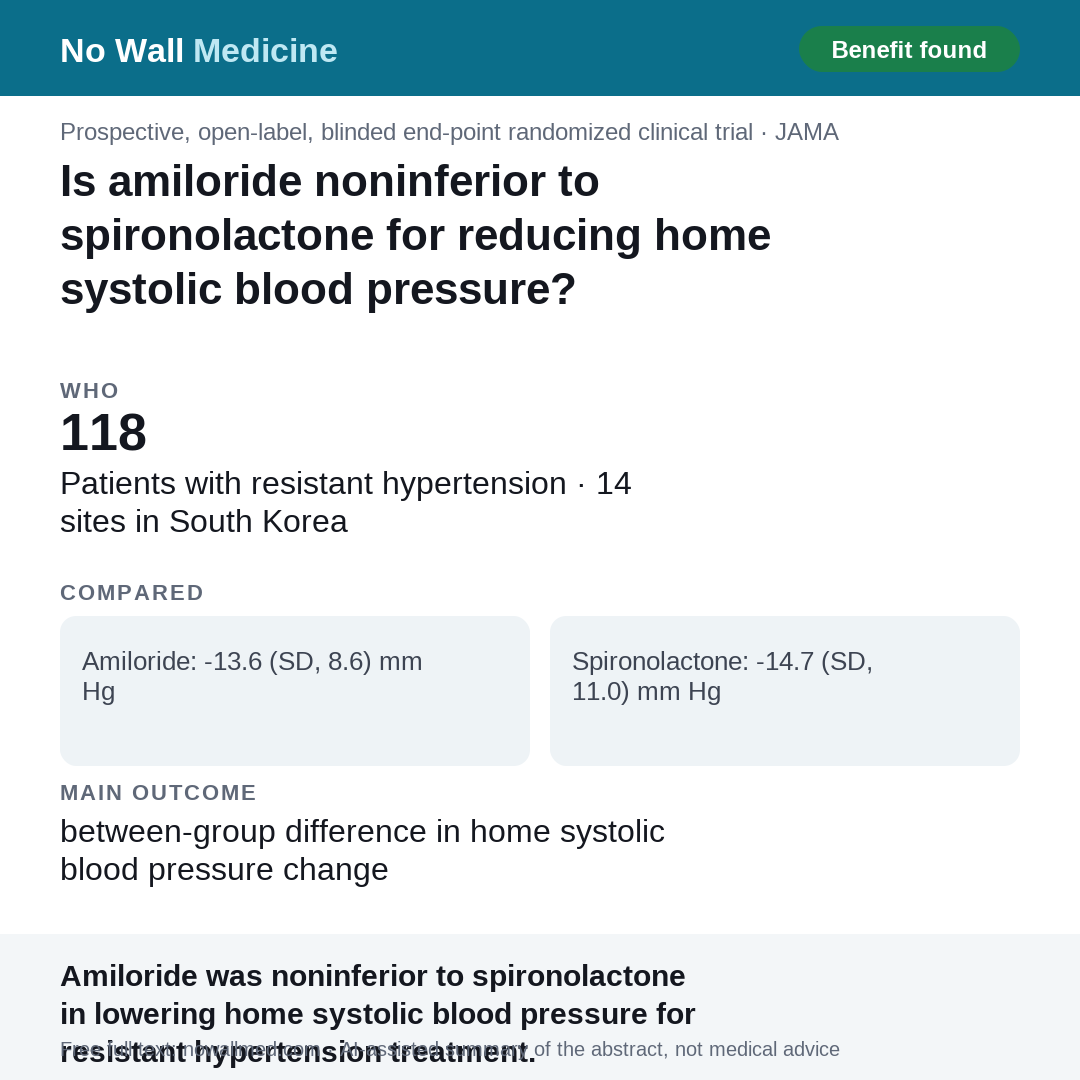
Spironolactone vs Amiloride for Resistant Hypertension: A Randomized Clinical Trial
Prospective, open-label, blinded end-point randomized clinical trialBenefit found
Is amiloride noninferior to spironolactone for reducing home systolic blood pressure?
Who
118
Patients with resistant hypertension · 14 sites in South Korea
Compared
Amiloride: -13.6 (SD, 8.6) mm Hg
Spironolactone: -14.7 (SD, 11.0) mm Hg
Main outcome
between-group difference in home systolic blood pressure change
Result: -0.68 mm Hg; 90% CI, -3.50 to 2.14 mm Hg
Bottom line: Amiloride was noninferior to spironolactone in lowering home systolic blood pressure for resistant hypertension treatment.
JAMA · 2025-05-14Download image
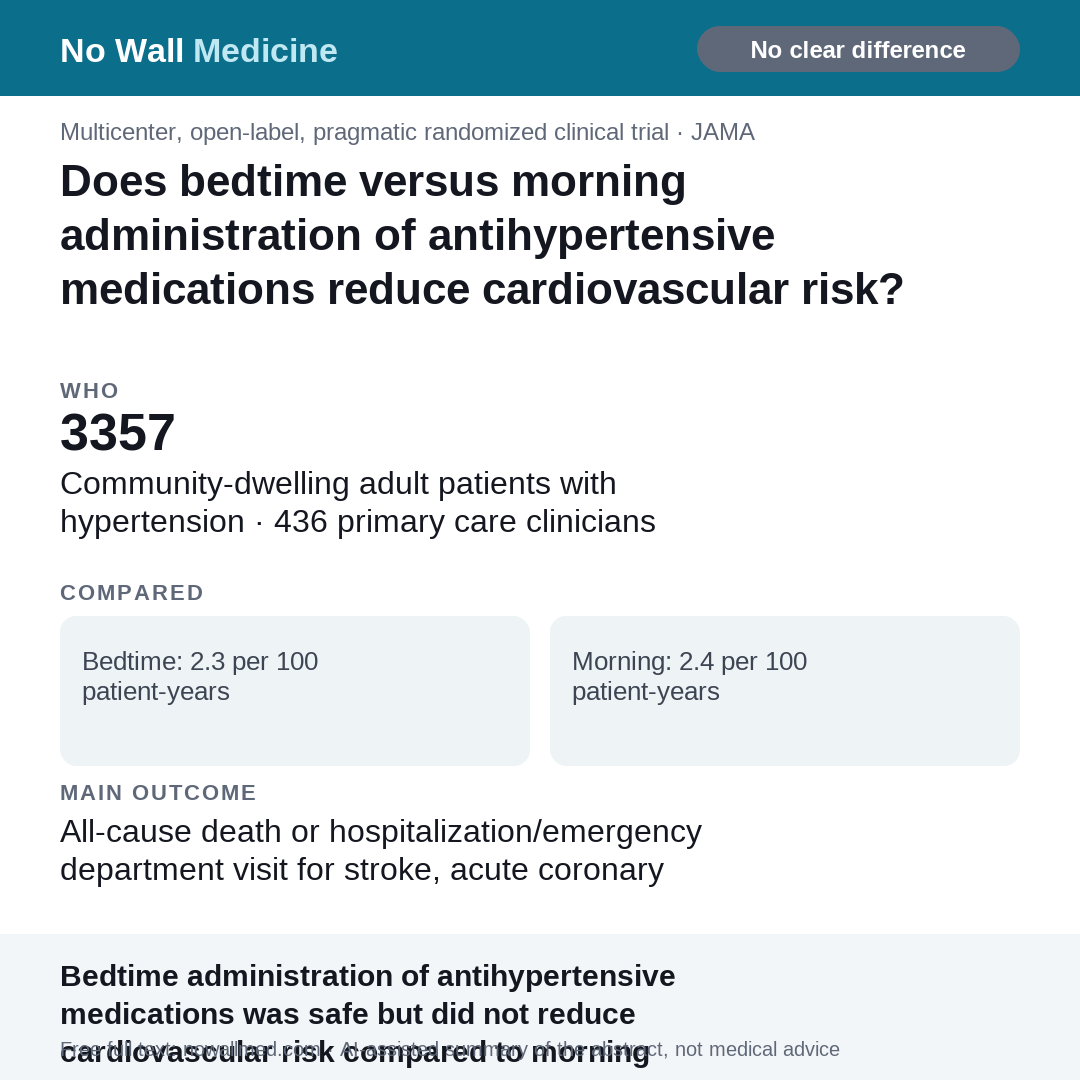
Antihypertensive Medication Timing and Cardiovascular Events and Death: The BedMed Randomized Clinical Trial
Multicenter, open-label, pragmatic randomized clinical trialNo clear difference
Does bedtime versus morning administration of antihypertensive medications reduce cardiovascular risk?
Who
3357
Community-dwelling adult patients with hypertension · 436 primary care clinicians across 5 Canadian provinces
Compared
Bedtime: 2.3 per 100 patient-years
Morning: 2.4 per 100 patient-years
Main outcome
All-cause death or hospitalization/emergency department visit for stroke, acute coronary syndrome, or heart failure
Result: adjusted hazard ratio 0.96 (95% CI 0.77-1.19)
Bottom line: Bedtime administration of antihypertensive medications was safe but did not reduce cardiovascular risk compared to morning administration.
JAMA · 2025-05-12Download image
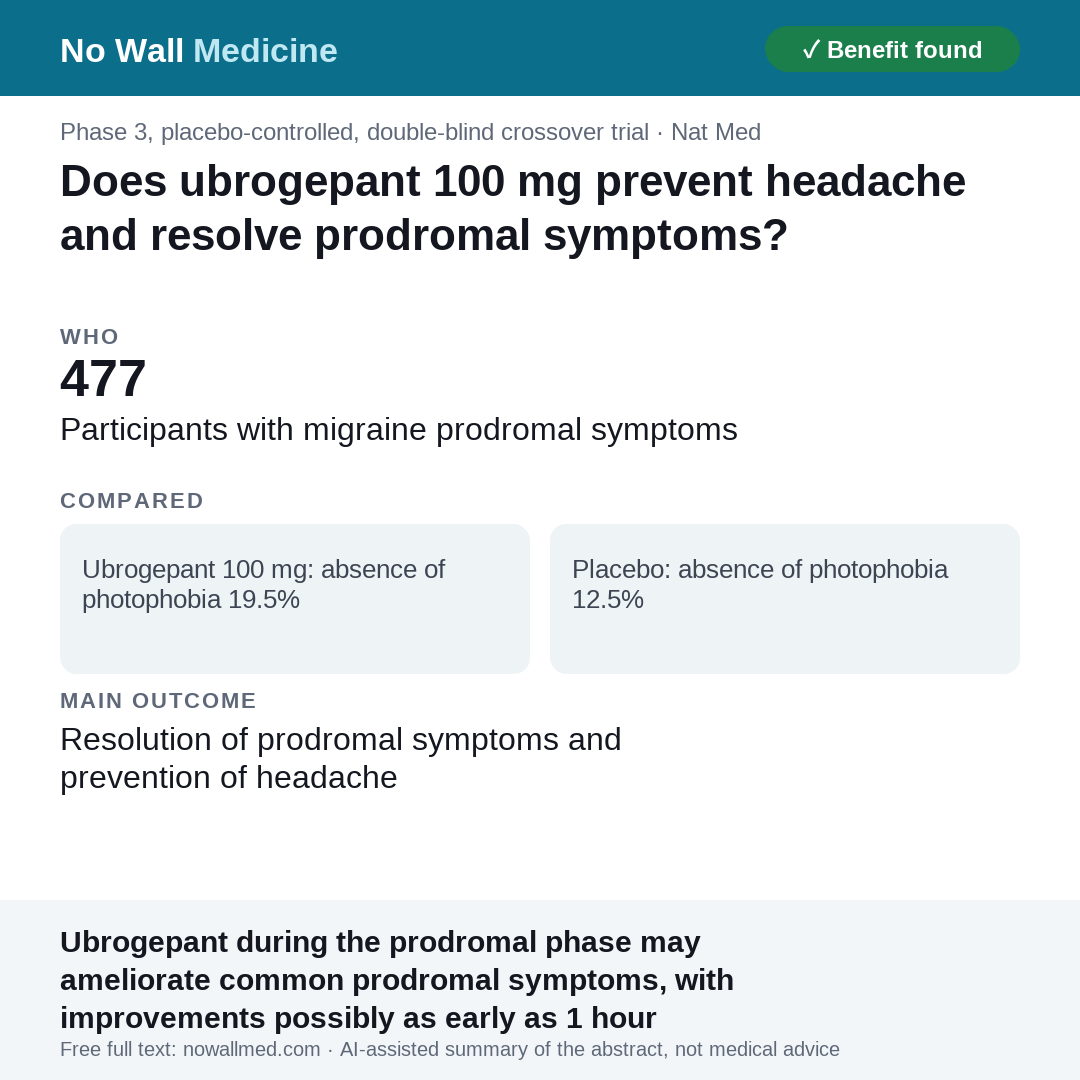
Ubrogepant for the treatment of migraine prodromal symptoms: an exploratory analysis from the randomized phase 3 PRODROME trial
Phase 3, placebo-controlled, double-blind crossover trialBenefit found
Does ubrogepant 100 mg prevent headache and resolve prodromal symptoms?
Who
477
Participants with migraine prodromal symptoms
Compared
Ubrogepant 100 mg: absence of photophobia 19.5%
Placebo: absence of photophobia 12.5%
Main outcome
Resolution of prodromal symptoms and prevention of headache
Bottom line: Ubrogepant during the prodromal phase may ameliorate common prodromal symptoms, with improvements possibly as early as 1 hour post-dose.
Nat Med · 2025-05-12Download image