Visual abstracts
New randomized trials and meta-analyses from leading journals at a glance: who was studied, what was compared, and what was found. Every paper is free to read in full.
All specialtiesCardiology 221Oncology 182Gastroenterology & Hepatology 102Infectious Disease 174Neurology 100Psychiatry & Mental Health 149Pulmonology 104Critical Care 64Endocrinology & Diabetes 147Pediatrics 92Surgery 72Orthopedics & Sports Medicine 41Neurosurgery 8Cardiothoracic & Vascular Surgery 24Plastic & Reconstructive Surgery 52Nephrology 44Rheumatology 42Hematology 51Dermatology 25Ophthalmology 41Obstetrics & Gynecology 58Public & Global Health 67Radiology & Imaging 18Anesthesiology 35Urology 51ENT (Otolaryngology) 27Emergency Medicine 25Allergy & Immunology 17Geriatrics 67Family Medicine & Primary Care 29Medical Genetics & Genomics 22Pathology & Laboratory Medicine 5Physical Medicine & Rehabilitation 55Palliative Care 29Nutrition 79Digital Health & AI 201General Medicine 31
Cancer risk among individuals with mental illness - a systematic review and meta-analysis of nordic register-based prospective studies
Systematic review and meta-analysisMixed results
Is there an association between mental illness and subsequent cancer risk?
Who
Individuals with mental illness in Nordic countries · Nordic countries
Compared
Schizophrenia: no association with overall cancer risk
General population
Main outcome
Cancer incidence
Result: standardized incidence ratio 1.28 (95% CI 1.08-1.52) for breast cancer
Bottom line: Mental illness is associated with altered cancer risk, including higher breast cancer risk for schizophrenia.
Limitation: high level of heterogeneity was detected between studies
Transl Psychiatry · 2026-08-01Download image

The impact of immune checkpoint inhibitors on infection in patients with solid malignancies: a systematic review and meta-analysis of randomised controlled trials
Systematic review and meta-analysis of randomised controlled trialsHarm found
Do immune checkpoint inhibitors increase infection risk in patients with solid malignancies?
Who
87,484
Patients with solid malignancies
Compared
Immune checkpoint inhibitors
Placebo or chemotherapy
Main outcome
Risk of all-grade and severe infections
Result: risk ratio 1.25 (95% confidence interval 1.12-1.39)
Bottom line: Immune checkpoint inhibitors are associated with increased risks of any-grade and severe treatment-emergent infections.
Limitation: Publication bias was suggested for any-grade infectious treatment-related adverse events.
eClinicalMedicine · 2026-07-31Download image

Drug stock-outs in HIV, tuberculosis, and malaria programs: a systematic review
Systematic reviewMixed results
What are the causes, consequences, and mitigation strategies of drug stock-outs?
Who
HIV, tuberculosis, and malaria medicine programs · Low- and middle-income countries
Compared
Causes: supply chain inefficiencies, procurement delays, inadequate funding, weak governance, and poor demand forecasting
Consequences: treatment interruptions, increased drug resistance, and higher morbidity and mortality
Main outcome
Causes, consequences, and mitigation strategies of medicine stock-outs
Bottom line: Stock-outs are largely preventable by fortifying supply chains with better forecasting, robust logistics, and sufficient financing.
Funded by: Wellcome trust CAMO-Net programme and Global Antibiotic Research and Development Partnership
eClinicalMedicine · 2026-07-31Download image

Assessment of Trophoblast cell surface antigen 2 (Trop-2) expression and its clinical significance in breast cancer: a multi-level analysis of protein and gene expression
Meta-analysis and retrospective analysisBenefit found
What is the Trop-2 expression rate and clinical significance in breast cancer?
Who
9170
Patients with breast cancer
Compared
Trop-2-directed antibody-drug conjugates: improved progression-free survival
Chemotherapy
Main outcome
Trop-2 protein positivity, progression-free survival, and overall survival
Result: hazard ratio 0.33 (95% CI 0.20-0.56)
Bottom line: Trop-2 is highly expressed in breast cancer and antibody-drug conjugates improve progression-free survival compared to chemotherapy.
BMC Med · 2026-07-31Download image

Rapid Identification of Low-quality Meta-analyses in Plastic Surgery Using the Meta-analysis Critique (MAC) Tool
Observational studyBenefit found
Can the Meta-analysis Critique tool quickly appraise plastic surgery meta-analysis quality?
Who
283
Plastic surgery meta-analyses published between 2011 and 2023 · MEDLINE and EMBASE databases
Compared
100.00%Research question assessment
96.23%Statistical analysis appropriateness assessment
98.97%Risk of bias assessment
Main outcome
Specificity of the Meta-analysis Critique tool compared to AMSTAR 2
Bottom line: The Meta-analysis Critique tool provides high specificity for quickly screening the quality of plastic surgery meta-analyses.
Limitation: Not intended as a confirmatory quality assessment instrument and requires further validation in other specialties.
Aesthet Surg J · 2026-07-31Download image

Association Between Rare Germline Variants in Cancer Susceptibility Genes and Lung Cancer Risk
Meta-analysis of two data setsBenefit found
Are rare germline variants in hereditary cancer genes associated with lung cancer risk?
Who
Participants of European ancestry · United Kingdom and United States
Compared
Rare germline variants
Controls
Main outcome
Lung cancer risk
Bottom line: Suggestive evidence supports associations between rare germline variants in eight hereditary cancer genes and lung cancer risk.
Ann Thorac Surg · 2026-07-31Download image

Propofol for palliative sedation: A systematic review of clinical outcomes, safety, and ethical implications
Systematic review of ten non-randomized studiesUnclear result
What is the role of propofol in palliative sedation for terminally ill patients?
Who
4072
Adult terminally ill patients, mainly with cancer · Europe
Compared
Propofol use: Symptom control reported in 73%-100% of cases
Target sedation depth: 52%-100%
Main outcome
Symptom control, sedation depth, survival time, and safety
Bottom line: Propofol may be a rescue option for refractory cases, but evidence certainty is low to very low.
Limitation: Low to very low certainty of available evidence and varied outcome definitions.
Palliat Med · 2026-07-31Download image

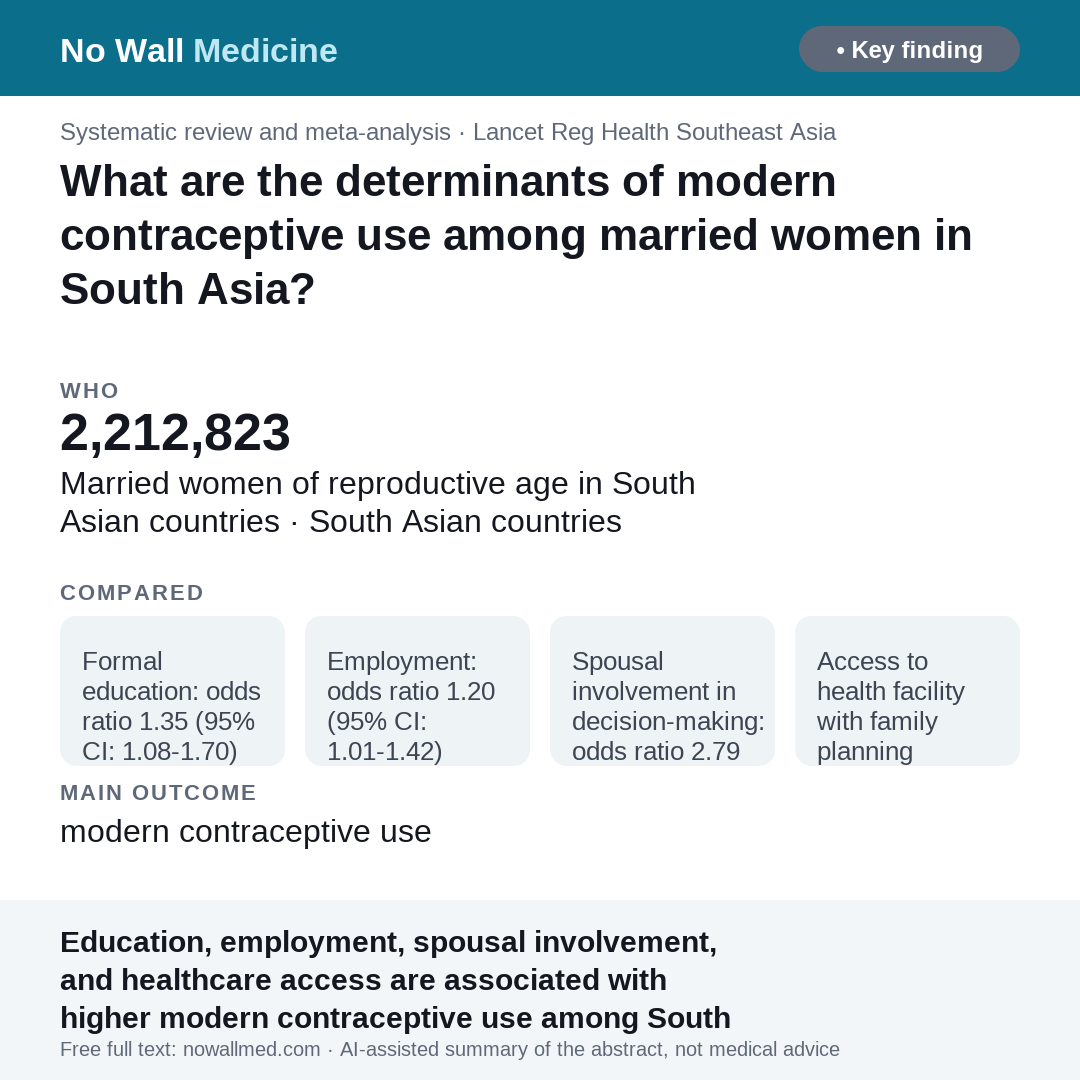
Determinants of family planning use among married women of reproductive age in south Asia: a systematic review and meta-analysis
Systematic review and meta-analysisBenefit found
What are the determinants of modern contraceptive use among married women in South Asia?
Who
2,212,823
Married women of reproductive age in South Asian countries · South Asian countries
Compared
Formal education: odds ratio 1.35 (95% CI: 1.08-1.70)
Employment: odds ratio 1.20 (95% CI: 1.01-1.42)
Spousal involvement in decision-making: odds ratio 2.79 (95% CI: 1.17-6.65)
Access to health facility with family planning services: odds ratio 2.13 (95% CI: 1.12-4.05)
Main outcome
modern contraceptive use
Bottom line: Education, employment, spousal involvement, and healthcare access are associated with higher modern contraceptive use among South Asian women.
Limitation: some estimates were based on limited studies hence should be interpreted with caution
Lancet Reg Health Southeast Asia · 2026-07-31Download image
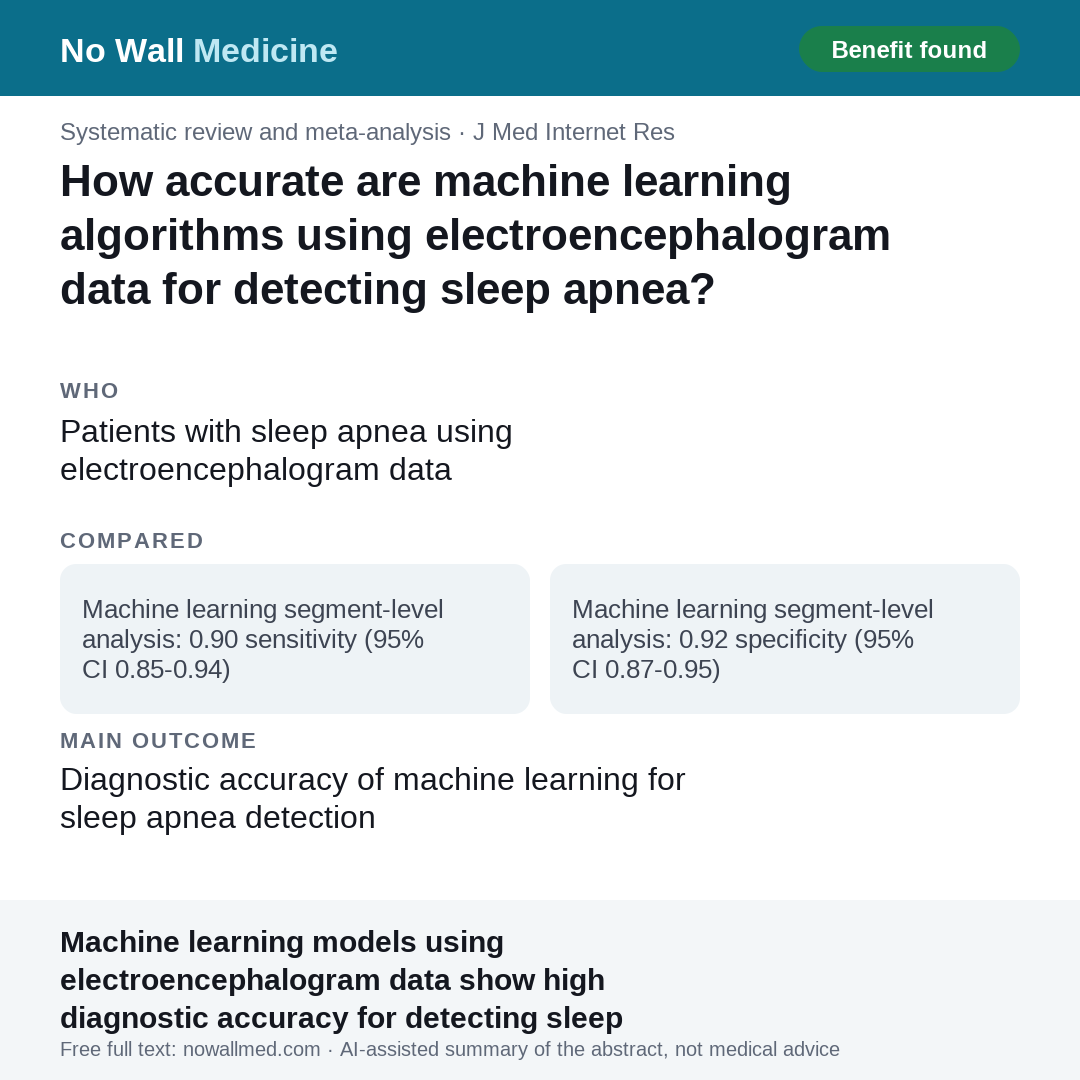
Accuracy of Machine Learning Algorithms Based on Electroencephalogram in Sleep Apnea Detection: Systematic Review and Meta-Analysis
Systematic review and meta-analysisBenefit found
How accurate are machine learning algorithms using electroencephalogram data for detecting sleep apnea?
Who
Patients with sleep apnea using electroencephalogram data
Compared
Machine learning segment-level analysis: 0.90 sensitivity (95% CI 0.85-0.94)
Machine learning segment-level analysis: 0.92 specificity (95% CI 0.87-0.95)
Main outcome
Diagnostic accuracy of machine learning for sleep apnea detection
Result: area under the summary receiver operating characteristic curve 0.95 (95% CI 0.92-0.99)
Bottom line: Machine learning models using electroencephalogram data show high diagnostic accuracy for detecting sleep apnea at the segment level.
Limitation: Most studies are retrospective segment-level analyses, which may overestimate practical value in real-world settings.
J Med Internet Res · 2026-07-31Download image
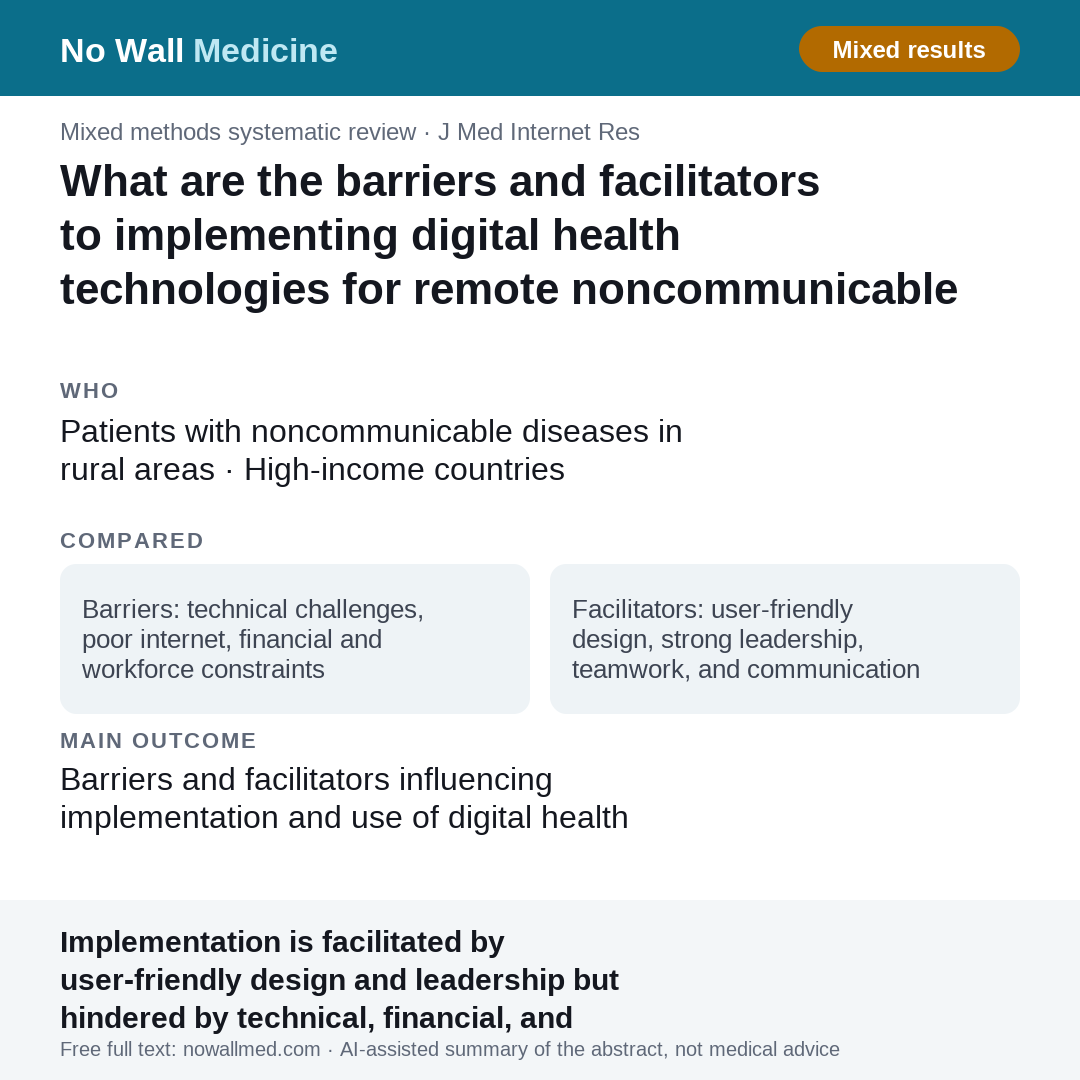
Barriers and Facilitators to Implementing Digital Health Technologies for Remote Management of NCDs in Rural Areas: Mixed Methods Systematic Review
Mixed methods systematic reviewMixed results
What are the barriers and facilitators to implementing digital health technologies for remote noncommunicable disease management?
Who
Patients with noncommunicable diseases in rural areas · High-income countries
Compared
Barriers: technical challenges, poor internet, financial and workforce constraints
Facilitators: user-friendly design, strong leadership, teamwork, and communication
Main outcome
Barriers and facilitators influencing implementation and use of digital health technologies
Bottom line: Implementation is facilitated by user-friendly design and leadership but hindered by technical, financial, and workforce constraints.
Limitation: Evidence was predominantly qualitative, with only limited quantitative data available.
J Med Internet Res · 2026-07-31Download image
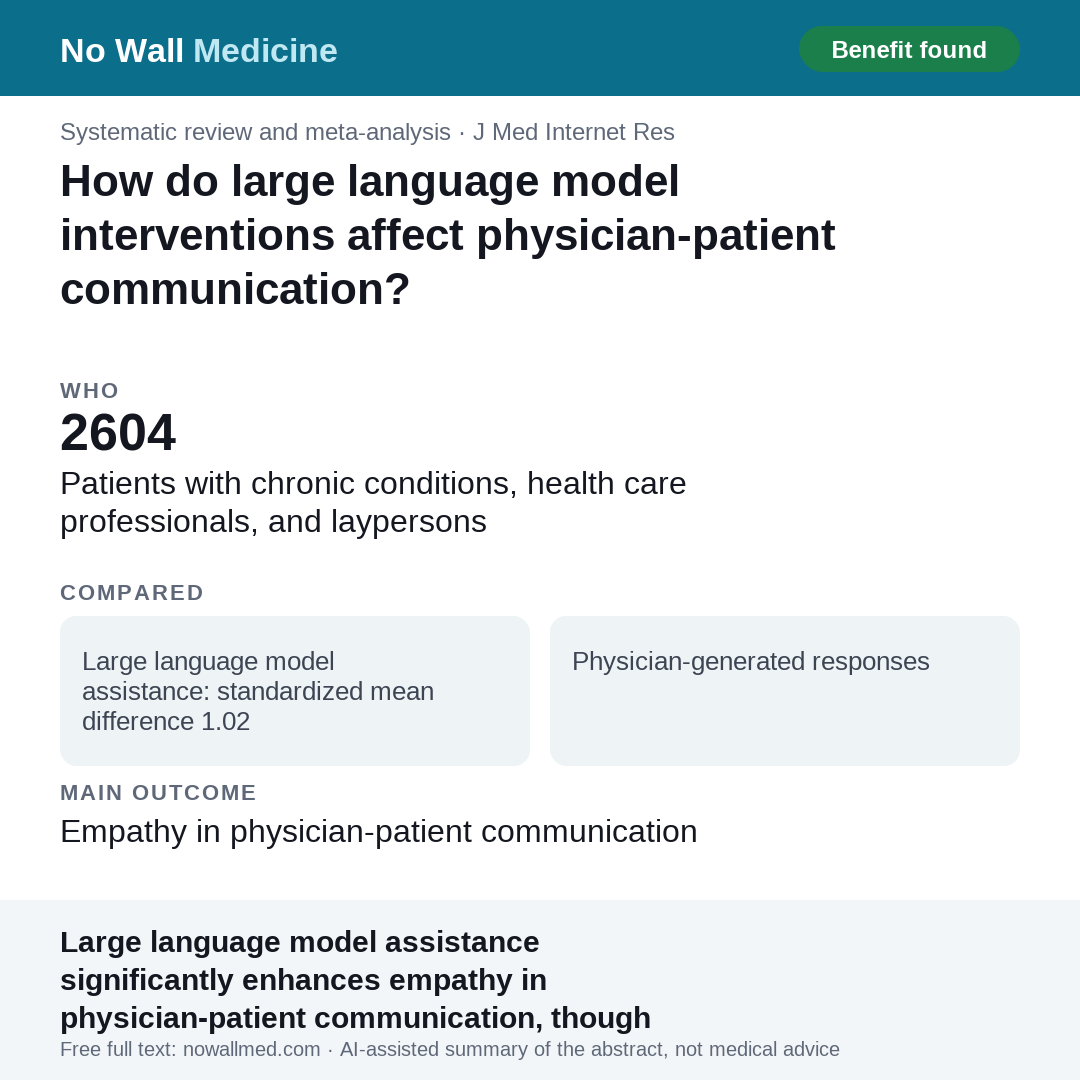
Impact of Large Language Model-Based AI Tools on Physician-Patient Communication: Systematic Review and Meta-Analysis
Systematic review and meta-analysisBenefit found
How do large language model-based interventions affect physician-patient communication?
Who
Patients, health care professionals, and laypersons
Compared
45.1%Large language model-based responses
4.6%Physician-generated responses
Main outcome
Empathy, clarity, trust, and patient understanding
Result: odds ratio approximately 9.8
Bottom line: Large language model chatbots can enhance communication by producing more empathetic, detailed, and understandable responses.
Limitation: Need for robust randomized controlled trials, real-world, and longitudinal studies.
J Med Internet Res · 2026-07-31Download image
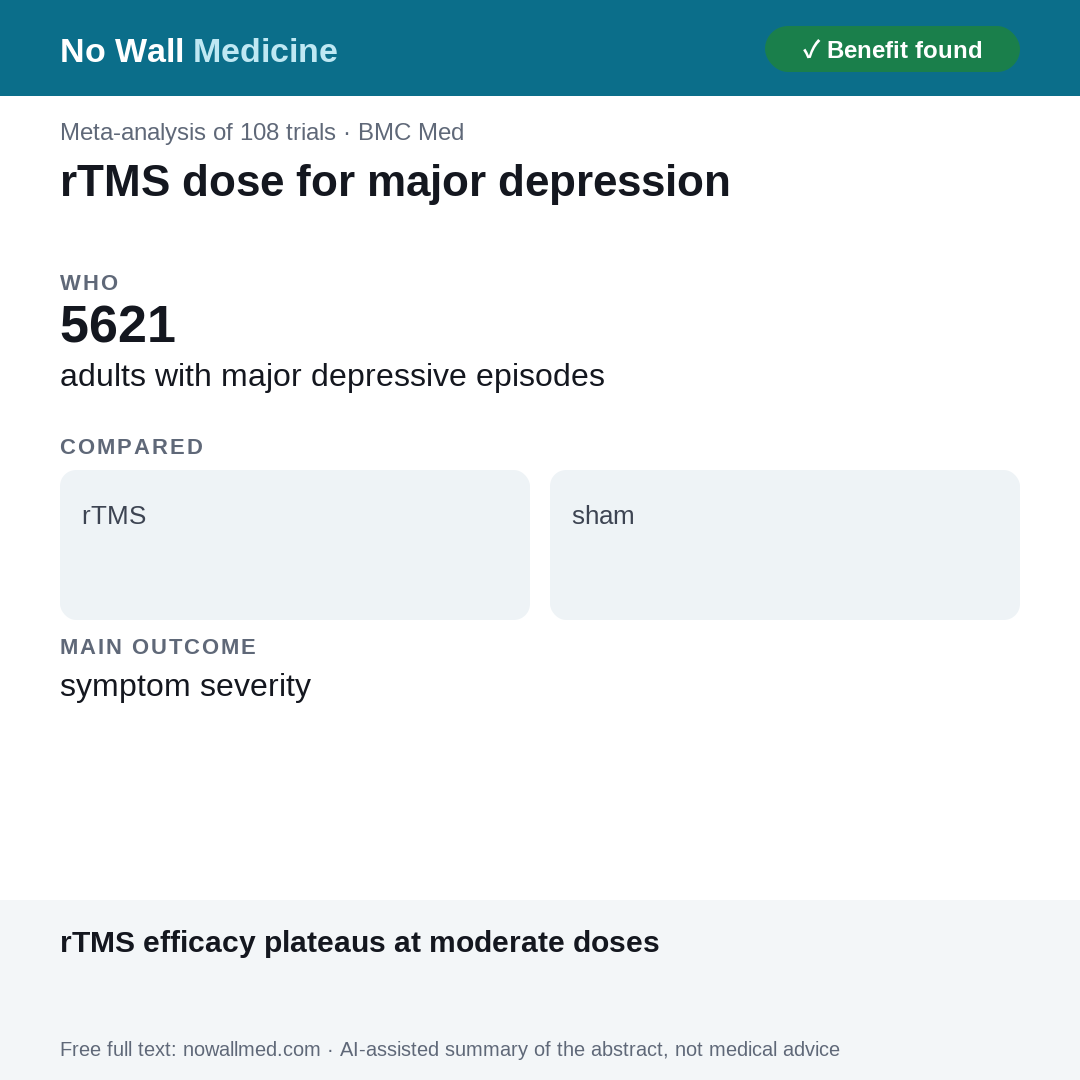
Acute and long-term effects of repetitive transcranial magnetic stimulation in major depressive episodes: a systematic review and dose-response meta-analysis of randomized sham-controlled trials
Meta-analysis of 108 trialsBenefit found
rTMS dose for major depression
Who
5621
adults with major depressive episodes
Compared
rTMS
sham
Main outcome
symptom severity
Bottom line: rTMS efficacy plateaus at moderate doses
Limitation: not individualized dosing
BMC Med · 2026-07-30Download image
Market-source pathogens in traditional food markets, 2000-25: a systematic review and meta-analysis
Systematic review and meta-analysisHarm found
What is the global prevalence of market-source pathogens in traditional food markets?
Who
Pathogen detection records in traditional food markets · 41 countries across 16 regions
Compared
19.41%Bacteria (16.21-23.08)
8.40%Viruses (7.15-9.83)
27.05%Parasites (21.91-32.89)
Main outcome
Pooled prevalence of market-source pathogens
Result: 15.32% (95% CI 13.96-16.80)
Bottom line: Traditional markets are global hotspots for pathogens, with the highest prevalence found in fish, seafood, raw meat, and environmental samples.
Lancet Glob Health · 2026-07-30Download image

Efficacy and Safety of Bimagrumab in Adults With Obesity and Metabolic Dysfunction: A Systematic Review and Meta-Analysis of Randomized Controlled Trials
Systematic review and meta-analysis of 4 randomized controlled trialsBenefit found
Does bimagrumab improve body composition and glucose parameters in adults with obesity?
Who
268
Adults with obesity, insulin resistance, or type 2 diabetes mellitus
Compared
Bimagrumab
Placebo
Main outcome
Body composition, glucose parameters, and safety
Result: mean difference -4.85 kg (95% CI -6.82 to -2.88) for total weight
Bottom line: Bimagrumab significantly reduces fat mass and glycated haemoglobin while increasing lean mass in adults with metabolic dysfunction.
Diabetes Obes Metab · 2026-07-30Download image

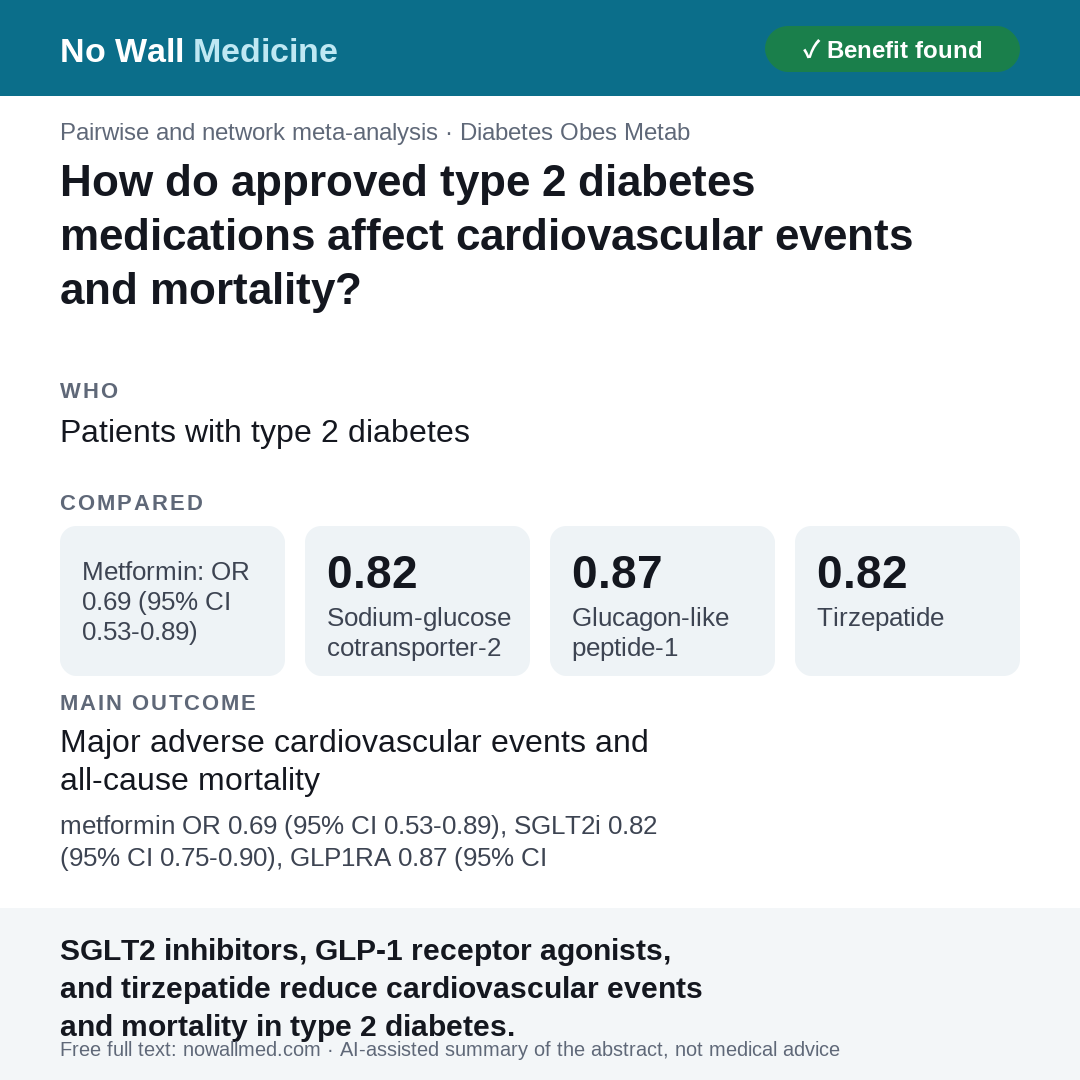
Effect of Medications for Type 2 Diabetes on Cardiovascular Events and Mortality: A Comprehensive Pairwise and Network Meta-Analysis
Pairwise and network meta-analysisBenefit found
How do approved type 2 diabetes medications affect cardiovascular events and mortality?
Who
Patients with type 2 diabetes
Compared
Metformin: OR 0.69 (95% CI 0.53-0.89)
0.82Sodium-glucose cotransporter-2 inhibitors (95% CI 0.75-0.90)
0.87Glucagon-like peptide-1 receptor agonists (95% CI 0.83-0.92)
0.82Tirzepatide (95% CI 0.72-0.93)
Main outcome
Major adverse cardiovascular events and all-cause mortality
Result: metformin OR 0.69 (95% CI 0.53-0.89), SGLT2i 0.82 (95% CI 0.75-0.90), GLP1RA 0.87 (95% CI 0.83-0.92), tirzepatide 0.82 (95% CI 0.72-0.93)
Bottom line: SGLT2 inhibitors, GLP-1 receptor agonists, and tirzepatide reduce cardiovascular events and mortality in type 2 diabetes.
Diabetes Obes Metab · 2026-07-30Download image
Mapping the global work-related impact of immune-mediated inflammatory skin diseases: A systematic review
Systematic reviewHarm found
Impact of skin diseases on work
Who
Adults with immune-mediated inflammatory skin diseases · Global, mainly Europe
Compared
Psoriasis
Atopic dermatitis
Main outcome
Work outcomes
Bottom line: Skin diseases affect work significantly
J Invest Dermatol · 2026-07-30Download image

Comparative Meta-Analysis of Complications of Maxillomandibular Advancement for OSA versus Orthognathic Surgeries for Dentofacial Deformities
Meta-analysis and systematic reviewHarm found
Are complications and recovery metrics different between MMA for OSA and orthognathic surgeries?
Who
Patients undergoing MMA for OSA or orthognathic surgeries for dentofacial deformities
Compared
Maxillomandibular advancement: 79.6% surgical success rate
Bimaxillary surgery: 326.95 min operative time
Main outcome
Operative time, hospital stay, and complications
Bottom line: Maxillomandibular advancement is associated with longer operative time, increased hospital stay, and higher complication rates.
Otolaryngol Head Neck Surg · 2026-07-30Download image

Structured exercise training for fatigue management in multiple sclerosis: an umbrella review of systematic reviews and meta-analyses
Umbrella review of systematic reviews and meta-analysesBenefit found
Does structured exercise training reduce fatigue in people with multiple sclerosis?
Who
People with multiple sclerosis
Compared
Structured exercise training: small-to-moderate reductions in self-reported fatigue (g range, -0.56 to -0.39)
Control conditions
Main outcome
self-reported fatigue
Bottom line: Structured exercise training is associated with reductions in self-reported fatigue in multiple sclerosis.
Limitation: Substantial heterogeneity, incomplete exercise-dose reporting, and high overlap across reviews.
Arch Phys Med Rehabil · 2026-07-30Download image

Impact of treatment duration on the effectiveness of opioid analgesia: a systematic review and meta-analysis
Systematic review and random-effects meta-analysisMixed results
Does opioid effectiveness diminish with treatment duration for chronic low back pain or osteoarthritis?
Who
27
People with chronic low back pain or osteoarthritis
Compared
Short-term treatment (≤4 weeks): risk ratio 1.42 (95% CI 1.08 to 1.89)
Intermediate-term treatment (4-12 weeks): risk ratio 1.04 (95% CI 0.84 to 1.30)
Long-term treatment (≥12 weeks): risk ratio 0.91 (95% CI 0.73 to 1.14)
Main outcome
Attainment of clinically important pain relief
Result: risk ratio 1.42 (95% CI 1.08 to 1.89) for short-term
Bottom line: Opioids provide meaningful pain relief over short durations but little or no benefit beyond placebo over longer periods.
Br J Gen Pract · 2026-07-30Download image

Point-of-care biomarkers or laboratory-based tests to reduce antibiotic prescribing for COPD exacerbations: a literature review and meta-analysis in primary care
Systematic review and meta-analysisBenefit found
Do point-of-care biomarkers or laboratory tests reduce antibiotic prescribing for COPD exacerbations?
Who
Patients with acute exacerbations of chronic obstructive pulmonary disease · Primary care
Compared
C-reactive protein point-of-care testing
Control
Main outcome
Rate of antibiotic prescribing or use
Result: odds ratio 0.41, 95% confidence interval = 0.32 to 0.53
Bottom line: C-reactive protein point-of-care testing reduces antibiotic prescribing for acute exacerbations of chronic obstructive pulmonary disease.
Limitation: Insufficient data to draw conclusions about procalcitonin biomarkers.
Br J Gen Pract · 2026-07-30Download image