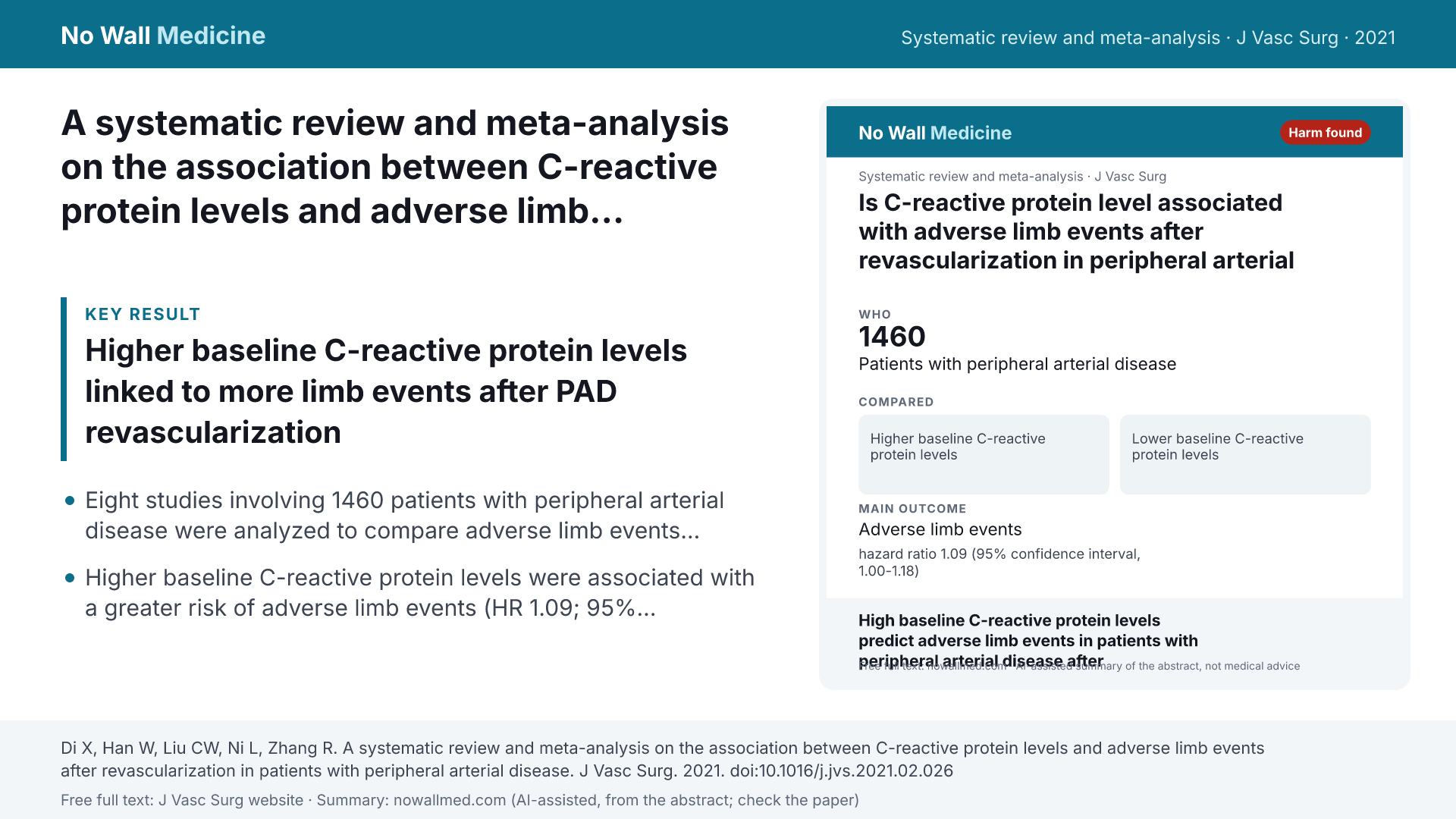
Higher baseline C-reactive protein levels linked to more limb events after PAD revascularization
A systematic review and meta-analysis on the association between C-reactive protein levels and adverse limb events after revascularization in patients with peripheral arterial disease
Systematic review and meta-analysisHarm found
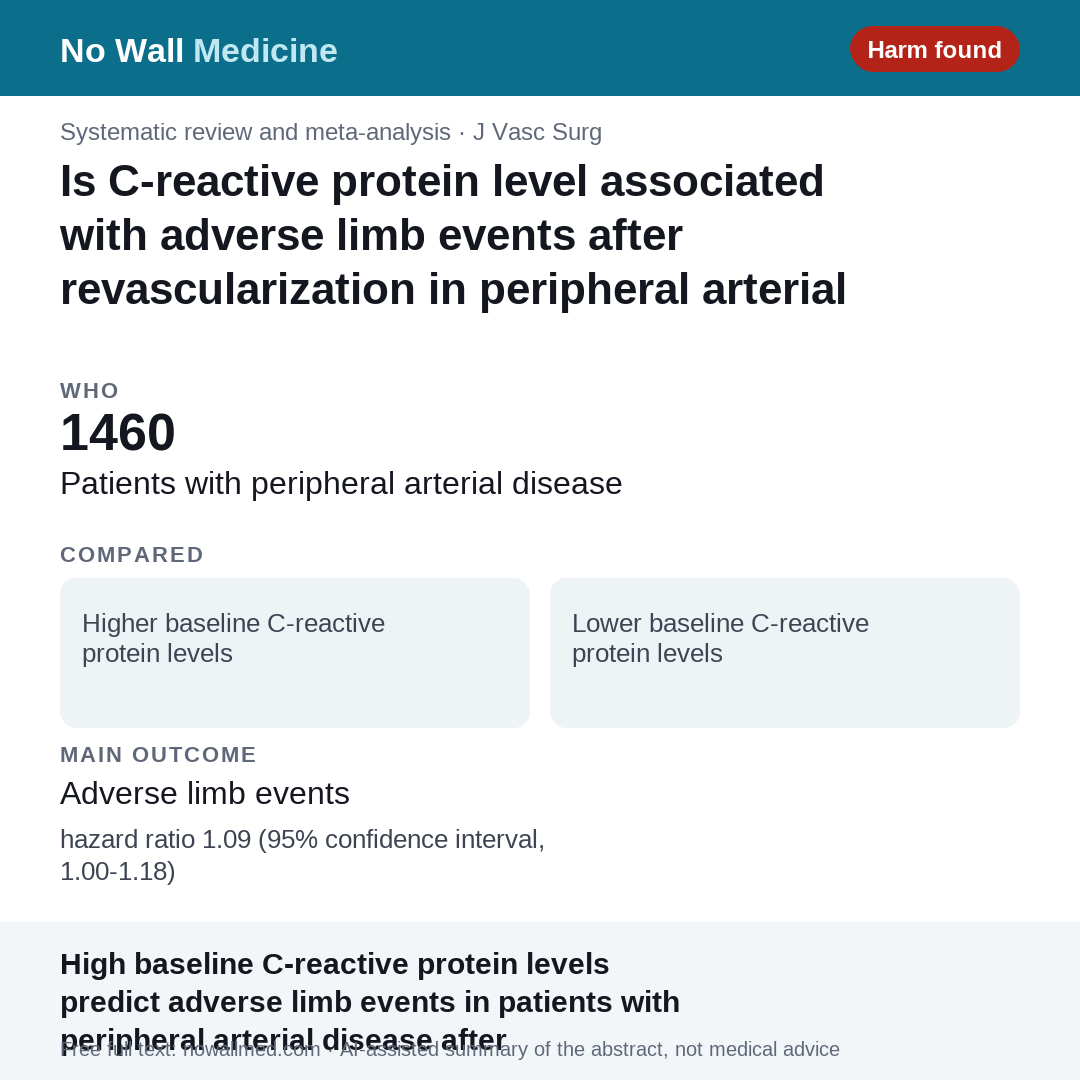
Is C-reactive protein level associated with adverse limb events after revascularization in peripheral arterial disease?
Who
1460
Patients with peripheral arterial disease
Compared
Higher baseline C-reactive protein levels
Lower baseline C-reactive protein levels
Main outcome
Adverse limb events
Result: hazard ratio 1.09 (95% confidence interval, 1.00-1.18)
Bottom line: High baseline C-reactive protein levels predict adverse limb events in patients with peripheral arterial disease after revascularization.
J Vasc Surg · 2021-03-05Download image
Clinical question: Is C-reactive protein level associated with adverse limb events after revascularization in peripheral arterial disease?
Why it matters: Previous single-center studies reported inconsistent results regarding the relationship between baseline C-reactive protein levels and postprocedure adverse limb events.
Key points
- Eight studies involving 1460 patients with peripheral arterial disease were analyzed to compare adverse limb events after revascularization.
- Higher baseline C-reactive protein levels were associated with a greater risk of adverse limb events (HR 1.09; 95% CI 1.00-1.18).
- The pooled odds ratio for adverse limb events was 2.25 (95% CI 1.49-3.41) per unit increase in logeCRP.
Headline and key points written with AI from the paper’s abstract, with every number checked against it. Read the paper before relying on them.
Was this summary helpful?
Subject terms
Cite this article
Di X, Han W, Liu CW, Ni L, Zhang R. A systematic review and meta-analysis on the association between C-reactive protein levels and adverse limb events after revascularization in patients with peripheral arterial disease. J Vasc Surg. 2021. doi:10.1016/j.jvs.2021.02.026
Spotted a mistake? Suggest a correction