Deferred consent increased recruitment rates for infants in a neonatal resuscitation trial
Alternative consent processes in a neonatal resuscitation trial (SAIL): secondary analysis of an open-label, international, multicentre, randomised trial
Secondary analysis of a randomized trialNo clear difference
Does deferred consent increase recruitment and affect outcomes compared to antenatal consent only?
Who
426
Infants born at 23 to less than 27 weeks' gestation · 18 centres across nine countries
Compared
57%Antenatal consent only (113/197)
65%Deferred consent available (149/229)
Main outcome
Combined rate of death or bronchopulmonary dysplasia
Result: adjusted relative risk 1.18 (95% CI 0.98 to 1.42)
Bottom line: Deferred consent enabled higher recruitment rates and a more generalisable sample without changing death or bronchopulmonary dysplasia rates.
Funded by: Eunice Kennedy Shriver National Institute of Child Health and Human Development
Lancet Child Adolesc Health · 2025-08-12Download image
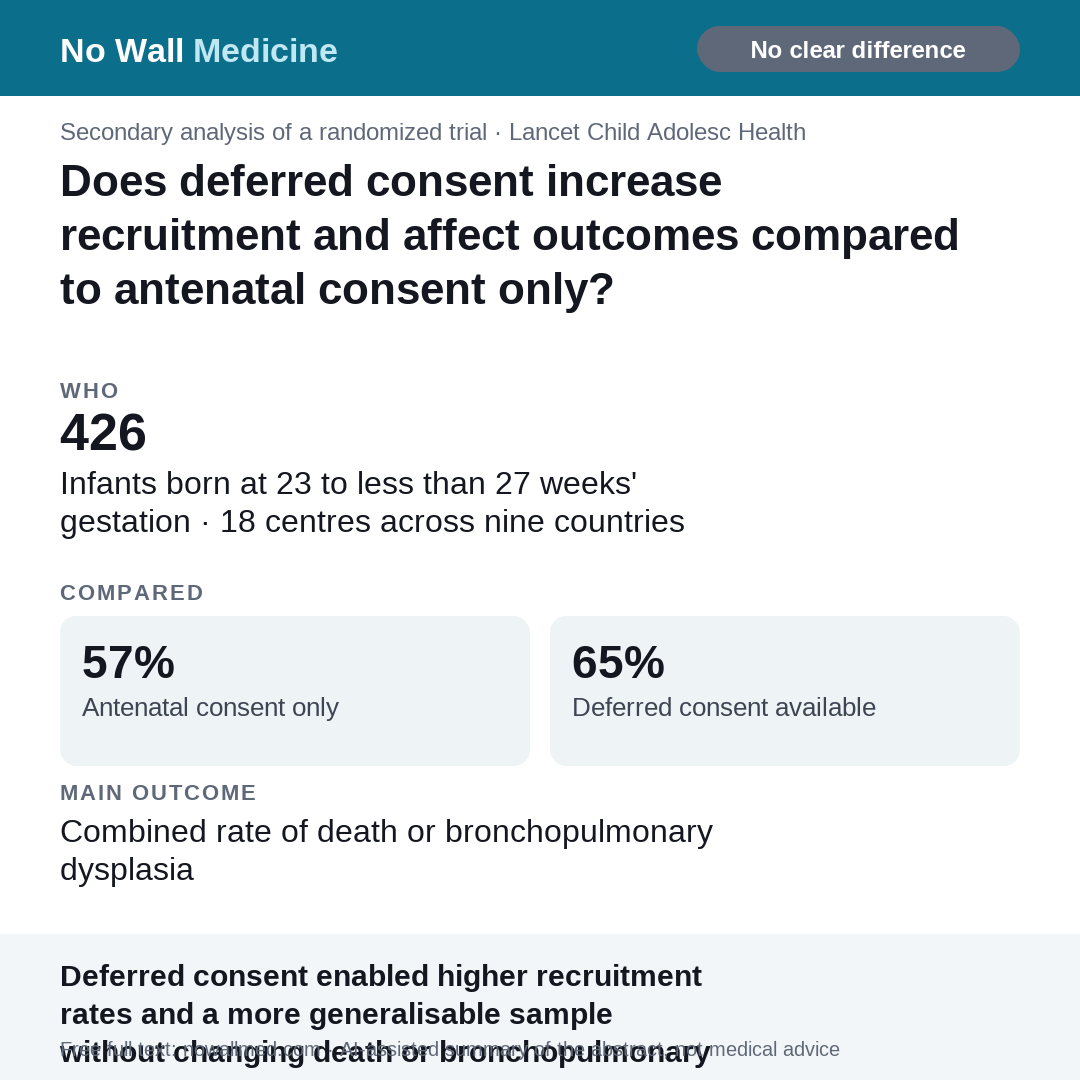
Clinical question: Does deferred consent increase recruitment and affect outcomes compared to antenatal consent only?
Why it matters: Delivery room trials face ethical and logistical challenges regarding the requirement for prospective, antenatal, parental consent.
Key points
- Researchers analyzed 426 infants born between 23 and 27 weeks' gestation across 18 international centers to compare recruitment using antenatal consent versus deferred postnatal consent.
- Centers with deferred consent recruited 73% of eligible infants compared to 41% at centers using only antenatal consent, an absolute difference of 31.78%.
- The combined rate of death or bronchopulmonary dysplasia, a chronic lung disease, was 65% at deferred consent centers versus 57% at antenatal consent centers.
Headline and key points written with AI from the paper’s abstract, with every number checked against it. Read the paper before relying on them.
Topics
Cite this article
Owen LS, Foglia EE, Ratcliffe SJ, Simma B, Katheria AC, Te Pas A. Alternative consent processes in a neonatal resuscitation trial (SAIL): secondary analysis of an open-label, international, multicentre, randomised trial. Lancet Child Adolesc Health. 2025. doi:10.1016/S2352-4642(25)00185-3
Spotted a mistake? Suggest a correction
Top studies every Monday
The week’s key trials and guidelines in your specialties, by email. Free.
Get the weekly digest