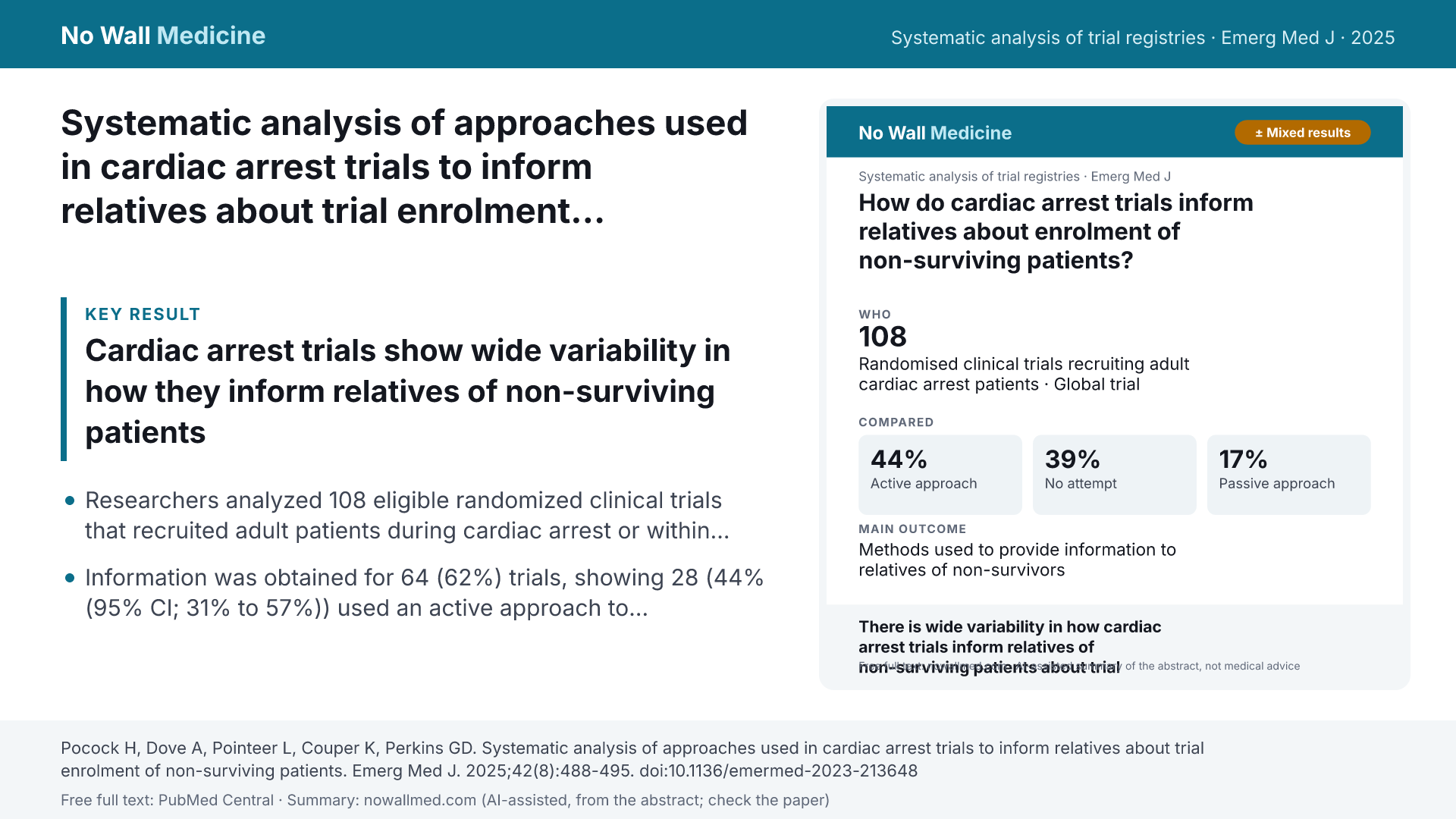
Cardiac arrest trials show wide variability in how they inform relatives of non-surviving patients
Systematic analysis of approaches used in cardiac arrest trials to inform relatives about trial enrolment of non-surviving patients
Systematic analysis of trial registriesMixed results
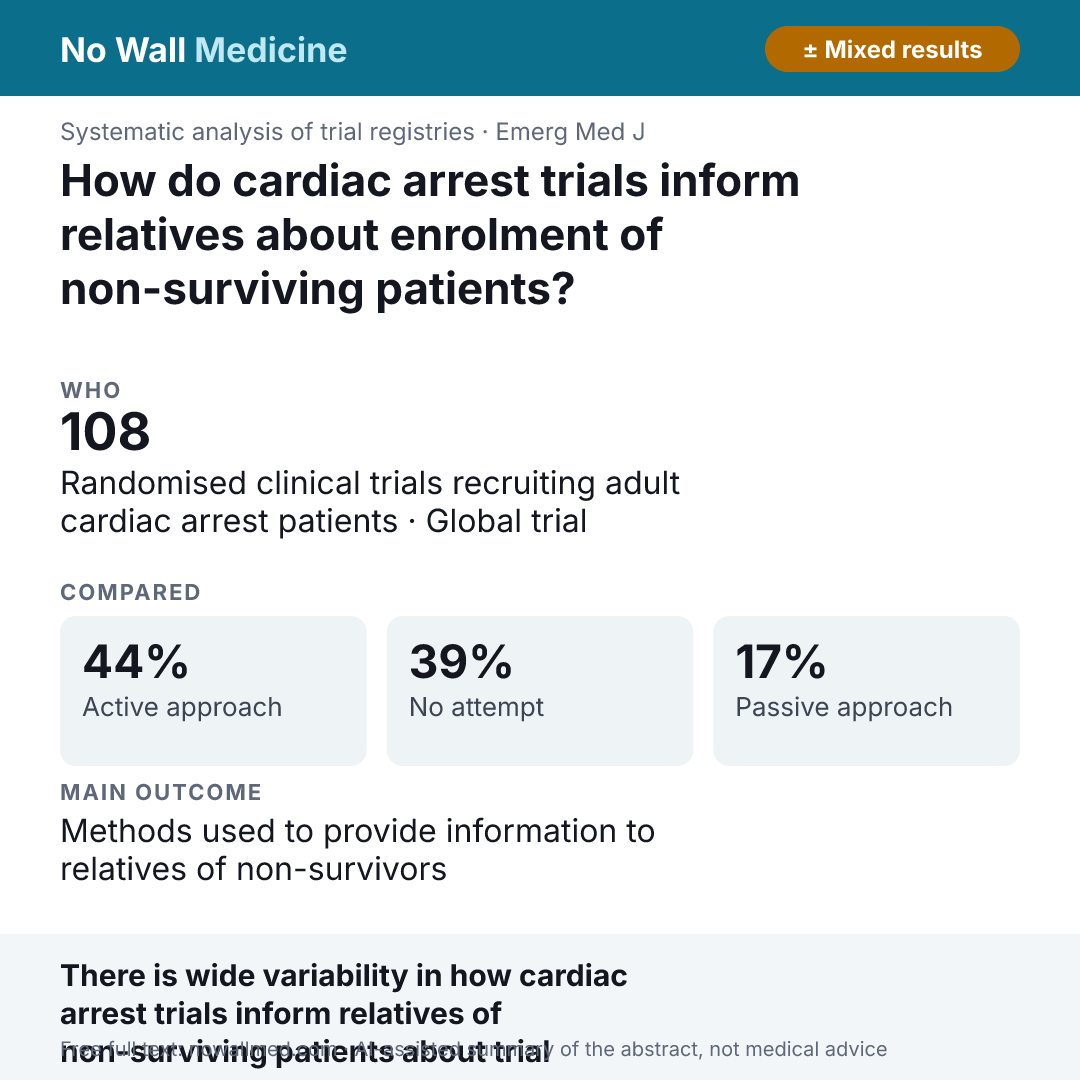
How do cardiac arrest trials inform relatives about enrolment of non-surviving patients?
Who
108
Randomised clinical trials recruiting adult cardiac arrest patients · Global trial registries
Compared
44%Active approach (95% CI; 31% to 57%)
39%No attempt (95% CI; 27% to 52%)
17%Passive approach (95% CI; 8% to 29%)
Main outcome
Methods used to provide information to relatives of non-survivors
Bottom line: There is wide variability in how cardiac arrest trials inform relatives of non-surviving patients about trial enrolment.
Emerg Med J · 2025-07-22
Why it matters: Researchers do not know how different approaches are used globally to inform relatives when patients enrolled in emergency research studies do not survive.
Headline and visual abstract written with AI from the paper’s abstract, with every number checked against it. Read the paper before relying on them.
Was this summary helpful?
Abstract
Background
The recruitment of patients to emergency research studies without the requirement for prior informed consent has furthered the conduct of randomised studies in cardiac arrest. Frameworks enabling this vary around the world depending on local legal or ethical requirements. When an enrolled patient does not survive, researchers may take one of three approaches to inform relatives of their enrolment: a direct (active) approach, providing information indirectly (passively) and inviting relatives to seek further information if they choose, or providing no information about the trial (no attempt). Previous studies have described experiences of US researchers' active approach but there is little known about approaches elsewhere.We aimed to conduct a structured investigation of methods used in cardiac arrest trials to provide information about trial enrolment to relatives of non-surviving patients. Methods
We systematically searched trial registries to identify randomised clinical trials that recruited cardiac arrest patients. Trials were eligible for inclusion if they recruited adults during cardiac arrest (or within 1 hour of return of spontaneous circulation) between 2010 and 2022 (in the decade prior to study conception). We extracted data from trial registries and, where relevant, published papers and protocols. Investigators were contacted and asked to describe the style, rationale and timing of approach to relatives of non-surviving patients. We present descriptive statistics. Results
Our trial registry search identified 710 unique trials, of which 108 were eligible for inclusion. We obtained information from investigators for 64 (62%) trials. Approximately equal numbers of trials attempted to actively inform relatives of non-survivors (n=28 (44% (95% CI; 31% to 57%))), or made no attempt (n=25 (39% (95% CI; 27% to 52%))). The remaining studies provided general information about the trial to relatives but did not actively inform them (n=11 (17% (95% CI; 8% to 29%))). Conclusions
There is wide variability in the approach taken to informing relatives of non-surviving patients enrolled in cardiac arrest randomised clinical trials.
Abstract reproduced under the article’s CC BY licence.
Subject terms
Cite this article
Pocock H, Dove A, Pointeer L, Couper K, Perkins GD. Systematic analysis of approaches used in cardiac arrest trials to inform relatives about trial enrolment of non-surviving patients. Emerg Med J. 2025;42(8):488-495. doi:10.1136/emermed-2023-213648
Spotted a mistake? Suggest a correction