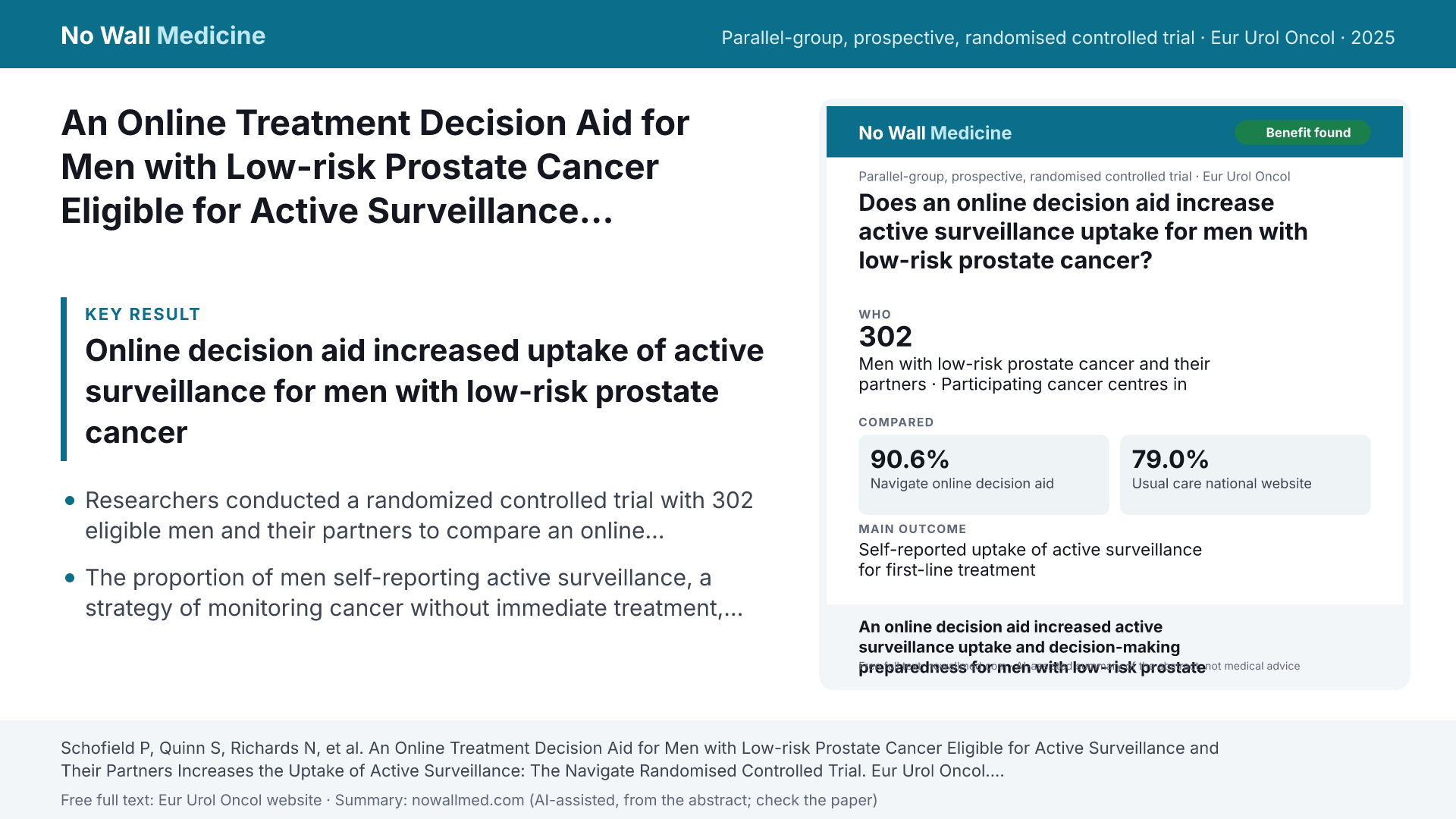
Online decision aid increased uptake of active surveillance for men with low-risk prostate cancer
An Online Treatment Decision Aid for Men with Low-risk Prostate Cancer Eligible for Active Surveillance and Their Partners Increases the Uptake of Active Surveillance: The Navigate Randomised Controlled Trial
Parallel-group, prospective, randomised controlled trialBenefit found
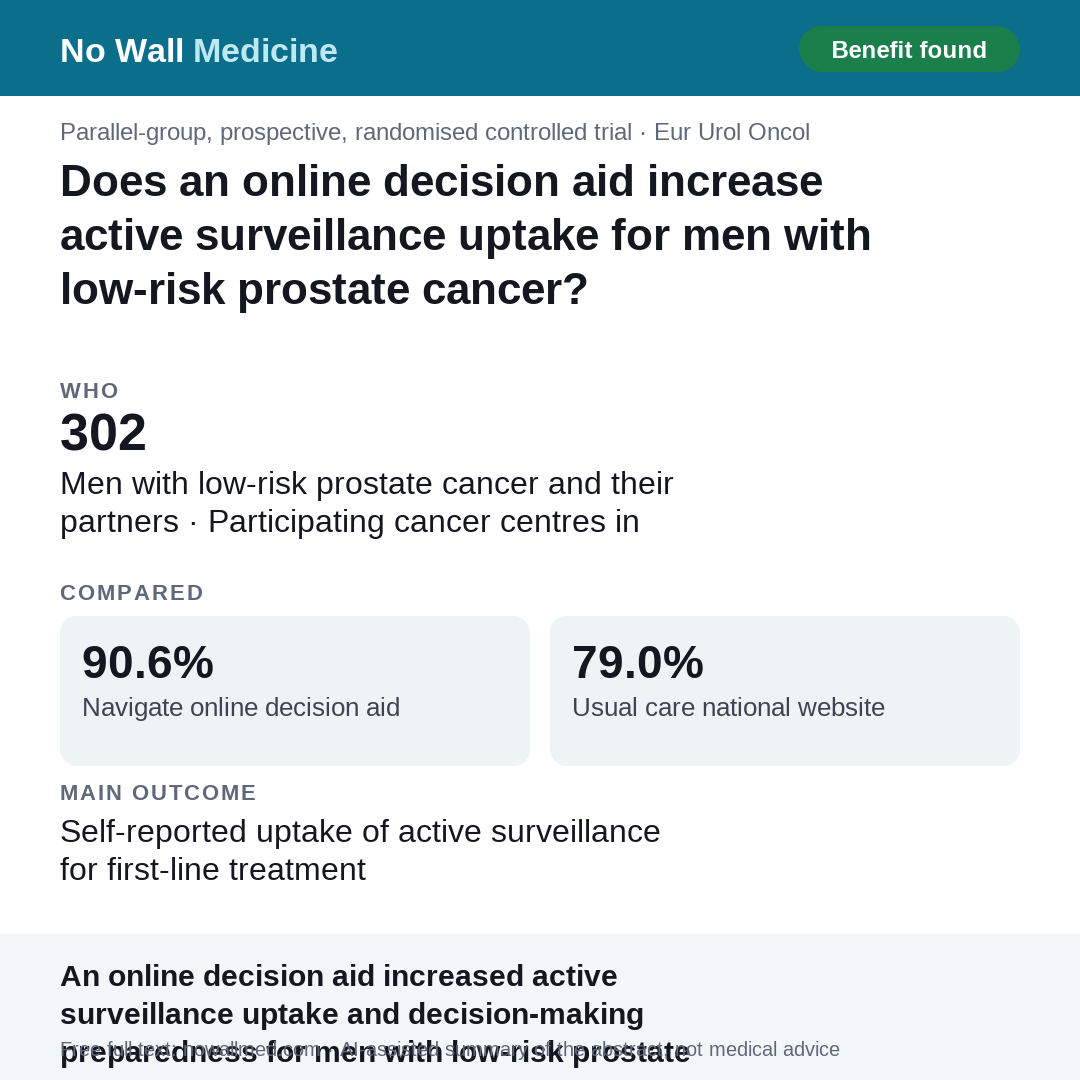
Does an online decision aid increase active surveillance uptake for men with low-risk prostate cancer?
Who
302
Men with low-risk prostate cancer and their partners · Participating cancer centres in Australia
Compared
90.6%Navigate online decision aid
79.0%Usual care national website
Main outcome
Self-reported uptake of active surveillance for first-line treatment
Bottom line: An online decision aid increased active surveillance uptake and decision-making preparedness for men with low-risk prostate cancer.
Limitation: Longer-term outcomes were not measured.
Eur Urol Oncol · 2025-04-12Download image
Clinical question: Does an online decision aid increase active surveillance uptake for men with low-risk prostate cancer?
In absolute numbers
Navigate online decision aid: 90.6% · Usual care national website: 79% → a difference of 11.6 percentage points, so about 9 people would need the treatment for 1 more to benefit (number needed to treat) over the trial’s follow-up.
Worked out by us from the two group results above, not reported by the authors. Check the paper for the exact outcome and timing.
Key points
- Researchers conducted a randomized controlled trial with 302 eligible men and their partners to compare an online decision aid against a national prostate cancer website.
- The proportion of men self-reporting active surveillance, a strategy of monitoring cancer without immediate treatment, was 90.6% in the decision aid group versus 79.0% in the usual care group.
- Men using the online decision aid also reported greater preparedness regarding their medical decisions compared to those receiving usual care.
Limitation the authors note: Longer-term outcomes were not measured.
Headline and key points written with AI from the paper’s abstract, with every number checked against it. Read the paper before relying on them.
Was this summary helpful?
Subject terms
Headline, design, result, key points, caveat and citation as plain text.
Cite this article
Schofield P, Quinn S, Richards N, et al. An Online Treatment Decision Aid for Men with Low-risk Prostate Cancer Eligible for Active Surveillance and Their Partners Increases the Uptake of Active Surveillance: The Navigate Randomised Controlled Trial. Eur Urol Oncol. 2025. doi:10.1016/j.euo.2025.02.004
Spotted a mistake? Suggest a correction