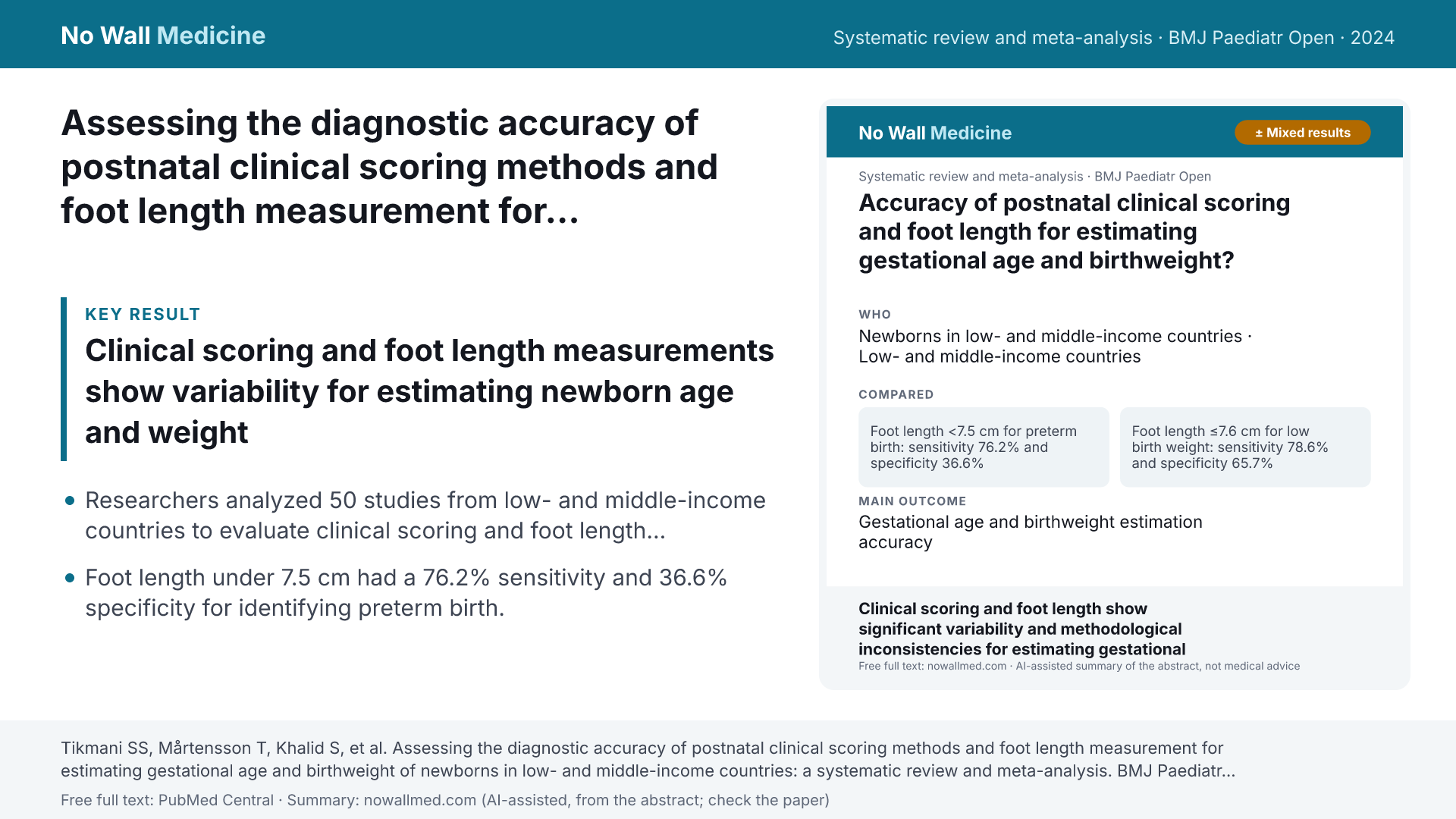
Clinical scoring and foot length measurements show variability for estimating newborn age and weight
Assessing the diagnostic accuracy of postnatal clinical scoring methods and foot length measurement for estimating gestational age and birthweight of newborns in low- and middle-income countries: a systematic review and meta-analysis
Systematic review and meta-analysisMixed results
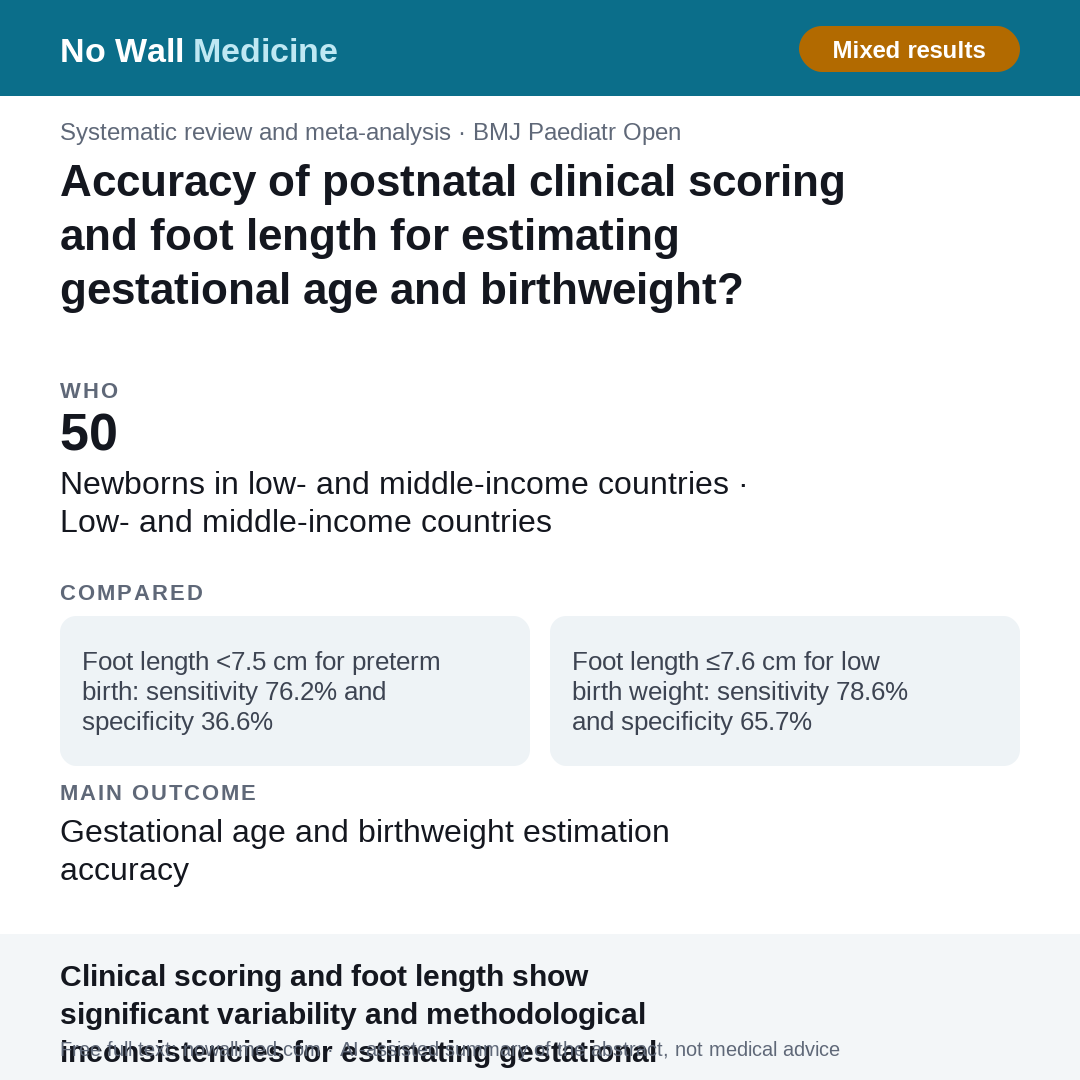
Accuracy of postnatal clinical scoring and foot length for estimating gestational age and birthweight?
Who
50
Newborns in low- and middle-income countries · Low- and middle-income countries
Compared
Foot length <7.5 cm for preterm birth: sensitivity 76.2% and specificity 36.6%
Foot length ≤7.6 cm for low birth weight: sensitivity 78.6% and specificity 65.7%
Main outcome
Gestational age and birthweight estimation accuracy
Bottom line: Clinical scoring and foot length show significant variability and methodological inconsistencies for estimating gestational age and birthweight.
Limitation: High heterogeneity across studies was observed.
BMJ Paediatr Open · 2024-08-30Download image
Clinical question: Accuracy of postnatal clinical scoring and foot length for estimating gestational age and birthweight?
Why it matters: The accuracy of postnatal clinical scoring and foot length measurement for assessing newborn age and weight in low- and middle-income countries was not fully established.
Key points
- Researchers analyzed 50 studies from low- and middle-income countries to evaluate clinical scoring and foot length for estimating gestational age and birthweight.
- Foot length under 7.5 cm had a 76.2% sensitivity and 36.6% specificity for identifying preterm birth.
- Foot length of 7.6 cm or less had a 78.6% sensitivity and 65.7% specificity for identifying low birth weight.
Limitation the authors note: High heterogeneity across studies was observed.
Headline and key points written with AI from the paper’s abstract, with every number checked against it. Read the paper before relying on them.
Was this summary helpful?
Abstract
Background
This study aimed to update systematic reviews and meta-analyses on the diagnostic accuracy of postnatal clinical scoring (PCS) methods and foot length (FL) measurement for assessing gestational age (GA) and birth weight in low-income and middle-income countries (LMICs). In addition, the quality of reference standards, including antenatal ultrasound (A-US), last menstrual period (LMP), PCS and newborn weighing scales, was also evaluated. Methods
Studies from LMICs published between January 2000 and February 2024 were searched, using databases such as PubMed, Web of Science, Cochrane Library, CINAHL and Scopus. Studies that compared PCS and/or FL with LMP and/or A-US to estimate GA or used calibrated newborn weighing scales for birthweight estimation were included. The risk of bias was assessed using the Quality Assessment of Diagnostic Accuracy Studies-II tool and evaluated the quality of the reference standards. When sufficient data were available, pooled estimates were calculated using random-effects models. Results
A total of 50 studies were included. A-US was a reasonable tool for GA assessment if conducted by physicians using fetal biometry and the Hadlock method for GA estimation. LMP was reasonable when women had regular cycles, knew their LMP, were not using contraceptives and LMP data were collected by healthcare providers. When A-US was used as the reference standard, PCS methods estimated GA with a precision of ±2.8 to ±3.2 weeks. FL measurement <7.5 cm showed a pooled sensitivity of 76.2% and specificity of 36.6% for identifying preterm birth. FL measurement ≤7.6 cm had a pooled sensitivity of 78.6% and specificity of 65.7% for identifying low birth weight (LBW). High heterogeneity across studies was observed. Conclusion
This systematic review and meta-analysis highlights significant variability and methodological inconsistencies in using PCS methods and FL measurement for estimating GA and LBW in LMICs. The observed high heterogeneity across studies suggests a cautious interpretation of the results. Prospero registration number
CRD42020209455.
Abstract reproduced under the article’s CC BY NC licence.
Subject terms
Cite this article
Tikmani SS, Mårtensson T, Khalid S, Uzair M, Ali Q, Rahim A. Assessing the diagnostic accuracy of postnatal clinical scoring methods and foot length measurement for estimating gestational age and birthweight of newborns in low- and middle-income countries: a systematic review and meta-analysis. BMJ Paediatr Open. 2024. doi:10.1136/bmjpo-2024-002717
Spotted a mistake? Suggest a correction
Top studies every Monday
The week’s key trials and guidelines in your specialties, plus any topics you follow. By email, free.
Get the weekly digest