Intermittent theta burst stimulation combined with virtual reality cycling improved spasticity and daily participation in stroke patients
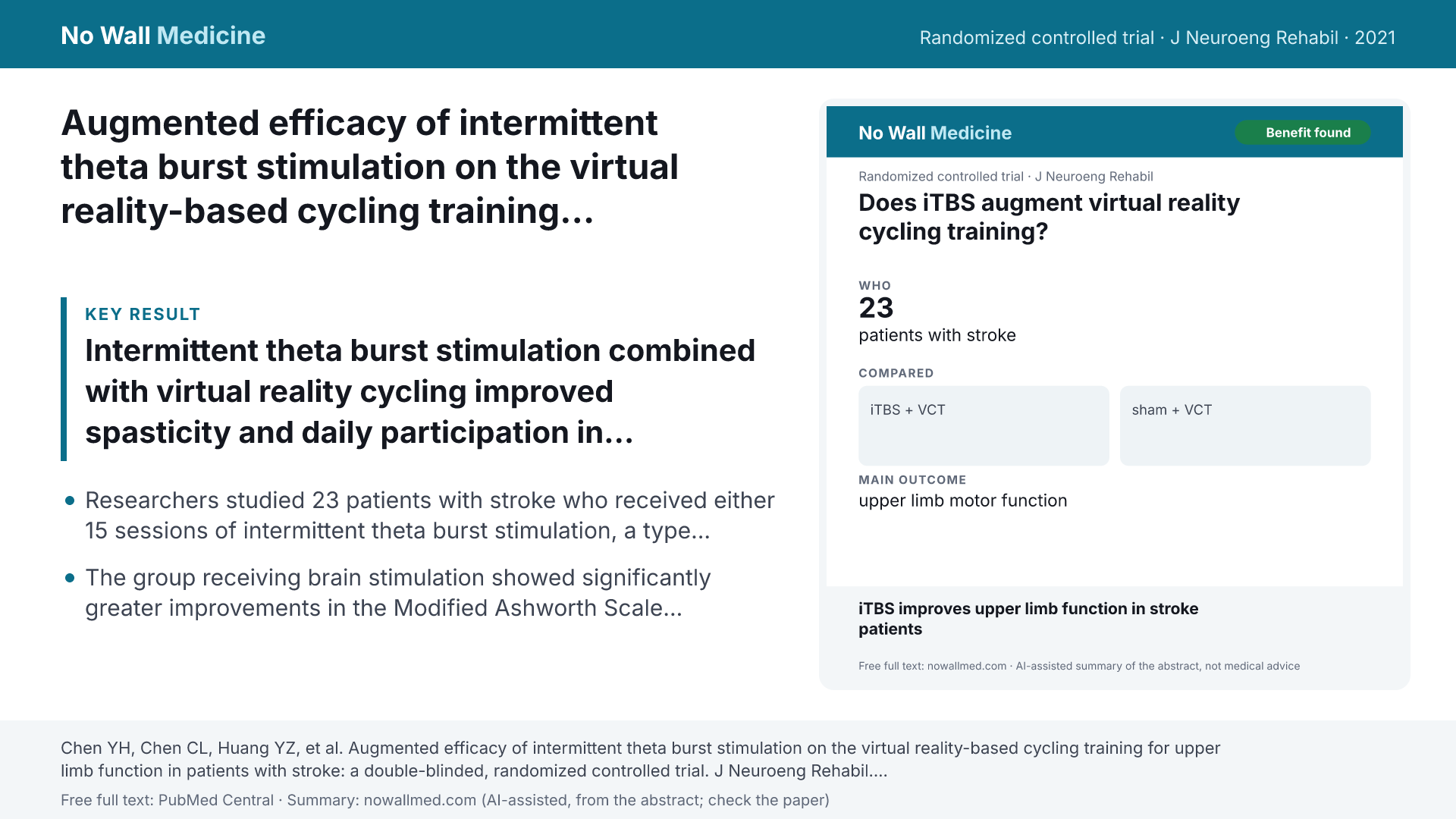
Augmented efficacy of intermittent theta burst stimulation on the virtual reality-based cycling training for upper limb function in patients with stroke: a double-blinded, randomized controlled trial
Randomized controlled trialBenefit found
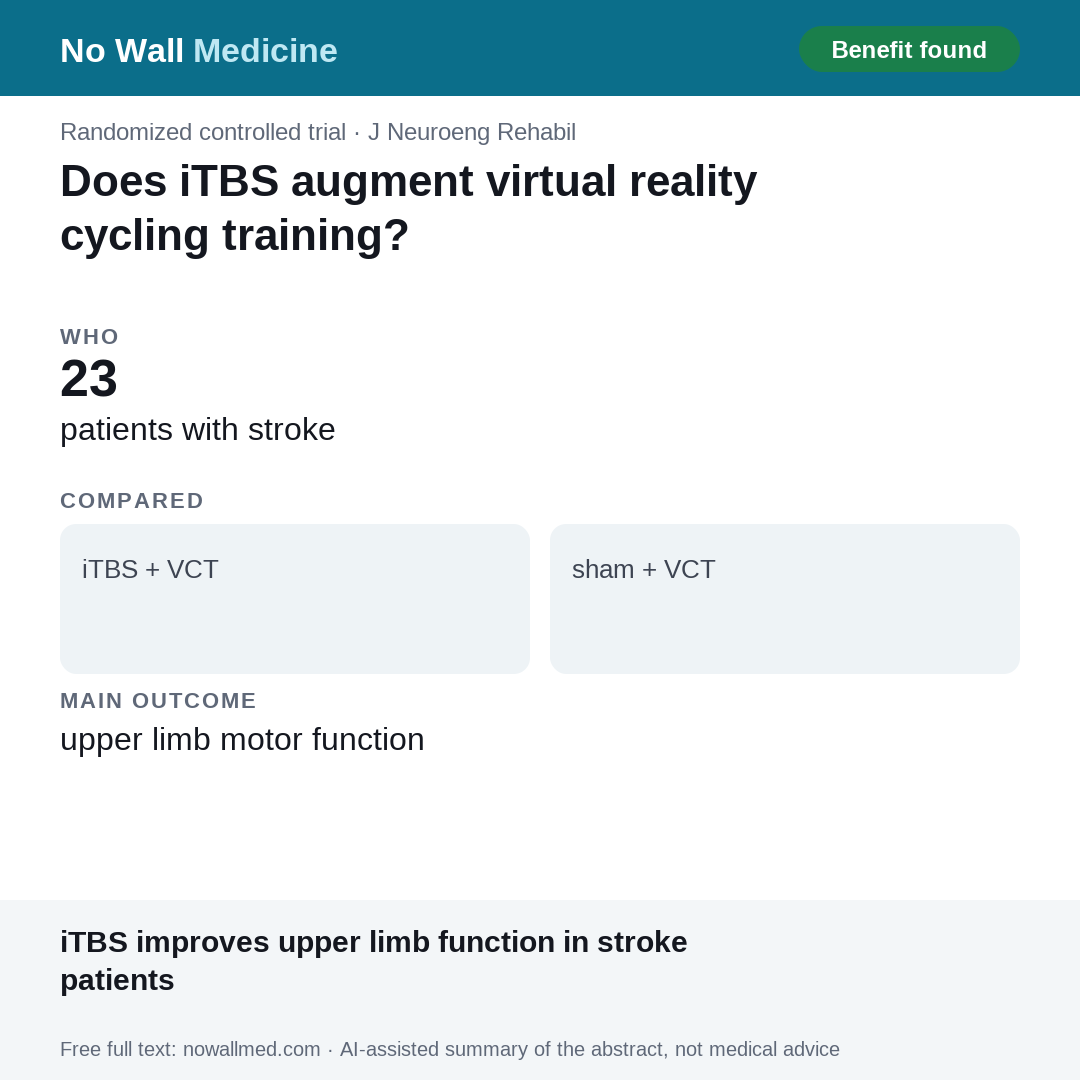
Does iTBS augment virtual reality cycling training?
Who
23
patients with stroke
Compared
iTBS + VCT
sham + VCT
Main outcome
upper limb motor function
Bottom line: iTBS improves upper limb function in stroke patients
Limitation: small sample size
J Neuroeng Rehabil · 2021-05-31Download image
Clinical question: Does iTBS augment virtual reality cycling training?
Key points
- Researchers studied 23 patients with stroke who received either 15 sessions of intermittent theta burst stimulation, a type of brain stimulation, or a sham version alongside virtual reality-based cycling training.
- The group receiving brain stimulation showed significantly greater improvements in the Modified Ashworth Scale for spasticity, the Motor Activity Log for actual limb use, and the Stroke Impact Scale.
- There were no significant differences between the two groups regarding changes in the Fugl-Meyer Assessment-Upper Extremity, Action Research Arm Test, Box and Block Test, Nine Hole Peg Test, or Motor Activity Log-Quality of Movement.
Limitation the authors note: The authors state that the study has a small sample size.
Headline and key points written with AI from the paper’s abstract, with every number checked against it. Read the paper before relying on them.
Was this summary helpful?
Subject terms
Headline, design, result, key points, caveat and citation as plain text.
Cite this article
Chen YH, Chen CL, Huang YZ, et al. Augmented efficacy of intermittent theta burst stimulation on the virtual reality-based cycling training for upper limb function in patients with stroke: a double-blinded, randomized controlled trial. J Neuroeng Rehabil. 2021. doi:10.1186/s12984-021-00885-5
Spotted a mistake? Suggest a correction