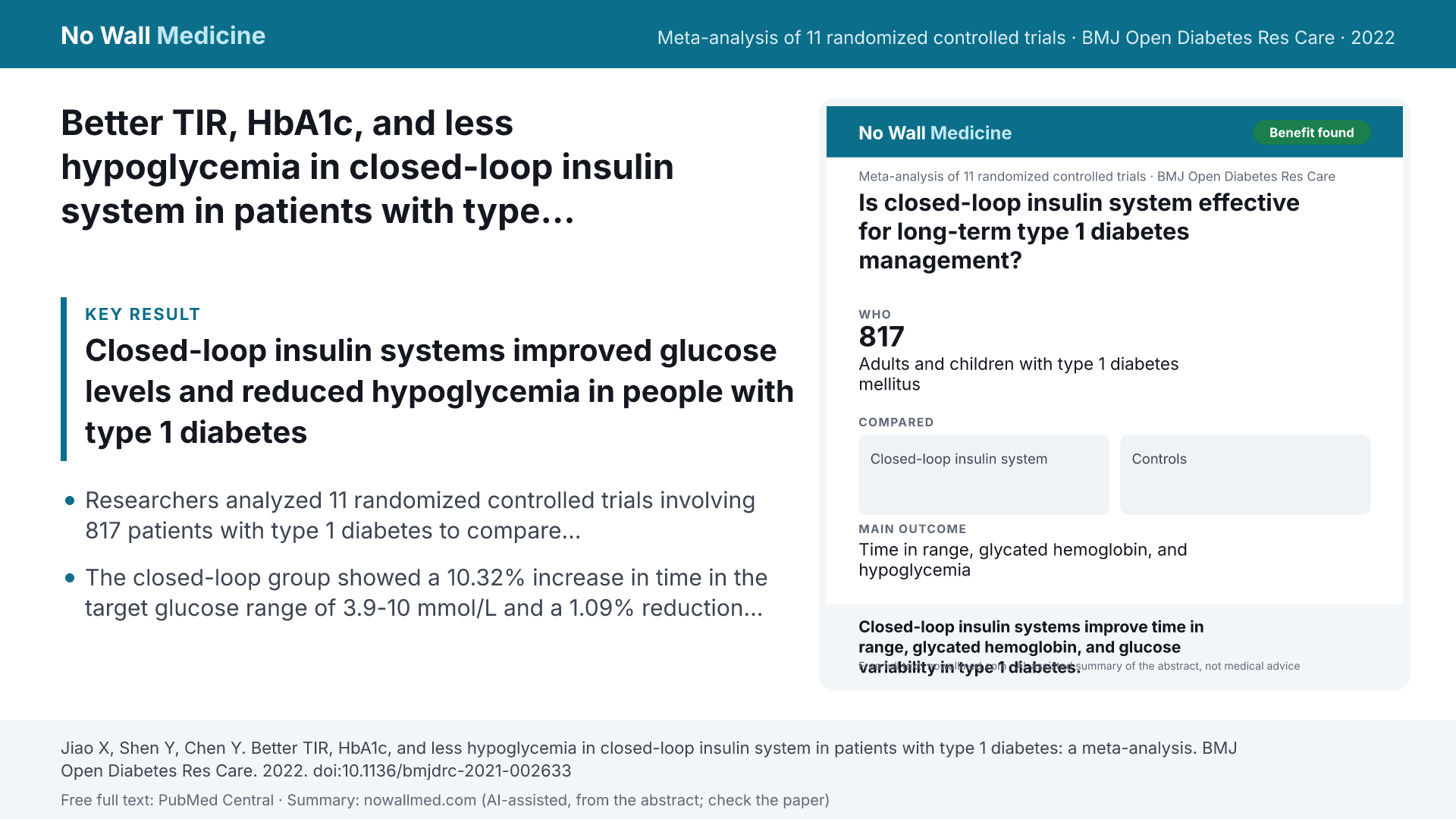
Closed-loop insulin systems improved glucose levels and reduced hypoglycemia in people with type 1 diabetes
Better TIR, HbA1c, and less hypoglycemia in closed-loop insulin system in patients with type 1 diabetes: a meta-analysis
Endocrinology & DiabetesAdult and pediatric
Meta-analysis of 11 randomized controlled trialsBenefit found
Is closed-loop insulin system effective for long-term type 1 diabetes management?
Who
817
Adults and children with type 1 diabetes mellitus
Compared
Closed-loop insulin system
Controls
Main outcome
Time in range, glycated hemoglobin, and hypoglycemia
Result: glycated hemoglobin -0.30% (-0.41% to -0.19%)
Bottom line: Closed-loop insulin systems improve time in range, glycated hemoglobin, and glucose variability in type 1 diabetes.
BMJ Open Diabetes Res Care · 2022-04-22Download image
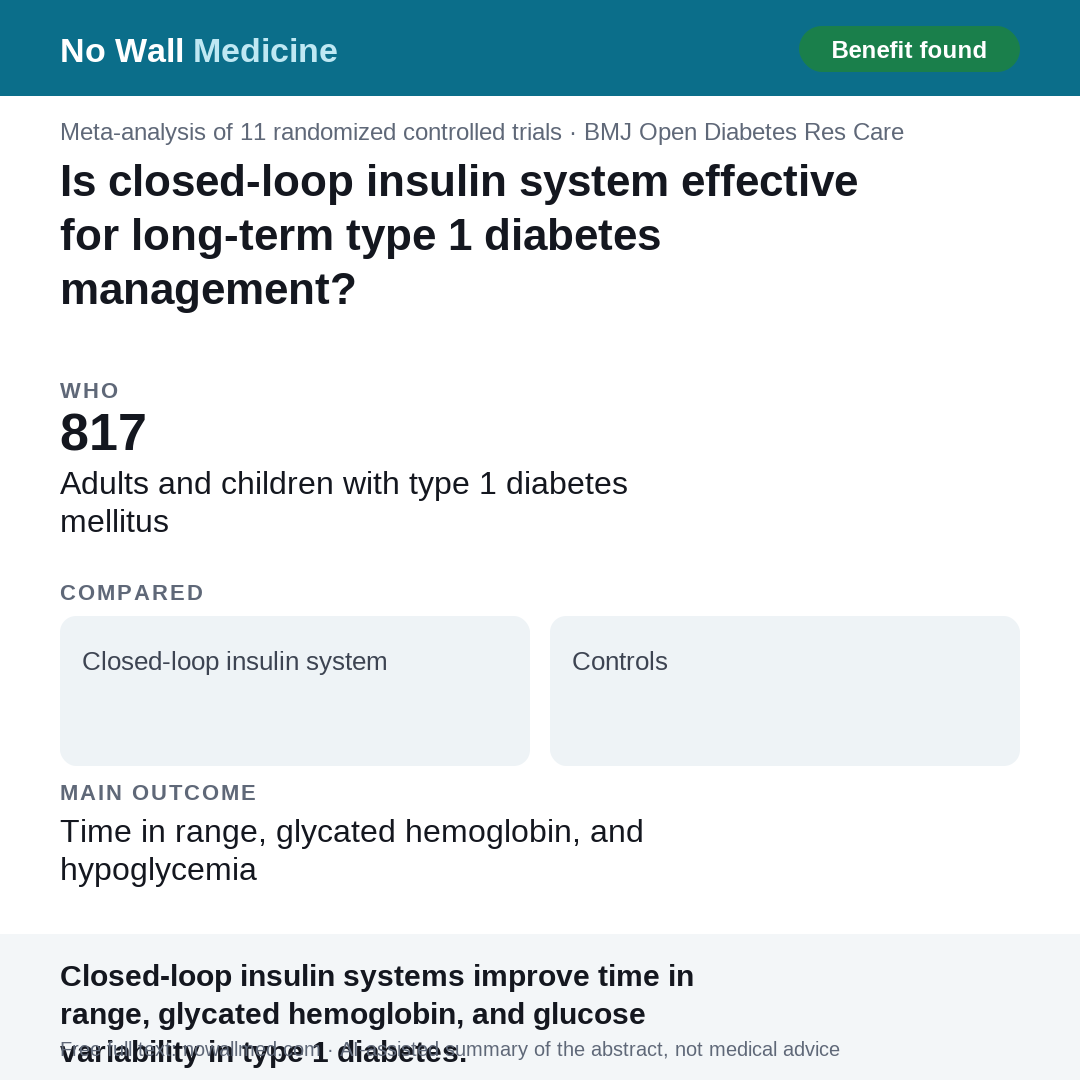
Clinical question: Is closed-loop insulin system effective for long-term type 1 diabetes management?
Why it matters: It was unknown how long-term use of closed-loop insulin systems affects blood glucose management and safety compared to other insulin delivery methods.
Key points
- Researchers analyzed 11 randomized controlled trials involving 817 patients with type 1 diabetes to compare closed-loop insulin systems against various standard insulin delivery methods.
- The closed-loop group showed a 10.32% increase in time in the target glucose range of 3.9-10 mmol/L and a 1.09% reduction in time below 3.9 mmol/L.
- Glycated hemoglobin, a measure of long-term blood sugar, was lower by 0.30% in the closed-loop group compared to control groups.
Headline and key points written with AI from the paper’s abstract, with every number checked against it. Read the paper before relying on them.
Was this summary helpful?
Abstract
The study aimed to evaluate the effectiveness and safety of long-term use of closed-loop insulin system (CLS) in non-pregnant patients with type 1 diabetes mellitus (T1DM) using systematic review and meta-analysis. A literature search was performed using MEDLINE, EMBASE, and the Cochrane Library. Randomized controlled trials (RCTs) on long-term use (not less than 8 weeks) of CLS in patients with T1DM were selected. Meta-analysis was performed with RevMan V.5.3.5 to compare CLS with controls (continuous subcutaneous insulin infusion with blinded continuous glucose monitoring or unblinded sensor-augmented pump therapy or multiple daily injections or predictive low-glucose suspend system) in adults and children with type 1 diabetes. Research quality evaluation was conducted using the Cochrane risk of bias tool. Eleven RCTs (817 patients) that satisfied the eligibility criteria were included in the meta-analysis. Compared with controls, the CLS group had a favorable effect on the proportion of time with sensor glucose level in 3.9-10 mmol/L (10.32%, 8.70% to 11.95%), above 10 mmol/L (-8.89%, -10.57% to -7.22%), or below 3.9 mmol/L (-1.09%, -1.54% to -0.64%) over 24 hours. The CLS group also had lower glycated hemoglobin levels (-0.30%, -0.41% to -0.19%), and glucose variability, coefficient of variation of glucose, and SD were lower by 1.41 (-2.38 to -0.44, p=0.004) and 6.37 mg/dL (-9.19 mg/dL to -3.55 mg/dL, p<0.00001). There were no significant differences between the CLS and the control group in terms of daily insulin dose, quality of life assessment, and satisfaction with diabetes treatment. CLS is a better solution than control treatment in optimizing blood glucose management in patients with T1DM. CLS could become a common means of treating T1DM in clinical practice.
Abstract reproduced under the article’s CC BY NC licence.
Subject terms
Cite this article
Jiao X, Shen Y, Chen Y. Better TIR, HbA1c, and less hypoglycemia in closed-loop insulin system in patients with type 1 diabetes: a meta-analysis. BMJ Open Diabetes Res Care. 2022. doi:10.1136/bmjdrc-2021-002633
Spotted a mistake? Suggest a correction