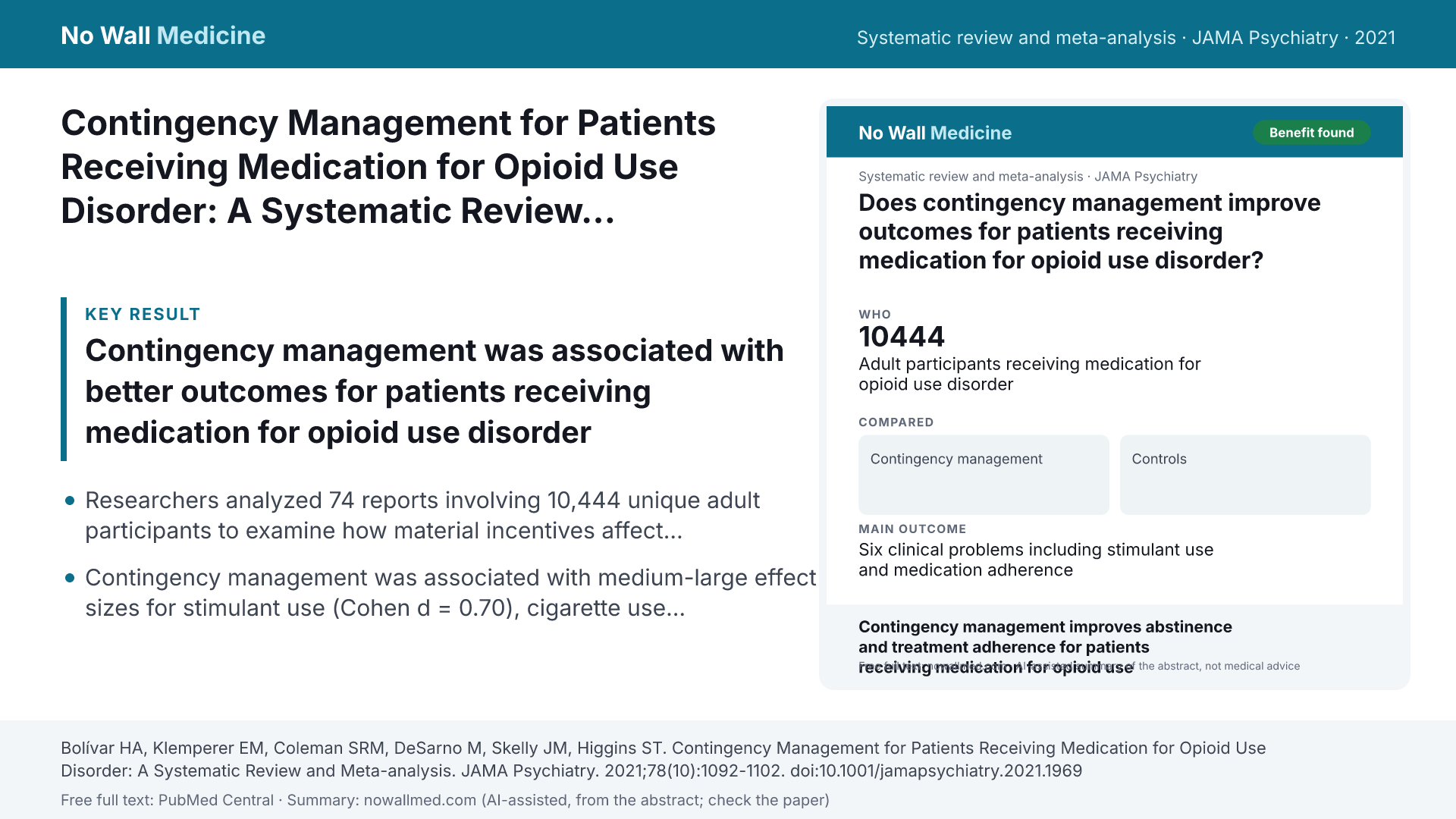
Contingency management was associated with better outcomes for patients receiving medication for opioid use disorder
Contingency Management for Patients Receiving Medication for Opioid Use Disorder: A Systematic Review and Meta-analysis
Systematic review and meta-analysisBenefit found
Does contingency management improve outcomes for patients receiving medication for opioid use disorder?
Who
10444
Adult participants receiving medication for opioid use disorder
Compared
Contingency management
Controls
Main outcome
Six clinical problems including stimulant use and medication adherence
Result: abstinence Cohen d 0.58 (95% CI 0.47-0.69); treatment adherence Cohen d 0.62 (95% CI 0.40-0.84)
Bottom line: Contingency management improves abstinence and treatment adherence for patients receiving medication for opioid use disorder.
JAMA Psychiatry · 2021-08-05 · Save PNG
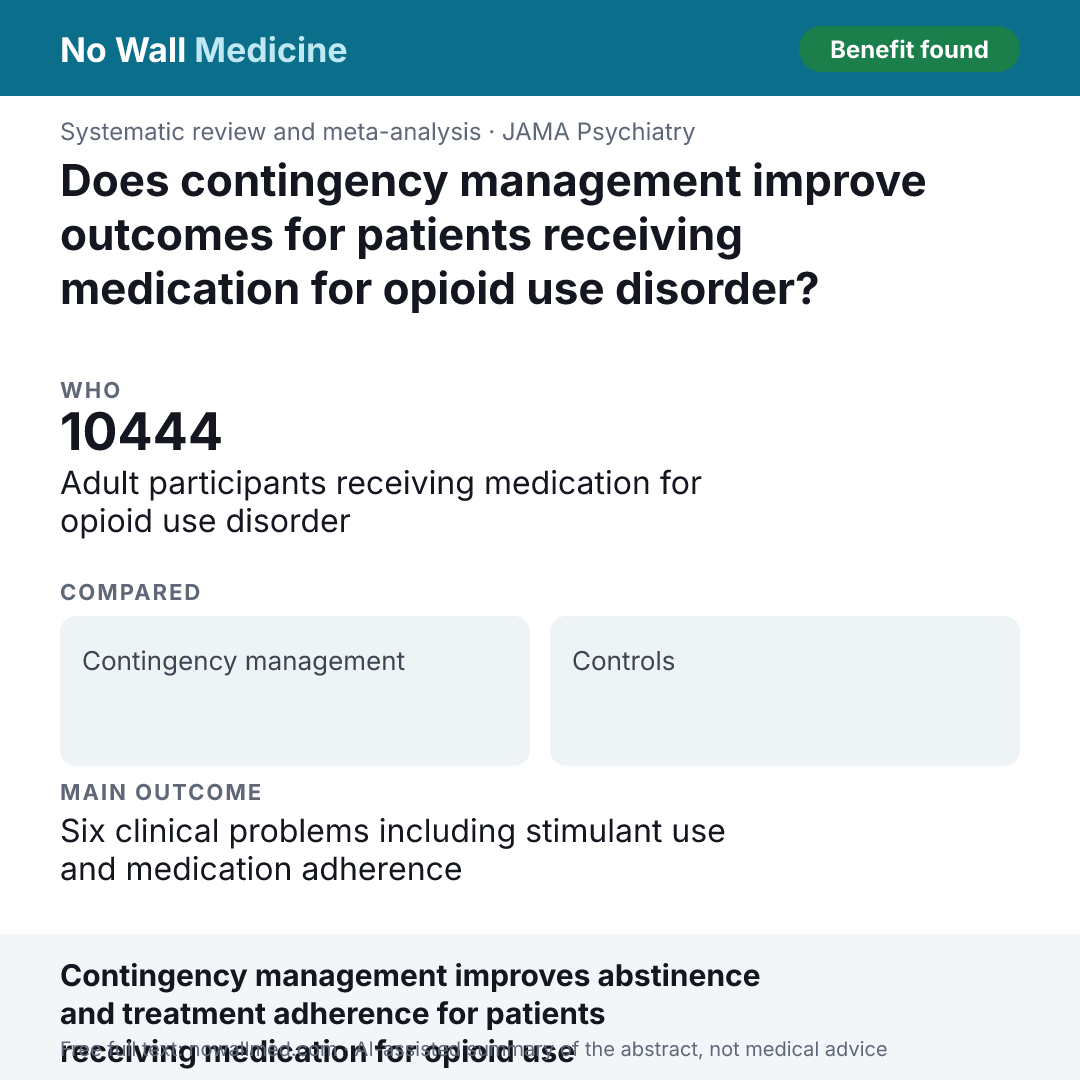
Clinical question: Does contingency management improve outcomes for patients receiving medication for opioid use disorder?
Why it matters: Comorbid stimulant use and other behavioral health problems often undermine the efficacy of medication treatment for opioid use disorder.
Key points
- Researchers analyzed 74 reports involving 10,444 unique adult participants to examine how material incentives affect clinical outcomes during medication treatment for opioid use disorder.
- Contingency management was associated with medium-large effect sizes for stimulant use (Cohen d = 0.70), cigarette use (Cohen d = 0.78), illicit opioid use (Cohen d = 0.58), and medication adherence (Cohen d = 0.75).
- The intervention was also associated with small-medium effect sizes for polysubstance use (Cohen d = 0.46) and therapy attendance (d = 0.43).
Headline and key points written with AI from the paper’s abstract, with every number checked against it. Read the paper before relying on them.
Was this summary helpful?
Subject terms
Headline, design, result, key points, caveat and citation as plain text.
Cite this article
Bolívar HA, Klemperer EM, Coleman SRM, DeSarno M, Skelly JM, Higgins ST. Contingency Management for Patients Receiving Medication for Opioid Use Disorder: A Systematic Review and Meta-analysis. JAMA Psychiatry. 2021. doi:10.1001/jamapsychiatry.2021.1969
Spotted a mistake? Suggest a correction