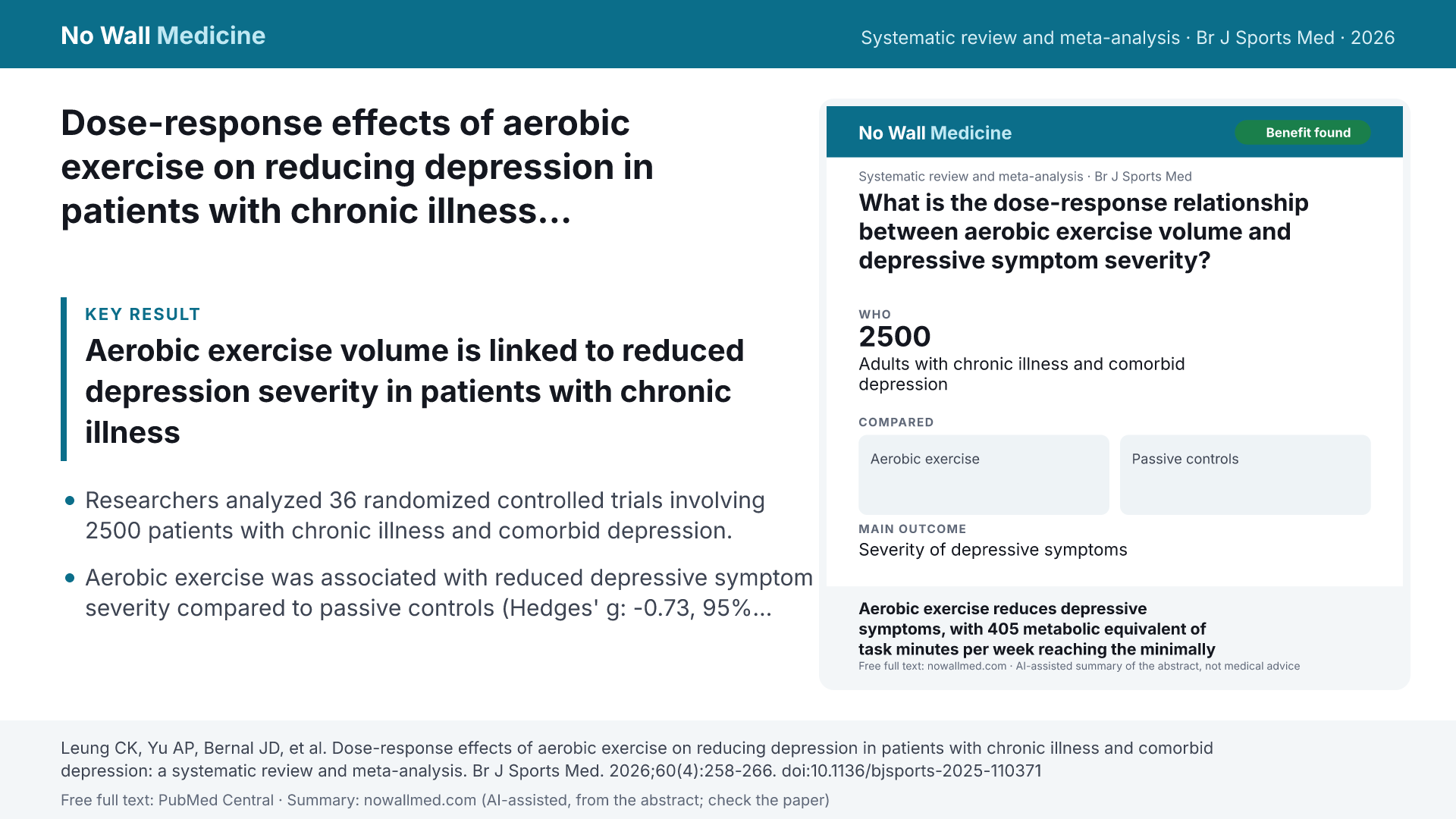
Aerobic exercise volume is linked to reduced depression severity in patients with chronic illness
Dose-response effects of aerobic exercise on reducing depression in patients with chronic illness and comorbid depression: a systematic review and meta-analysis
Systematic review and meta-analysisBenefit found
What is the dose-response relationship between aerobic exercise volume and depressive symptom severity?
Who
2500
Adults with chronic illness and comorbid depression
Compared
Aerobic exercise
Passive controls
Main outcome
Severity of depressive symptoms
Result: Hedges' g: -0.73 (95% CI -0.99 to -0.46)
Bottom line: Aerobic exercise reduces depressive symptoms, with 405 metabolic equivalent of task minutes per week reaching the minimally important difference.
Br J Sports Med · 2026-02-12Download image
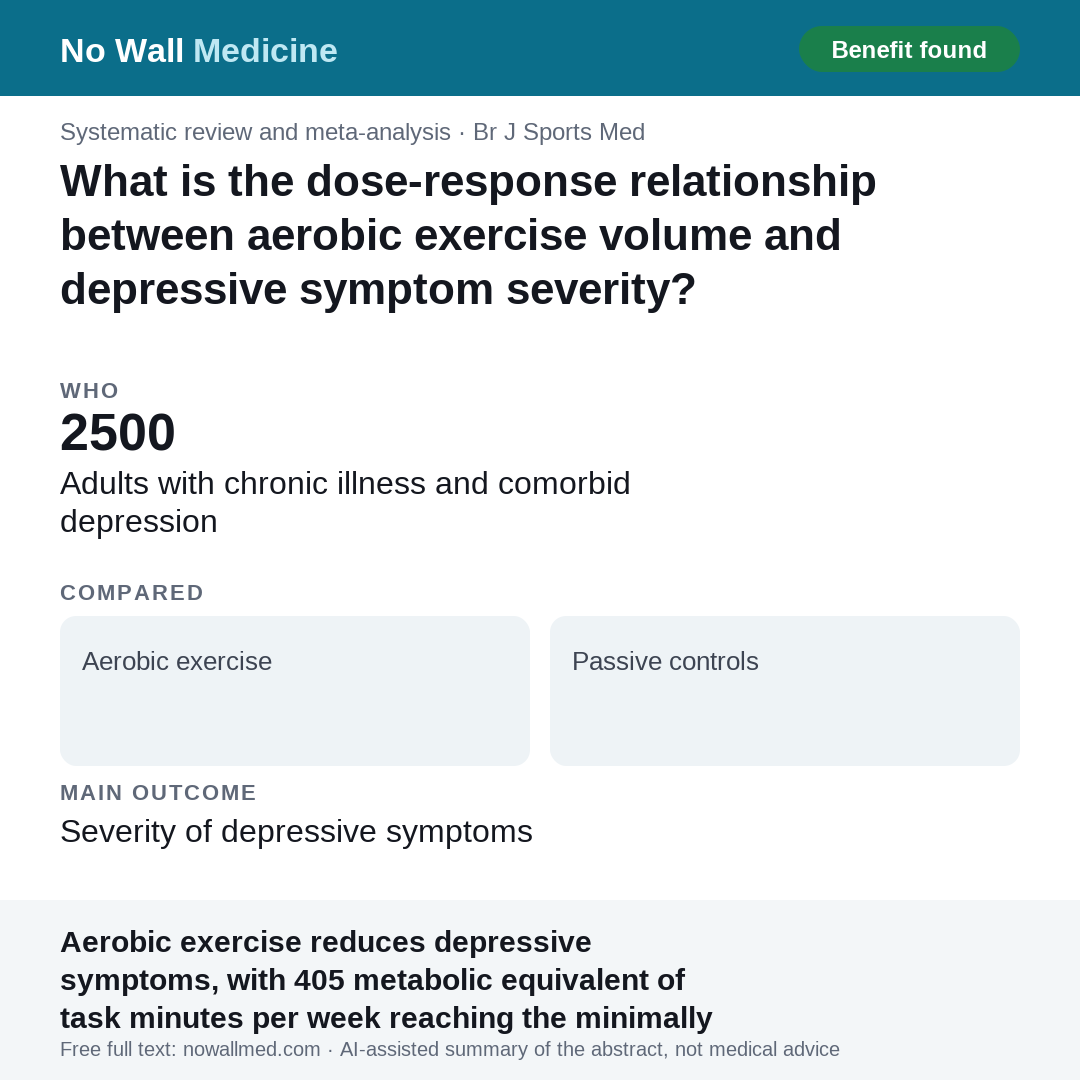
Clinical question: What is the dose-response relationship between aerobic exercise volume and depressive symptom severity?
Why it matters: Current exercise recommendations may not account for the limited functional capacity of patients with chronic illness and comorbid depression.
Key points
- Researchers analyzed 36 randomized controlled trials involving 2500 patients with chronic illness and comorbid depression.
- Aerobic exercise was associated with reduced depressive symptom severity compared to passive controls (Hedges' g: -0.73, 95% CI -0.99 to -0.46, p<0.001).
- A weekly volume of 405 MET-min/week, a measure of exercise intensity and duration, was associated with improvements perceived as important by patients.
Headline and key points written with AI from the paper’s abstract, with every number checked against it. Read the paper before relying on them.
Was this summary helpful?
Abstract
Importance
Aerobic exercise is an evidence-based treatment for depression. However, current exercise recommendations do not account for the limited functional capacity of patients with chronic illness and comorbid depression. Consequently, these recommendations risk being inappropriate and having low therapeutic application in this population. Objective
To examine the dose-response relationship between aerobic exercise volume and the severity of depressive symptoms, and to determine the exercise volume needed to alleviate depressive symptoms to the minimally important difference (MID) threshold in patients with chronic illness and comorbid depression. Data sources
We searched four databases (PubMed, Embase, Web of Science and PsycINFO) for randomised controlled trials published between database inception and May 2025, without language restrictions. Study selection
We included studies that compared the effects of aerobic exercise interventions with passive controls on depressive symptoms in adults with chronic illness and comorbid depression. Data extraction and synthesis
Data extraction was performed independently by two reviewers using a standardised form. A random-effects meta-analysis was employed to calculate the pooled estimate (Hedges' g) and the 95% CI. Meta-regression was conducted to determine the dose-response relationship between aerobic exercise volume and the severity of depressive symptoms. Main outcome and measure
The prespecified primary outcome was depressive symptoms and was assessed using validated depression rating scales. Results
36 randomised controlled trials involving 2500 patients were included. Aerobic exercise compared with passive controls reduced the severity of depressive symptoms in patients with chronic illness and comorbid depression (Hedges' g: -0.73, 95% CI -0.99 to -0.46, p<0.001, I2=81%). Additionally, aerobic exercise had a dose-response effect of -0.01 (95% CI -0.016 to -0.002, p=0.014) per 10 metabolic equivalent of task minutes per week (MET-min/week) on the severity of depressive symptoms. A weekly volume of 405 MET-min/week was found to alleviate depressive symptoms to an extent perceived as important (MID) by patients with chronic illness and comorbid depression. Conclusions and relevance
This study presents a dose-response relationship between aerobic exercise volume and the severity of depressive symptoms, suggesting that minimal volumes of aerobic exercise can confer improvements. Importantly, it informs stakeholders that achieving the WHO recommendation of 450 MET-min/week is not mandatory to elicit improvements in depressive symptoms. These findings underscore that irrespective of the functional capacity of patients with chronic illness and comorbid depression, aerobic exercise remains a viable strategy to manage their depressive symptoms. Prospero registration number
CRD42021282103.
Abstract reproduced under the article’s CC BY NC licence.
Subject terms
Cite this article
Leung CK, Yu AP, Bernal JD, Recchia F, Fong DY, Wong SH. Dose-response effects of aerobic exercise on reducing depression in patients with chronic illness and comorbid depression: a systematic review and meta-analysis. Br J Sports Med. 2026. doi:10.1136/bjsports-2025-110371
Spotted a mistake? Suggest a correction
Top studies every Monday
The week’s key trials and guidelines in your specialties, plus any topics you follow. By email, free.
Get the weekly digest