Machine learning models show moderate accuracy in predicting bleeding after acute ischemic stroke
Early Predictive Accuracy of Machine Learning for Hemorrhagic Transformation in Acute Ischemic Stroke: Systematic Review and Meta-Analysis
Meta-analysis of 83 articlesBenefit found
Can machine learning predict hemorrhagic transformation
Who
88197
patients with acute ischemic stroke
Compared
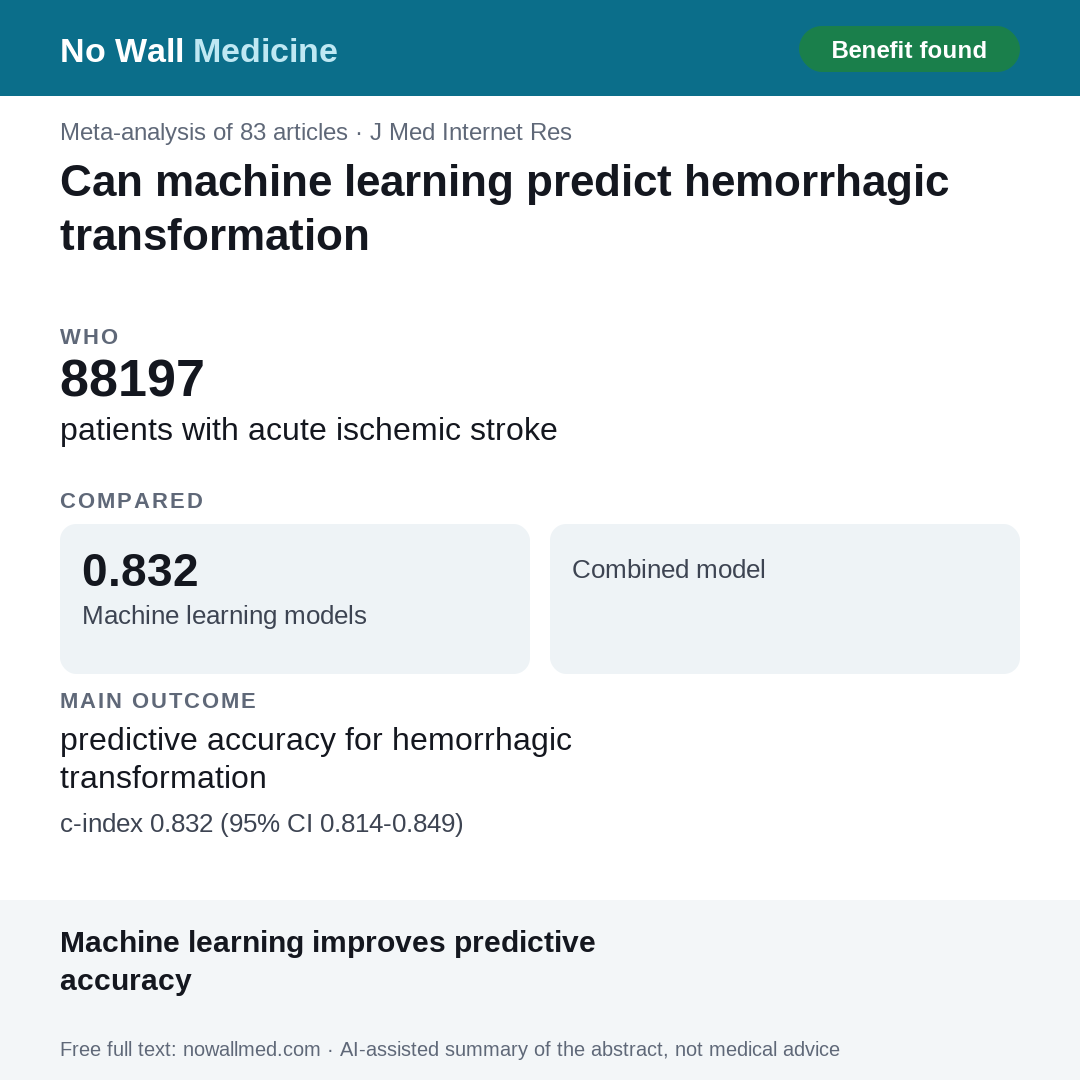
0.832Machine learning models (95% CI 0.814-0.849)
Combined model
Main outcome
predictive accuracy for hemorrhagic transformation
Result: c-index 0.832 (95% CI 0.814-0.849)
Bottom line: Machine learning improves predictive accuracy
J Med Internet Res · 2025-05-23Download image
Why it matters: There is currently no ideal tool for the early prediction of hemorrhagic transformation risk in patients with acute ischemic stroke.
Key points
- Researchers analyzed 83 articles involving 106 models and 88,197 patients with acute ischemic stroke and 9323 cases of hemorrhagic transformation.
- The meta-analysis of 104 validation sets found a c-index of 0.832, a sensitivity of 0.82, and a specificity of 0.78.
- Models that combined clinical features with radiomics, which is the extraction of data from medical images, showed promise for accuracy.
Headline and key points written with AI from the paper’s abstract, with every number checked against it. Read the paper before relying on them.
Topics
Cite this article
Wang B, Jiang B, Liu D, Zhu R. Early Predictive Accuracy of Machine Learning for Hemorrhagic Transformation in Acute Ischemic Stroke: Systematic Review and Meta-Analysis. J Med Internet Res. 2025. doi:10.2196/71654
Spotted a mistake? Suggest a correction