Early improvement in blood flow grade predicts lower risk of major amputation after limb procedures
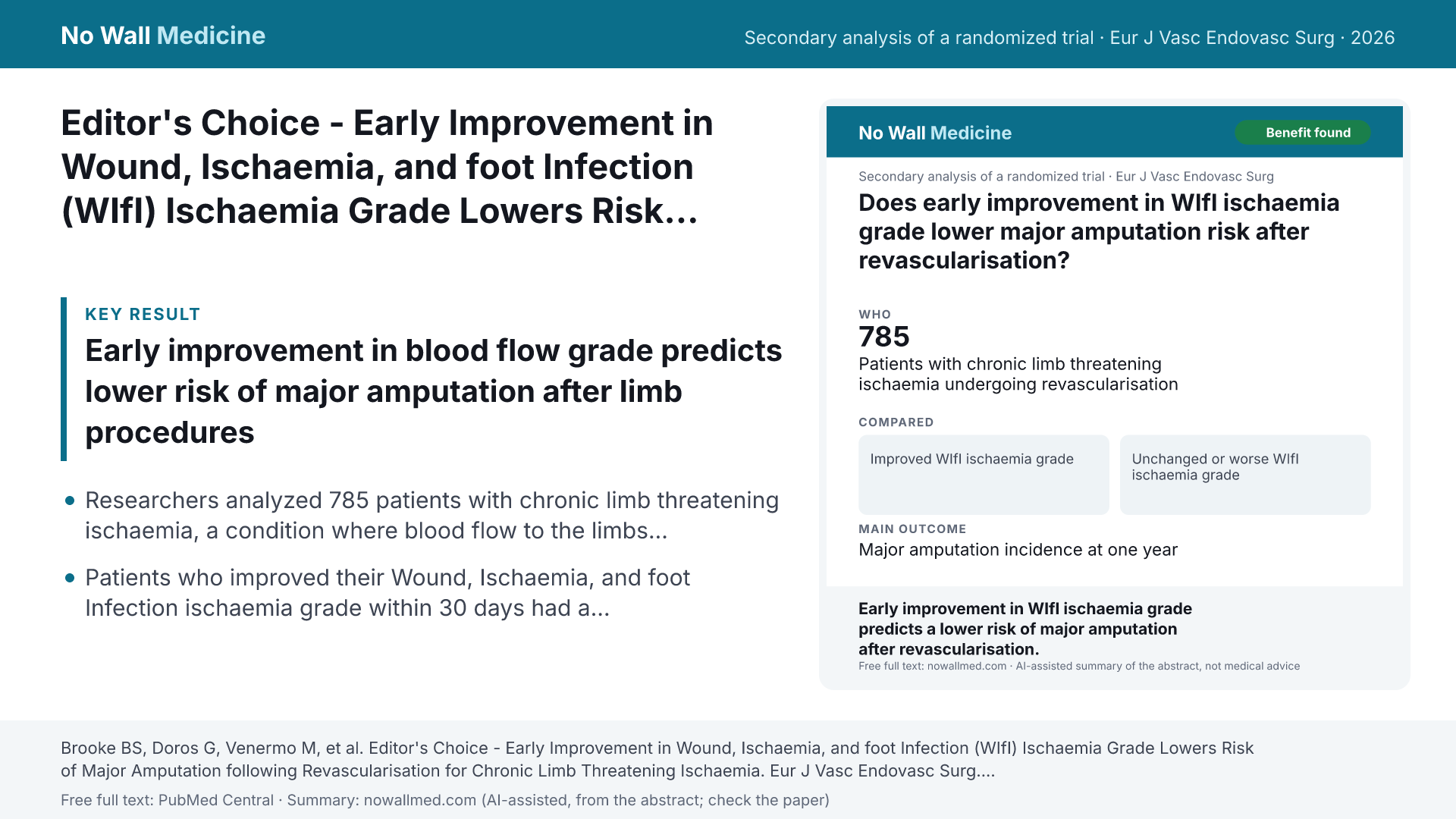
Editor's Choice - Early Improvement in Wound, Ischaemia, and foot Infection (WIfI) Ischaemia Grade Lowers Risk of Major Amputation following Revascularisation for Chronic Limb Threatening Ischaemia
Secondary analysis of a randomized trialBenefit found
Does early improvement in WIfI ischaemia grade lower major amputation risk after revascularisation?
Who
785
Patients with chronic limb threatening ischaemia undergoing revascularisation
Compared
Improved WIfI ischaemia grade
Unchanged or worse WIfI ischaemia grade
Main outcome
Major amputation incidence at one year
Result: hazard ratio 0.27 (95% confidence interval 0.18-0.41)
Bottom line: Early improvement in WIfI ischaemia grade predicts a lower risk of major amputation after revascularisation.
Eur J Vasc Endovasc Surg · 2026-02-02 · Save PNG
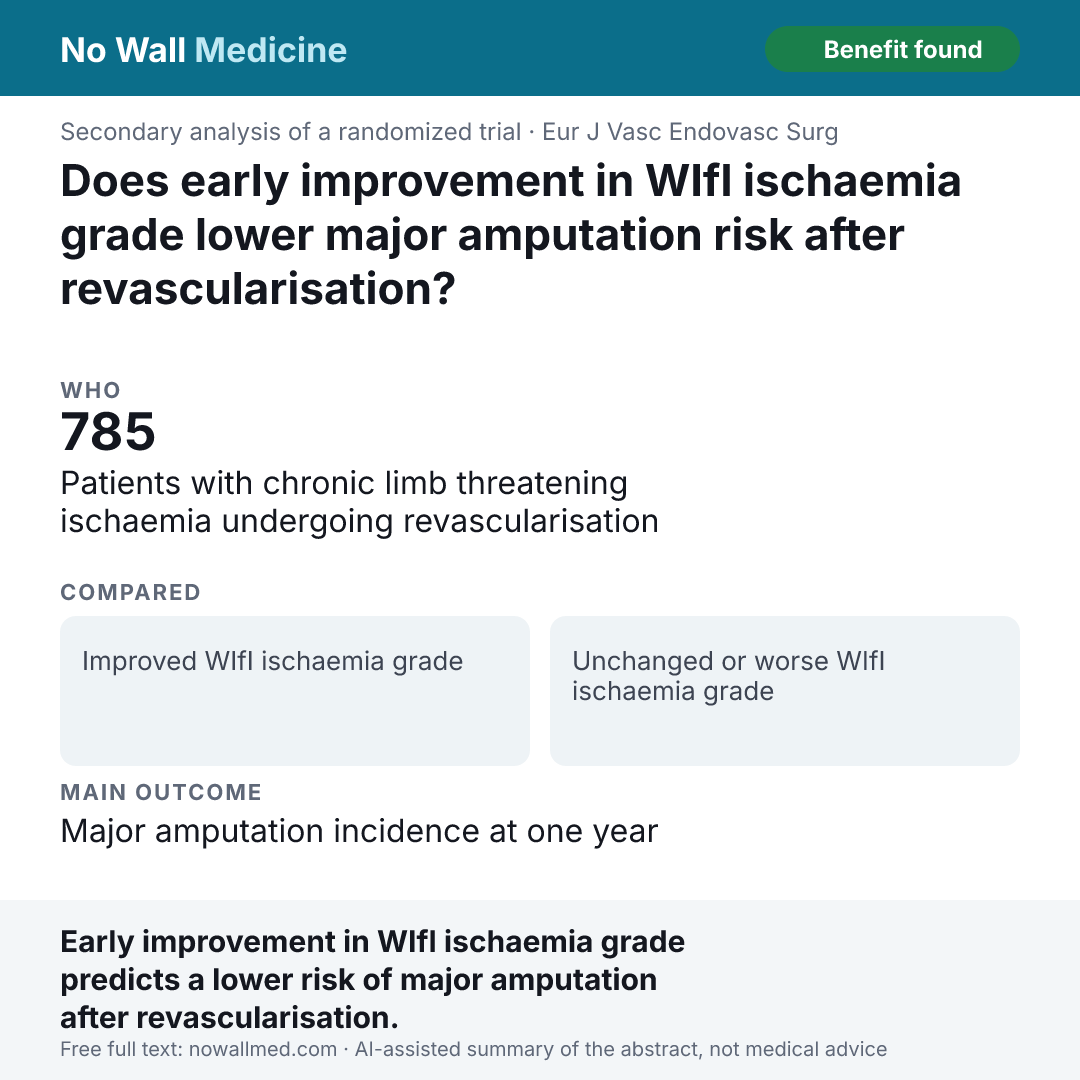
Clinical question: Does early improvement in WIfI ischaemia grade lower major amputation risk after revascularisation?
Why it matters: While the Wound, Ischaemia, and foot Infection staging system predicts outcomes, the individual components of the system have not been evaluated.
Key points
- Researchers analyzed 785 patients with chronic limb threatening ischaemia, a condition where blood flow to the limbs is severely reduced, who underwent surgical or endovascular revascularisation.
- Patients who improved their Wound, Ischaemia, and foot Infection ischaemia grade within 30 days had a significantly lower risk of major amputation at one year (hazard ratio 0.27, 95% confidence interval 0.18-0.41).
- The incidence of major amputation at one year was 14% among the study group.
Headline and key points written with AI from the paper’s abstract, with every number checked against it. Read the paper before relying on them.
Was this summary helpful?
Subject terms
Headline, design, result, key points, caveat and citation as plain text.
Cite this article
Brooke BS, Doros G, Venermo M, et al. Editor's Choice - Early Improvement in Wound, Ischaemia, and foot Infection (WIfI) Ischaemia Grade Lowers Risk of Major Amputation following Revascularisation for Chronic Limb Threatening Ischaemia. Eur J Vasc Endovasc Surg. 2026;72(4):571-578. doi:10.1016/j.ejvs.2026.01.055
Spotted a mistake? Suggest a correction