Combining two brain stimulation therapies improved sleep quality in adults with chronic insomnia
Effect of combined treatment with transcranial direct current stimulation and repetitive transcranial magnetic stimulation compared to monotherapy for the treatment of chronic insomnia: a randomised, double-blind, parallel-group, controlled trial
Randomised, double-blind trialBenefit found
Does combined tDCS and rTMS treat insomnia
Who
157
Adult patients with chronic insomnia
Compared
9.21tDCS + rTMS
10.03sham tDCS + rTMS
10.76tDCS + sham rTMS
Main outcome
Sleep quality
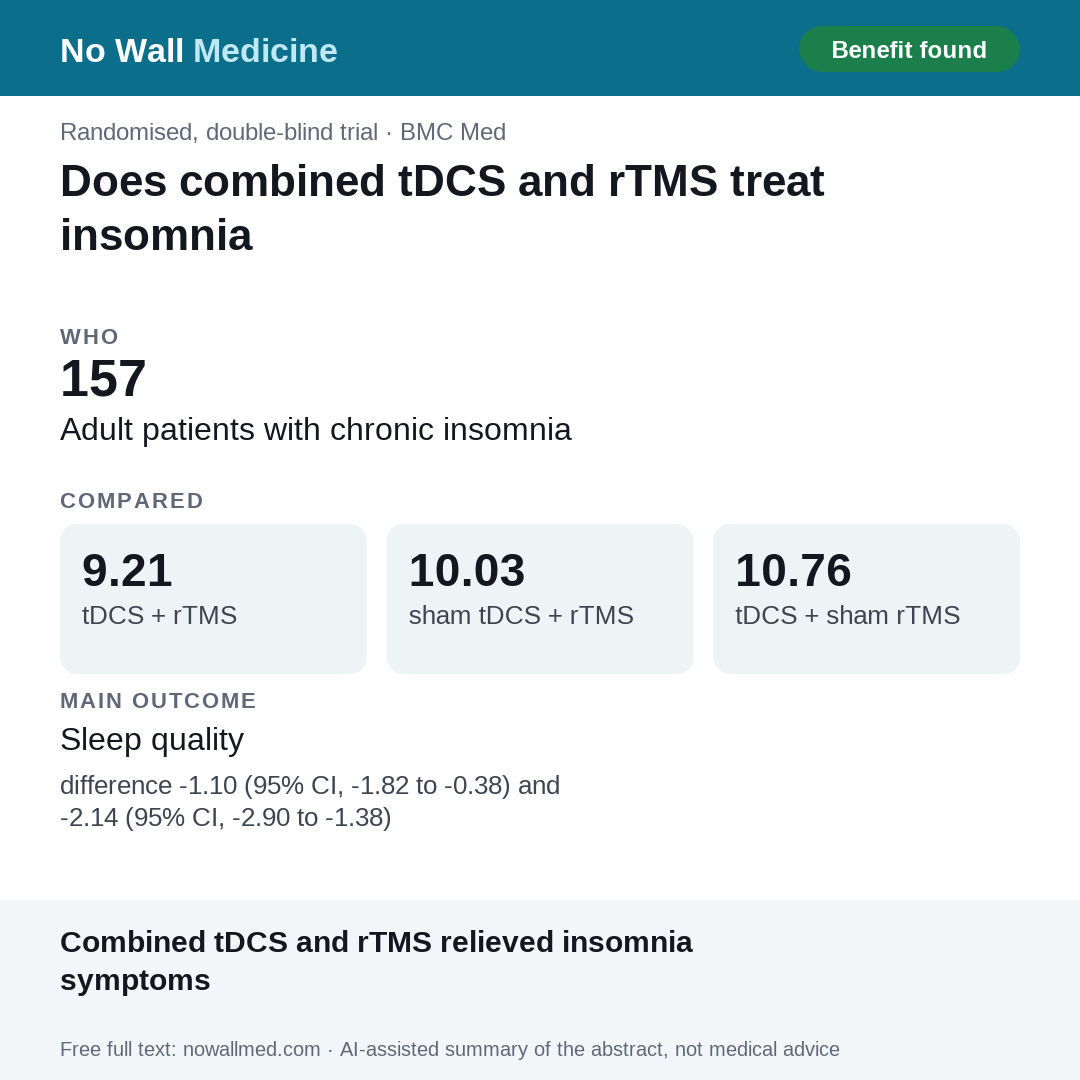
Result: difference -1.10 (95% CI, -1.82 to -0.38) and -2.14 (95% CI, -2.90 to -1.38)
Bottom line: Combined tDCS and rTMS relieved insomnia symptoms
BMC Med · 2024-11-18Download image
Why it matters: It was unclear if combining transcranial direct current stimulation and repetitive transcranial magnetic stimulation provides better efficacy and safety for chronic insomnia than using either method alone.
Key points
- Researchers studied 157 adults with chronic insomnia assigned to combined transcranial direct current stimulation and repetitive transcranial magnetic stimulation, or one of two single-therapy regimens.
- The combined therapy group had lower Pittsburgh Sleep Quality Index scores at 3 months compared to sham transcranial direct current stimulation plus repetitive transcranial magnetic stimulation (9.21 vs. 10.03).
- The combined group also showed lower Hamilton Depression Scale and insomnia factor scores than the other two groups, with no adverse events observed.
Headline and key points written with AI from the paper’s abstract, with every number checked against it. Read the paper before relying on them.
Topics
Cite this article
Zhou Q, Liu Z, Yu C, Wang Q, Zhuang W, Tang Y. Effect of combined treatment with transcranial direct current stimulation and repetitive transcranial magnetic stimulation compared to monotherapy for the treatment of chronic insomnia: a randomised, double-blind, parallel-group, controlled trial. BMC Med. 2024. doi:10.1186/s12916-024-03751-y
Spotted a mistake? Suggest a correction
Top studies every Monday
The week’s key trials and guidelines in your specialties, plus any topics you follow. By email, free.
Get the weekly digest