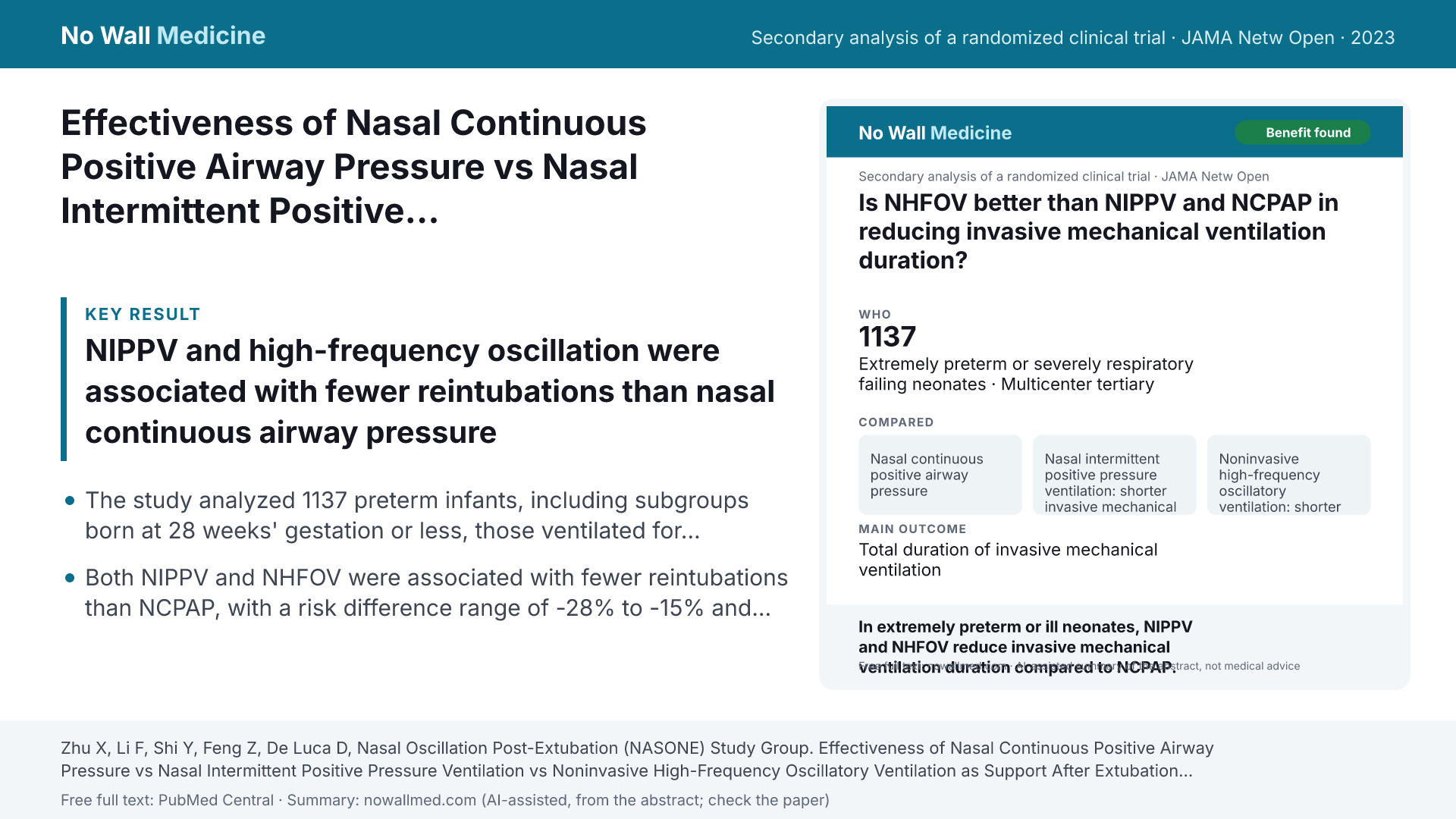
NIPPV and high-frequency oscillation were associated with fewer reintubations than nasal continuous airway pressure
Effectiveness of Nasal Continuous Positive Airway Pressure vs Nasal Intermittent Positive Pressure Ventilation vs Noninvasive High-Frequency Oscillatory Ventilation as Support After Extubation of Neonates Born Extremely Preterm or With More Severe Respiratory Failure: A Secondary Analysis of a Randomized Clinical Trial
Secondary analysis of a randomized clinical trialBenefit found
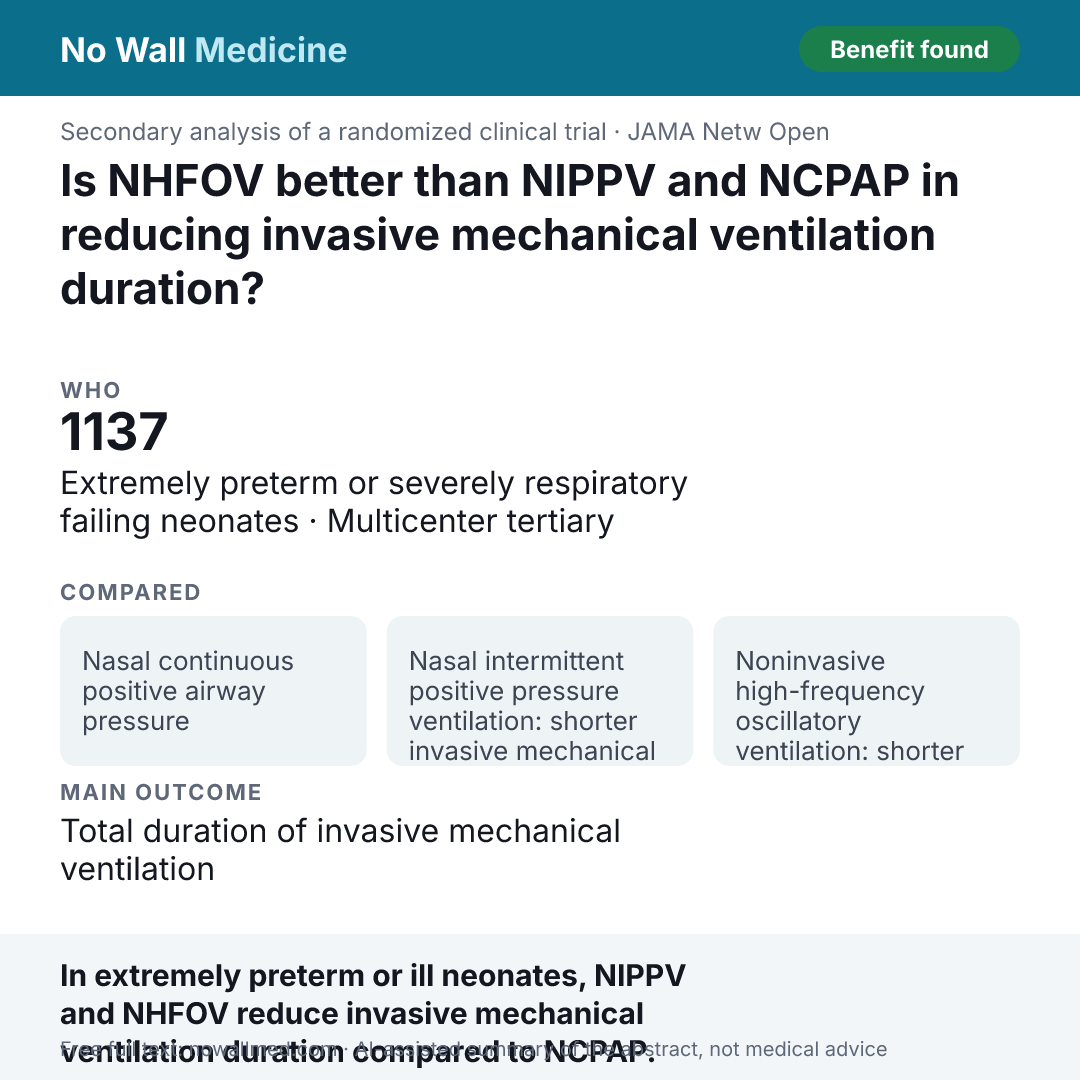
Is NHFOV better than NIPPV and NCPAP in reducing invasive mechanical ventilation duration?
Who
1137
Extremely preterm or severely respiratory failing neonates · Multicenter tertiary academic neonatal intensive care units in China
Compared
Nasal continuous positive airway pressure
Nasal intermittent positive pressure ventilation: shorter invasive mechanical ventilation
Noninvasive high-frequency oscillatory ventilation: shorter invasive mechanical ventilation
Main outcome
Total duration of invasive mechanical ventilation
Result: mean difference range, -5.0 days [95% CI, -6.8 to -3.1 days] to -2.3 days [95% CI, -4.1 to -0.4 days]
Bottom line: In extremely preterm or ill neonates, NIPPV and NHFOV reduce invasive mechanical ventilation duration compared to NCPAP.
JAMA Netw Open · 2023-07-03 · Save PNG
Same trial (NCT03181958)
Papers we list that report this registered trial, oldest first. Read a secondary analysis alongside the main results.
- Main results Benefit found
High-frequency oscillatory ventilation associated with shorter invasive ventilation duration in preterm neonates JAMA Pediatr 2022-04 - Secondary analysis Benefit found
This paper JAMA Netw Open 2023-07
Clinical question: Is NHFOV better than NIPPV and NCPAP in reducing invasive mechanical ventilation duration?
Key points
- The study analyzed 1137 preterm infants, including subgroups born at 28 weeks' gestation or less, those ventilated for over 1 week, and those with high CO2 levels.
- Both NIPPV and NHFOV were associated with fewer reintubations than NCPAP, with a risk difference range of -28% to -15% and a mean difference in invasive ventilation duration of -5.0 to -2.3 days.
- Infants receiving NHFOV showed significantly less moderate-to-severe bronchopulmonary dysplasia, a chronic lung disease, compared to those receiving NCPAP, with a range of -12% to -10%.
Headline and key points written with AI from the paper’s abstract, with every number checked against it. Read the paper before relying on them.
Was this summary helpful?
Subject terms
Headline, design, result, key points, caveat and citation as plain text.
Cite this article
Zhu X, Li F, Shi Y, Feng Z, De Luca D, Nasal Oscillation Post-Extubation (NASONE) Study Group. Effectiveness of Nasal Continuous Positive Airway Pressure vs Nasal Intermittent Positive Pressure Ventilation vs Noninvasive High-Frequency Oscillatory Ventilation as Support After Extubation of Neonates Born Extremely Preterm or With More Severe Respiratory Failure: A Secondary Analysis of a Randomized Clinical Trial. JAMA Netw Open. 2023;6(7):e2321644. doi:10.1001/jamanetworkopen.2023.21644
Spotted a mistake? Suggest a correction