Immersive technology education was more effective than traditional methods for nursing student knowledge and confidence
Effects of Immersive Technology-Based Education for Undergraduate Nursing Students: Systematic Review and Meta-Analysis Using the Grading of Recommendations, Assessment, Development, and Evaluation (GRADE) Approach
Systematic review and meta-analysisBenefit found
Is immersive technology-based education effective for undergraduate nursing students compared to traditional methods?
Who
undergraduate nursing students
Compared
immersive technology
traditional education
Main outcome
knowledge, confidence, self-efficacy, and other New World Kirkpatrick Model outcomes
Result: knowledge attainment SMD=0.59 (95% CI 0.28-0.90)
Bottom line: Immersive technology-based education is more effective than traditional education for knowledge, confidence, and self-efficacy in nursing students.
Limitation: heterogeneity in methods and interventions and lack of level 4 outcomes
J Med Internet Res · 2024-07-24Download image
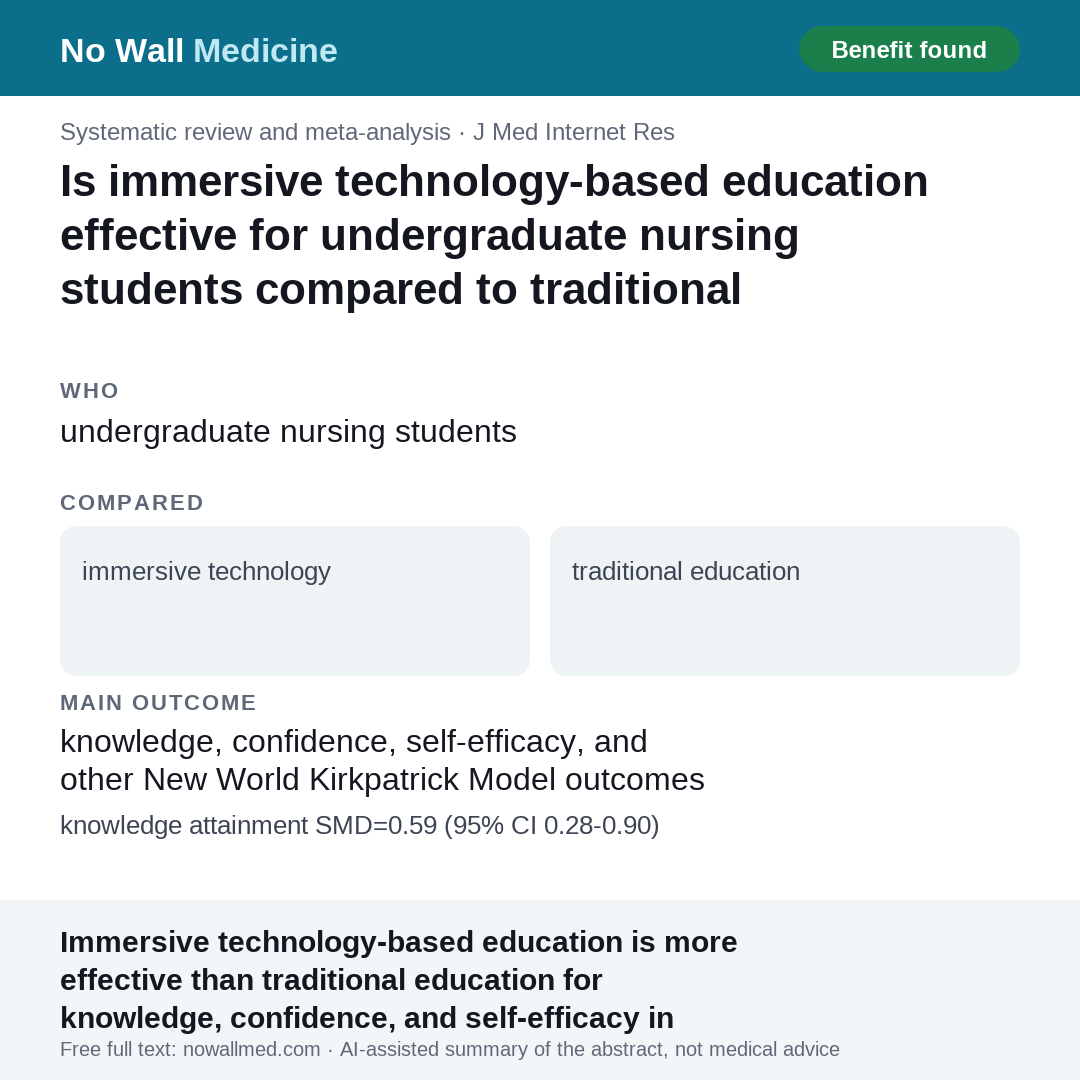
Clinical question: Is immersive technology-based education effective for undergraduate nursing students compared to traditional methods?
Why it matters: Reports regarding the effectiveness of immersive technology in nursing education are diverse, making it unclear how it compares to traditional teaching methods.
Key points
- Researchers analyzed 23 studies involving between 33 and 289 undergraduate nursing students using virtual reality, augmented reality, mixed reality, or extended reality.
- Immersive technology was more effective than traditional education for knowledge attainment (SMD=0.59, 95% CI 0.28-0.90), confidence (SMD=0.70, 95% CI 0.05-1.35), and self-efficacy (SMD=0.86, 95% CI 0.42-1.30).
- Most studies, 19 (82.6%), used virtual reality to simulate scenarios such as disaster training, resuscitation, and health assessments.
Limitation the authors note: The authors suggest that long-term cohort studies are needed to evaluate level 4 outcomes in the New World Kirkpatrick Model.
Headline and key points written with AI from the paper’s abstract, with every number checked against it. Read the paper before relying on them.
Was this summary helpful?
Subject terms
Cite this article
Park S, Shin HJ, Kwak H, Lee HJ. Effects of Immersive Technology-Based Education for Undergraduate Nursing Students: Systematic Review and Meta-Analysis Using the Grading of Recommendations, Assessment, Development, and Evaluation (GRADE) Approach. J Med Internet Res. 2024. doi:10.2196/57566
Spotted a mistake? Suggest a correction
Top studies every Monday
The week’s key trials and guidelines in your specialties, plus any topics you follow. By email, free.
Get the weekly digest