Hemostatic biomarkers associated with postpartum hemorrhage: a systematic review and meta-analysis
Systematic review and meta-analysisMixed results
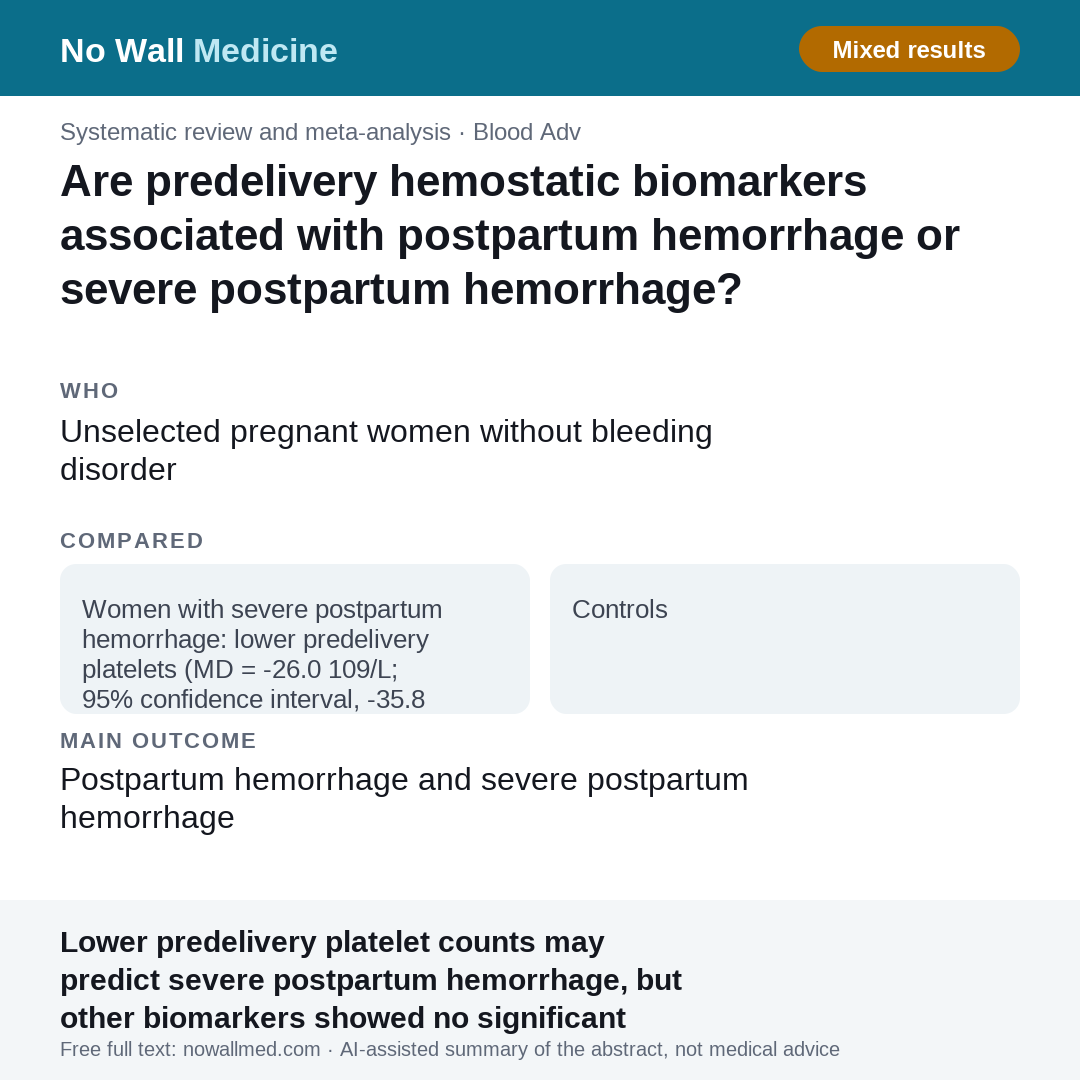
Are predelivery hemostatic biomarkers associated with postpartum hemorrhage or severe postpartum hemorrhage?
Who
Unselected pregnant women without bleeding disorder
Compared
Women with severe postpartum hemorrhage: lower predelivery platelets (MD = -26.0 109/L; 95% confidence interval, -35.8 to -16.1)
Controls
Main outcome
Postpartum hemorrhage and severe postpartum hemorrhage
Result: MD = -26.0 109/L (95% CI -35.8 to -16.1) for platelets in severe postpartum hemorrhage
Bottom line: Lower predelivery platelet counts may predict severe postpartum hemorrhage, but other biomarkers showed no significant association.
Blood Adv · 2023-06-12Download image
Clinical question: Are predelivery hemostatic biomarkers associated with postpartum hemorrhage or severe postpartum hemorrhage?
Abstract
Postpartum hemorrhage (PPH) is a leading cause of maternal morbi-mortality. Although obstetric risk factors are well described, the impact of predelivery hematologic and hemostatic biomarkers remains incompletely understood. In this systematic review, we aimed to summarize the available literature on the association between predelivery hemostatic biomarkers and PPH/severe PPH. Searching MEDLINE, EMBASE, and CENTRAL databases from inception to October 2022, we included observational studies on unselected pregnant women without bleeding disorder reporting on PPH and on predelivery hemostatic biomarkers. Two review authors independently performed title, abstract and full-text screening, upon which quantitative syntheses of studies reporting on the same hemostatic biomarker were conducted, calculating the mean difference (MD) between women with PPH/severe PPH and controls. A search on 18 October 2022 yielded 81 articles fitting our inclusion criteria. The heterogeneity between studies was considerable. With regard to PPH, the estimated average MD in the investigated biomarkers (platelets, fibrinogen, hemoglobin, Ddimer, activated partial thromboplastin time, and prothrombin time) were not statistically significant. Women who developed severe PPH had lower predelivery platelets than controls (MD = -26.0 109/L; 95% confidence interval, -35.8 to -16.1), whereas differences in predelivery fibrinogen concentration (MD = -0.31 g/L; 95% confidence interval, -0.75 to 0.13) and levels of factor XIII or hemoglobin were not statistically significant in women with and without severe PPH. Predelivery platelet counts were, on average, lower in women with severe PPH compared with controls, suggesting the potential usefulness of this biomarker for predicting severe PPH. This trial was registered at the International Prospective Register of Systematic Reviews as CRD42022368075.
Abstract reproduced under the article’s CC BY NC ND licence.
Subject terms
Cite this article
de Moreuil C, Mehic D, Nopp S, Kraemmer D, Gebhart J, Schramm T. Hemostatic biomarkers associated with postpartum hemorrhage: a systematic review and meta-analysis. Blood Adv. 2023. doi:10.1182/bloodadvances.2023010143
Spotted a mistake? Suggest a correction
Top studies every Monday
The week’s key trials and guidelines in your specialties, plus any topics you follow. By email, free.
Get the weekly digest